Hello! Welcome to the next stage of our journey into the Theory of Computation.
In the last module, we thoroughly explored regular languages and their limitations. We saw through the Pumping Lemma that simple, nested structures like are beyond the reach of finite automata. This limitation motivates the need for a more powerful model of computation.
Today, we move up the Chomsky Hierarchy to begin our study of Context-Free Languages. These languages are fundamental to computer science, forming the basis for the syntax of most programming languages, markup languages like HTML, and data formats like JSON. The tool we use to define them is the Context-Free Grammar (CFG).
This lesson's goal is to address the first and most crucial learning outcome of this module: Define the formal 4-tuple structure of a Context-Free Grammar (CFG). We will start with the intuition behind grammars and then build up to the precise mathematical definition.
1. Beyond Regularity: The Need for Grammars
Finite automata are limited because they have finite memory. To recognize a language like , a machine needs to count the number of 'a's it has seen, which requires potentially unbounded memory. Grammars provide a way to describe such languages using a set of recursive "rewriting rules".
Your experience with building parsers and working with complex data structures has already given you an intuitive feel for this. When a compiler parses code, it checks if the sequence of tokens (keywords, identifiers, operators) conforms to the language's syntax, which is defined by a grammar. For example, an if statement must be followed by a condition in parentheses, which is then followed by a statement block. This nested, rule-based structure is precisely what CFGs are designed to capture.
To get a feel for this recursive approach, let's start by reading about how grammars can solve the problems that finite automata cannot.
Lecture 11: Context-free grammars
The following lecture note from the University of Illinois provides excellent motivation for why we need grammars and introduces the concept using the example of properly nested parentheses and our familiar nemesis, the language a^n b^n.
Please read Section 1, "Context-free grammars" (up to page 4, before section 2.1). Focus on how a recursive definition like S \to aSb | \epsilon can generate all strings in the language a^n b^n. This introduces the core idea of building strings through substitution rules.
2. Terminals and Non-Terminals: The Building Blocks
As you saw in the reading, grammars use two types of symbols:
- Terminals: These are the basic symbols from which strings in the language are formed. They are the alphabet of the language. In the example , the symbols 'a' and 'b' are terminals. Think of them as the keywords, literals, and operators in a programming language—the final tokens that appear in the source code.
- Non-terminals (or Variables): These are placeholder symbols that represent sets of strings. They are used in the intermediate steps of generating a string. In the example, is a non-terminal. Think of them as syntactic categories like
<expression>,<statement>, or<function-declaration>.
The process of generating a string involves starting with a special non-terminal (the "start symbol") and repeatedly replacing non-terminals with the right-hand side of one of their corresponding rules, until only terminals remain.
To build a clearer intuition, let's watch a short video that explains this distinction using an analogy from natural language.
Introduction to Formal Grammars
This video from Neso Academy provides an excellent analogy using English sentences to illustrate the difference between non-terminals (like "noun" or "verb phrase") and terminals (the actual words like "learners" or "awesome").
Watch the first part of the video (from 00:06 to 04:34) to solidify your understanding of terminals and non-terminals.
3. The Formal Definition of a Context-Free Grammar
Now we are ready to formalize these ideas. A context-free grammar is defined by four components, much like how a finite automaton was defined by its 5-tuple.
A Context-Free Grammar (CFG) is a 4-tuple , where:
- is a finite set of non-terminal symbols (also called variables).
- is a finite set of terminal symbols, which is the alphabet of the language. It is required that and are disjoint sets ().
- is a finite set of production rules (or productions). Each rule is of the form , where and is a string of symbols from . The string can be any combination of variables and terminals, including the empty string .
- is the start symbol, a special non-terminal from () that initiates the generation process.
The term "context-free" signifies that the rule can be applied to the non-terminal regardless of the symbols that surround it. This is in contrast to "context-sensitive" grammars, which we will see later in the course.
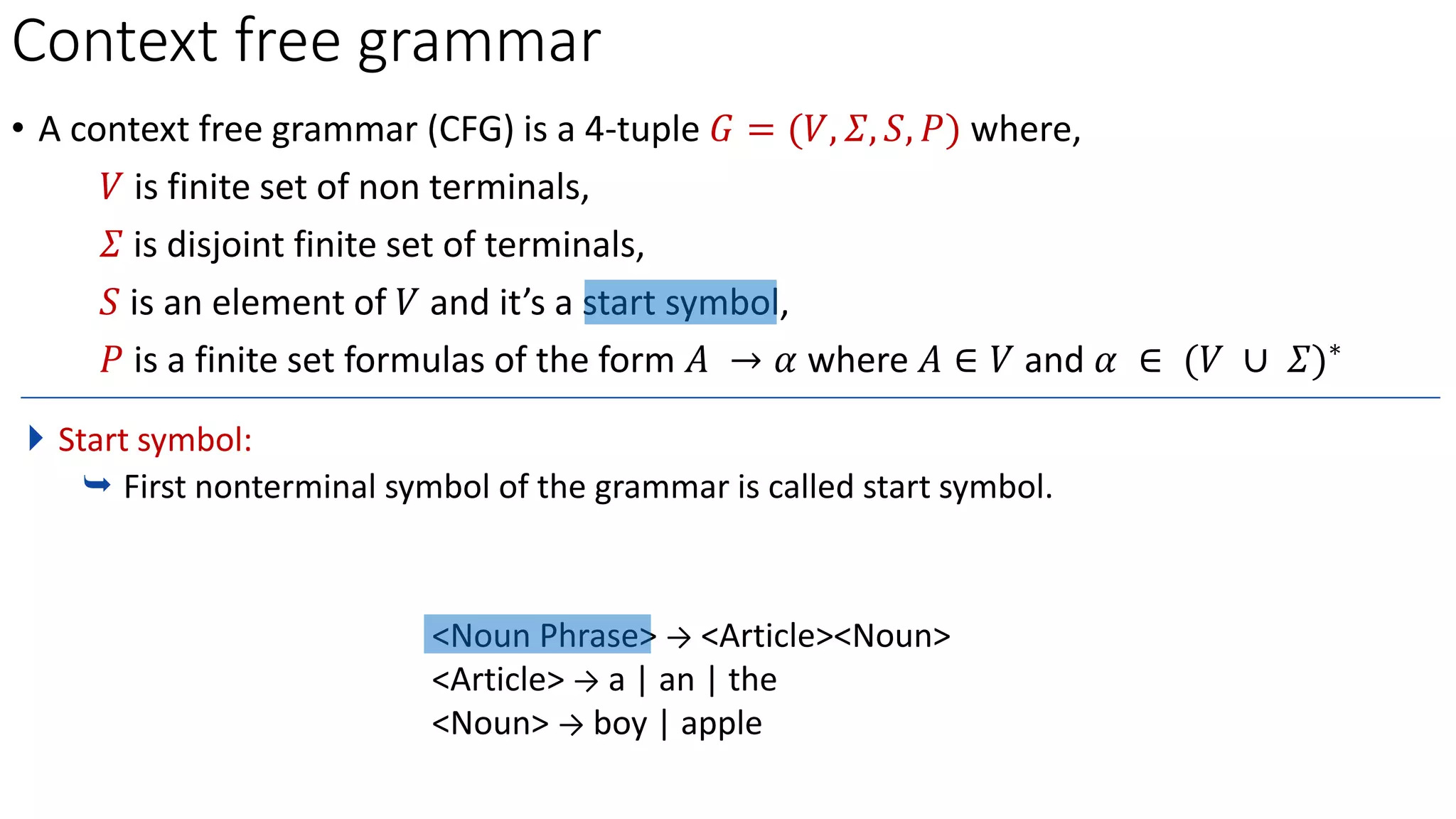
Let's ground this formal definition with a more detailed reading.
The following resource provides a clear and formal definition of a CFG, breaking down each component of the 4-tuple.
Please read the section under 'Definition 4.1'. This section formally defines the 4-tuple (V, \Sigma, P, S) and also explains a common convention: when a grammar is specified just by its production rules, the start symbol is typically the non-terminal on the left side of the first rule.
4. An Example Deconstructed
Let's revisit the grammar for the language and explicitly identify its components according to the formal definition.
The grammar is commonly written as:
The vertical bar | is a convenient shorthand for listing multiple production rules for the same non-terminal. This is equivalent to writing out two separate rules:
Now, let's define the grammar for this language as a formal 4-tuple :
- : The set of non-terminals is .
- : The set of terminals is .
- : The set of production rules is .
- : The start symbol is .
This simple set of rules is powerful enough to generate an infinite language with a specific nested structure that a DFA could not recognize.
Test your understanding!
Consider the following set of production rules for a grammar that generates palindromes over the alphabet :
Assuming is the start symbol, formally define the grammar by specifying its 4-tuple .
Show answer
The 4-tuple for the grammar is:
- : (the only symbol that appears on the left side of a rule).
- : (the other symbols that appear in the rules but are not non-terminals).
- : The full set of five productions: .
- : (as specified in the problem description).
Conclusion
In this lesson, we have taken the first step into the world of context-free languages by establishing the formal definition of a Context-Free Grammar. This generative system allows us to define complex, recursive language structures that are essential in computer science.
Key Takeaways:
- Context-Free Grammars (CFGs) are more powerful than finite automata and can describe languages with nested structures like .
- A CFG consists of terminals (the alphabet), non-terminals (syntactic variables), production rules for rewriting non-terminals, and a start symbol.
- Formally, a CFG is a 4-tuple .
- The "context-free" nature means that production rules can be applied to a non-terminal regardless of its surrounding symbols.
Preview of the Next Lesson:
Now that we have defined the structure of a CFG, our next step is to understand how to use it. In the next lesson, we will explore the process of derivation—the step-by-step application of production rules to generate strings in the language. We will also learn to visualize these derivations using parse trees, which you may have encountered in courses on compilers or natural language processing.