Hello! Welcome to the fifth lesson in your Theory of Computation course.
In our last session, we focused on the art of design, learning how to construct both DFAs and NFAs for various languages. We saw that NFAs often allow for more intuitive and simpler designs, while DFAs are more straightforward to implement due to their deterministic nature. This raises a crucial question: can we get the best of both worlds? Can we leverage the design simplicity of an NFA and still end up with an efficient, deterministic machine?
Today, we will answer that with a resounding yes. This lesson's objective is to master one of the most fundamental algorithms in this field: to apply the subset construction algorithm to convert any NFA into an equivalent DFA. This powerful procedure forms the theoretical backbone of many real-world tools, including lexical analyzers like lex and flex that parse code.
1. The Core Idea: Simulating Nondeterminism
The magic of an NFA lies in its ability to be in multiple states at once. How can a DFA, which can only be in one state at a time, possibly replicate this?
The answer is to make the DFA's states more powerful. In the subset construction, each state in our new DFA will correspond to a set of states from the original NFA. A single DFA state will represent all the possible states the NFA could be in after processing a certain prefix of the input string. This is often called the "parallel view" of NFA simulation—we're using the DFA to deterministically track all the parallel "threads" of computation happening in the NFA.
Let's start with the simpler case: an NFA without any "spontaneous" -transitions.
2. The Subset Construction: A Simple Case (No -transitions)
When an NFA has no -transitions, the conversion process is more direct. We can focus solely on how sets of states evolve as we read input symbols.
The following video provides a clear, step-by-step walkthrough of converting an NFA to a DFA using a transition table. This structured, table-based approach is an excellent way to organize your work and ensure you don't miss any states or transitions.
Conversion of NFA to DFA (Example 2)
This video from Neso Academy demonstrates the subset construction for an NFA without ε-transitions. Pay close attention to how new DFA states are created and added to the transition table as they are discovered.
Watch the video from the beginning to the end (10:54). The instructor starts with the NFA's formal definition, builds the DFA's transition table incrementally, and then draws the final state diagram.
Let's formalize the steps shown in the video:
- Initialize: The start state of the DFA is the set containing just the NFA's start state, .
- Explore: Create a worklist and add your new DFA start state to it.
- Iterate: While the worklist is not empty:
a. Pick a DFA state (a set of NFA states) from the worklist.
b. For each symbol in the alphabet :
i. Compute the target set of states, , by taking the union of for all states . Formally: .
ii. If this set is not already a state in our DFA, add it as a new state and add it to the worklist.
iii. Record the transition: . - Finalize: The final states of the DFA are all the states that contain at least one of the original NFA's final states. That is, if .
This process guarantees that we only create states that are reachable from the start state.
3. Handling -Transitions: The Epsilon-Closure
Real-world NFAs often use -transitions to simplify their design. An -transition allows the NFA to change its state without consuming an input symbol. Our conversion algorithm must account for this.
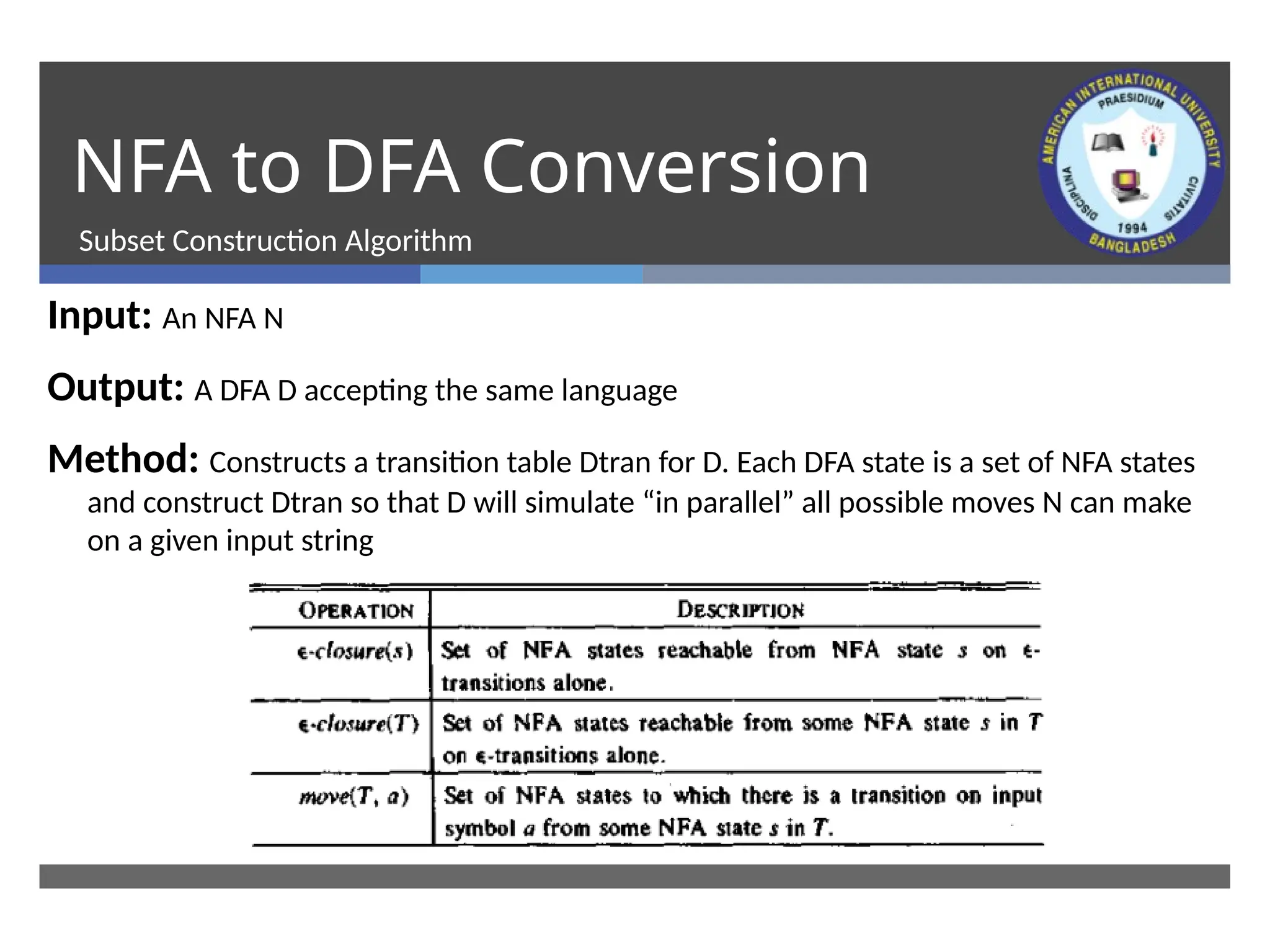
The key tool for this is the -closure. The -closure of a state , denoted , is the set of all states that the NFA can reach from using only -transitions (including itself).
Chapter 3 DFA's, NFA's, Regular Languages
To properly handle ε-transitions, we first need to understand and compute the ε-closure. These notes from the University of Pennsylvania provide a formal definition and an algorithm for this.
Please read Section 3.4, 'ϵ-Closure'. Focus on Definition 3.7 and the algorithmic approaches described for computing the ε-closure of a state. The stack-based algorithm is essentially a depth-first search, a pattern you're likely familiar with.
The concept extends to sets of states: .
With -closure, we can now define the full subset construction algorithm. Your experience with designing and implementing algorithms will be very helpful here.
The Full Algorithm
Given an NFA , we construct an equivalent DFA .
- DFA States (): The states of are sets of states of . So (the power set of ).
- DFA Start State (): The start state of is the -closure of 's start state.
- DFA Final States (): A state is a final state in if it contains any of 's final states.
- DFA Transition Function (): This is the core of the algorithm. For a DFA state and an input symbol , the next state is found by:
a. First, finding all states that can transition to from any state in on input . Let's call this themoveset:move(S, a)= .
b. Then, finding the -closure of themoveset.
This procedure is sometimes called the "lazy" subset construction, as we only construct DFA states as we discover they are reachable.
4. A Worked Example with -Transitions
Let's see this full algorithm in action. The visual, step-by-step process of building the DFA's state diagram directly is very illuminating.
Conversion of NFA to DFA (Powerset/Subset Construction Example)
This video from Easy Theory provides an excellent, dynamic walkthrough of the full subset construction algorithm on an NFA with ε-transitions.
Watch the video from the beginning to the end. The presenter does a great job of showing the process of discovery: calculating ε-closures, determining transitions, and creating new DFA states on the fly.
As you saw, the process is an exploration. You start with one state and systematically build out the graph until all transitions from all reachable states are defined.
Test your understanding!
Consider the NFA below, which accepts strings containing either "aa" or "bb". Let's manually compute the first few steps of the conversion.
- NFA:
- -closures:
- ... and so on.
- What is the start state of the equivalent DFA? Let's call it .
- From state , what is the next state on input 'a'? Calculate .
- From state , what is the next state on input 'b'? Calculate .
Show answer
-
DFA Start State ():
The start state is the -closure of the NFA's start state, . -
Transition on 'a' ():
First, we calculatemove(S_0, a):move({q_0, q_1, q_4}, a) = \delta(q_0, a) \cup \delta(q_1, a) \cup \delta(q_4, a)= \emptyset \cup \{q_2\} \cup \emptyset = \{q_2\}
Next, we take the -closure of the result:\delta'(S_0, a) = E(\{q_2\}) = \{q_2\}.
So, we have a new DFA state, , and a transition .
-
Transition on 'b' ():
First, we calculatemove(S_0, b):move({q_0, q_1, q_4}, b) = \delta(q_0, b) \cup \delta(q_1, b) \cup \delta(q_4, b)= \emptyset \cup \emptyset \cup \{q_5\} = \{q_5\}
Next, we take the -closure of the result:\delta'(S_0, b) = E(\{q_5\}) = \{q_5\}.
So, we have another new DFA state, , and a transition .
The process would then continue by computing the transitions for and .
5. Formal Correctness
We've seen how the algorithm works, but why does it work? Why is the resulting DFA truly equivalent to the NFA? The formal proof is quite elegant and builds on the intuition we've developed. For your interest, the following resource provides a rigorous proof.
These lecture notes from the University of Illinois provide a formal proof of correctness for the subset construction. This is not something you need to memorize, but understanding the logic will deepen your grasp of the theory, aligning with your preference for rigor.
Skim Section 3.2 'Formal Construction' to see the mathematical definitions of the DFA's components. Then, read through the 'Proof Idea' and the beginning of 'Correctness Proof I' in Section 4. The core idea is to prove by induction on the length of the string w that the state the DFA reaches is exactly the set of states the NFA could possibly be in.
The essence of the proof is that the construction is not arbitrary; it's a perfect simulation. The state the DFA is in after reading a string is precisely the set of all states the NFA could be in after reading . Therefore, if that set contains a final state of the NFA, the DFA will be in an accepting state, and vice versa.
Conclusion
Today you mastered a cornerstone algorithm of automata theory. The subset construction is not just a theoretical exercise; it is a constructive proof that NFAs, despite their "magical" guessing ability, are no more powerful than the strictly deterministic DFAs.
Key Takeaways:
- The Principle: The subset construction algorithm converts an NFA to a DFA by creating DFA states that correspond to sets of NFA states.
- The -closure: This is the critical tool for handling -transitions. It computes all states reachable from a starting set using only moves.
- The Algorithm: The process involves starting with the -closure of the NFA's start state and then iteratively computing transitions by applying the
moveandE(closure) operations until no new reachable states are found. - Equivalence: A DFA state is designated as final if its corresponding set of NFA states contains at least one of the original NFA's final states.
Preview of the Next Lesson:
In this lesson, you learned the how of NFA-DFA equivalence through a concrete algorithm. In our next lesson, we will formalize this, proving that DFAs and NFAs are equivalent in their language-recognizing power. We'll discuss the theoretical and practical implications of this equivalence and compare the trade-offs between using DFAs and NFAs in different scenarios.