Hello! Welcome back to our exploration of the Theory of Computation.
In the last lesson, we established a crucial theoretical result: DFAs and NFAs are equivalent in their language-recognizing power. We proved that for any NFA, we can construct a DFA that accepts the exact same language (and vice-versa).
Today, we shift from theoretical equivalence to practical comparison. If they can do the same job, why have both? This lesson addresses that question by focusing on our learning outcome: to compare the trade-offs between DFAs and NFAs in terms of state complexity and ease of design.
Understanding these trade-offs is fundamental for making informed architectural decisions in areas like compiler design, network protocol analysis, and building search tools. Given your experience in building complex software systems, you'll recognize this as a classic engineering dilemma: choosing the right tool for the job based on its inherent strengths and weaknesses.
1. Ease of Design: The NFA's Intuitive Edge
Let's start with the design process. When you're trying to capture a language's pattern, which automaton is easier to sketch out? More often than not, it's the NFA.
The NFA's primary advantage is its flexibility. You don't need to account for every possible input from every state. You can focus on the "success" paths that define the language. Any input that doesn't have a defined transition implicitly goes to a non-accepting "dead" state, but you don't have to draw it. This makes the resulting diagram much cleaner and more intuitive.
The following video provides two excellent examples that highlight this difference.
Non-Deterministic Finite Automata (Solved Example 2)
Watch these two examples from Neso Academy. The presenter designs an NFA for two simple languages and explicitly contrasts them with the more complex DFAs required for the same task.
Watch the entire video (it's short). Pay close attention to the parts where the presenter explains why the NFA does not need a 'trap state' (03:50 and 06:40), which simplifies its design compared to the equivalent DFA.
As you saw, for a language of strings starting with '0', the NFA is trivial. The DFA, however, needs an explicit trap state to handle the case where the string starts with '1'. This pattern holds for many languages. The NFA allows you to "ignore" the failure paths, while the DFA forces you to manage them explicitly.
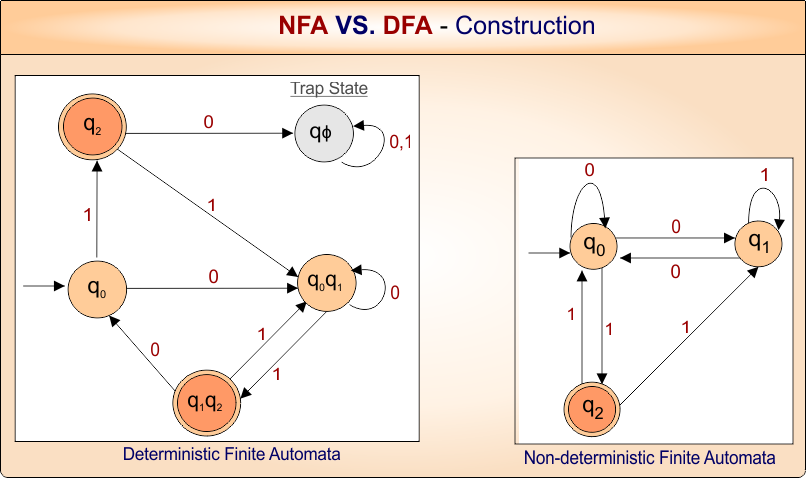
This ease of design is a key reason why NFAs are often used as an intermediate step in more complex processes, like converting a regular expression into a machine that can recognize it—a topic we'll be diving into soon.
2. State Complexity: The Potential Cost of Determinism
If NFAs are easier to design, why not use them all the time? The answer lies in the trade-off revealed by the subset construction algorithm you learned previously.
Recall that to convert an NFA to a DFA, each state in the new DFA corresponds to a set of states from the original NFA. If the NFA has states, the total number of possible subsets of states is . This means the equivalent DFA could have up to states. This is often called state space explosion or exponential blow-up.
The following video explains this phenomenon clearly.
Non-Deterministic Automata - Computerphile
This segment from Computerphile explains the subset construction, which they call the 'power automaton'. It provides a great intuitive explanation for why a DFA constructed from an NFA can have an exponentially larger number of states.
Watch from 09:21 to 12:48. Focus on the concept of DFA states being 'sets of NFA states' and the explanation of the potential 2^n blow-up.
While not every conversion results in the worst-case scenario (many states in the DFA may be unreachable), the possibility of this exponential increase in states is a significant trade-off. A compact, elegant NFA with just a handful of states might translate into a massive, sprawling DFA.
3. Execution Performance: The DFA's Speed and Simplicity
So, NFAs can be smaller and easier to design, while DFAs can be enormous. This might make the DFA seem like a poor choice, but it has a crucial advantage: execution speed and predictability.
-
DFA Execution: A DFA is simple to execute. You start in one state. For each character in the input string, you follow exactly one transition to the next state. It's a single, determined path. For a string of length , this takes O() time. In terms of implementation, it's a simple loop that updates a
current_statevariable. -
NFA Execution: Simulating an NFA is more complex. Since an NFA can be in multiple states at once, your simulation needs to track a set of all possible current states. After each character, you must calculate the new set of states. While this can also be done in time proportional to the string length (multiplied by a factor related to the NFA's size), the logic is inherently more complex than the DFA's simple path.
The "coin" analogy from the Computerphile video is a great way to visualize this parallel execution.
Non-Deterministic Automata - Computerphile
This clip revisits the Computerphile video to illustrate the mechanics of running an NFA. The 'coin' analogy effectively demonstrates how you must track multiple active states simultaneously.
Watch from 07:06 to 09:21. Notice how processing a single input character can require updating the positions of multiple 'coins', representing the set of active states.
Your background in backend development provides a perfect parallel. A DFA is like a highly optimized function with a simple switch statement in a loop. An NFA simulation is like managing a queue or set of parallel tasks that you have to update at each step. The DFA is faster and requires less overhead at runtime.
4. Synthesizing the Trade-offs: A Practical Summary
We've established a classic engineering trade-off: Ease of Design & Compactness (NFA) vs. Speed of Execution (DFA).
The following resource is an excellent read. It's written from the practical perspective of someone building a regex engine, which will resonate with your software engineering experience. It summarizes the theoretical differences and explores their real-world consequences.
NFA vs DFA - Building a Regex Engine Part 10
This article, 'NFA vs DFA', provides a deep, practical comparison. It moves beyond the basic theory to discuss how these trade-offs affect the implementation of real-world tools like regex engines.
Read the sections 'Practical differences between NFA and DFA', 'NFA and DFA in modern regex engines', 'Lazy quantifiers', and 'Backreferences'. Focus on how the structural differences impact performance (Speed vs. Memory) and the ability to implement advanced features.
This article highlights a critical point: the NFA's design flexibility makes it much better suited for the complex features found in modern regex engines (like lazy quantifiers and backreferences). A DFA's rigid, state-driven nature makes implementing such features extremely difficult, if not impossible. This is why many real-world regex implementations (e.g., in Python, Perl, Java) are based on NFA simulation (often called "backtracking"). They trade raw execution speed for expressive power and features.
For a final, structured summary, let's consult this clear comparison table.
This resource provides a concise, side-by-side table that summarizes the key differences between DFAs and NFAs across multiple criteria.
Review the main comparison table under the 'DFA vs NFA Key Differences' heading. It's a great way to consolidate your understanding of the trade-offs.
Test your understanding!
You are tasked with designing a system for two different scenarios. For each, would you recommend starting with an NFA-based or DFA-based design? Justify your choice based on the trade-offs we've discussed.
-
Scenario A: A hardware-embedded system for a high-speed network switch that must validate packet headers against a fixed set of simple, known patterns. Performance is the absolute top priority, and memory is limited.
-
Scenario B: A new text editor feature that allows developers to search their code using complex patterns with features like "find the shortest possible match" (laziness) and capturing groups. Rapid development and feature flexibility are more important than raw speed.
Show answer
-
Scenario A: DFA-based. The priority here is execution speed and a small runtime footprint. DFAs excel at this. Since the patterns are simple and fixed, you can afford the one-time, offline cost of converting them to a minimized DFA. The resulting DFA will be extremely fast to execute in hardware, as it's just a state lookup table.
-
Scenario B: NFA-based. The priority is design flexibility and support for complex features like lazy matching and capturing groups. As we saw, these are far easier to implement in an NFA-based ("regex-directed") engine. The design process will be faster, and adding new pattern-matching features will be more straightforward. The potential performance hit compared to a DFA is an acceptable trade-off for this enhanced functionality.
Conclusion
Today we moved beyond the theoretical equivalence of DFAs and NFAs to understand their practical differences, which are crucial in real-world applications.
Key Takeaways:
- Ease of Design: NFAs are generally easier and more intuitive to design because they don't require explicit handling of all possible transitions (no need for trap states).
- State Complexity: NFAs are often more compact (fewer states). A DFA equivalent to an -state NFA could have up to states due to the subset construction.
- Execution Performance: DFAs are faster and simpler to execute. Their deterministic nature translates to a direct, linear scan over the input. NFA simulation requires tracking multiple active states, adding complexity.
- The Core Trade-off: The choice between them depends on the application.
- Use a DFA (or convert an NFA to a DFA) when runtime performance is critical and patterns are relatively simple (e.g., lexical analysis in a compiler).
- Use an NFA when design flexibility, compactness, and support for complex features are more important (e.g., feature-rich regex engines).
Preview of the Next Lesson:
Our discussion on NFAs isn't quite complete. There's a special type of transition, the -transition, that allows an NFA to change state without consuming any input. In the next lesson, we will define NFA with -transitions (NFA-ε) and see how to convert them to equivalent NFAs without such transitions. This concept is the final piece of machinery we need before we can tackle the elegant process of converting any regular expression into a finite automaton.