Hello! Welcome to the next stage of your journey into the Theory of Computation.
In the previous module, we fully explored the world of regular languages, establishing the equivalence between finite automata, regular expressions, and regular grammars. This gave us a complete picture of the lowest level of the Chomsky Hierarchy.
Today, we climb one step higher. We're moving on to Context-Free Languages (CFLs), which, as you know from our work on grammars, can describe more complex, nested structures like those in programming languages. To recognize these languages, we need a more powerful computational model than a finite automaton. This lesson introduces that model: the Pushdown Automaton (PDA). Our objective is to define the formal 7-tuple structure of a PDA, laying the groundwork for understanding how these machines operate.
1. Why We Need More Than Finite Automata
Let's start with a foundational question: why are finite automata not enough? Consider the classic context-free language . To recognize strings in this language (e.g., aaabbb), a machine must ensure the number of a's perfectly matches the number of b's. This requires counting the a's, which implies some form of memory.
A finite automaton's memory is limited to its current state. It cannot remember an unbounded count of symbols. To solve this, we augment the finite automaton with a stack—a simple, yet powerful, memory device.
The following video provides an excellent intuitive build-up, explaining the limitations of FAs and introducing the stack as the natural solution. Your background in software development means you're already very familiar with stack data structures (LIFO - Last-In, First-Out), so the core concept should feel quite natural.
To build an intuition for why a new type of machine is needed, this video explains the limitations of Finite Automata and introduces the stack as a memory solution.
Watch the video from 15:00 to 25:15. Focus on the discussion of the language L = {aⁿbⁿ} and why a finite automaton cannot recognize it. Pay close attention to the analogy of using a box (a stack) to 'remember' the count of 'a's, which are then matched against the 'b's. This provides the core conceptual model for a Pushdown Automaton.
2. The Formal Definition of a Pushdown Automaton
Now that we have the intuition, let's formalize it. A Pushdown Automaton is defined by seven components, captured in a 7-tuple.
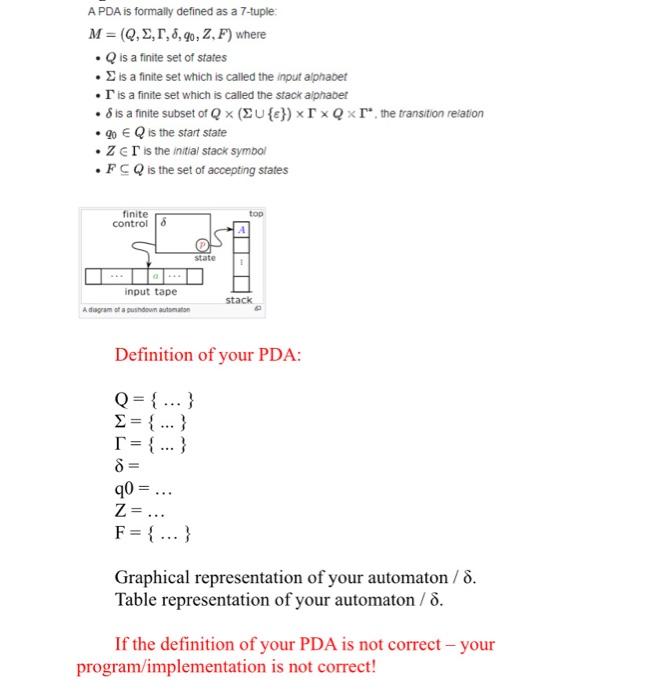
As the diagram shows, a PDA extends an NFA with a stack. Three of the seven components are entirely new and relate to this stack.
To get a clear, textual breakdown of these components, please read the following section from the article "Advanced Automata Theory — Week 4".
Advanced Automata Theory — Week 4
This article provides a crisp, formal definition of the PDA and breaks down each component of the 7-tuple.
Read the section titled '1. Definition of Pushdown Automata'. Pay close attention to the breakdown of the 7-tuple: M = (Q, Σ, Γ, δ, q₀, Z₀, F).
Let's summarize the 7-tuple :
- : A finite set of states. (Same as in an FA)
- : A finite set called the input alphabet. (Same as in an FA)
- : A finite set called the stack alphabet. These are the symbols that can be pushed onto the stack. This is a new component.
- : The transition function, which we will explore in detail next.
- : The start state. (Same as in an FA)
- : The initial stack symbol. This symbol is on the stack at the very beginning of computation. It often serves as a marker for an empty stack. This is a new component.
- : The set of accepting or final states. (Same as in an FA)
The power of the PDA comes from the three new elements: the stack alphabet , the initial stack symbol , and, most importantly, the new, more powerful transition function .
3. The Heart of the PDA: The Transition Function
The transition function is what drives the PDA. Unlike in an FA, where a transition only depends on the current state and input symbol, a PDA's transition also depends on the symbol at the top of the stack.
The formal signature of the transition function is:
Let's decode this:
-
Input to : A triplet
(state, input symbol or ε, stack-top symbol).state \in Q: The current state of the machine.input symbol or ε \in (\Sigma \cup \{\varepsilon\}): The next symbol on the input tape, orεif we're making a move without consuming input.stack-top symbol \in \Gamma: The symbol currently at the top of the stack.
-
Output of : A finite set of pairs
{(next_state, string_to_push), ...}.next_state \in Q: The state the machine will transition to.string_to_push \in \Gamma^*: The string of symbols that will replace the symbol that was just read from the stack. The symbol that was on top is effectively popped, and this new string is pushed in its place. The first symbol of this string becomes the new top of thestack.
Key Stack Operations:
The string_to_push (let's call it ) determines the stack operation:
- Push: If is a string of length 2 or more (e.g.,
AB), the original top symbol is replaced by multiple symbols. This grows the stack. - No Change: If is a single symbol (e.g.,
A), the original top symbol is replaced by one symbol. The stack size is unchanged. - Pop: If is the empty string, , the original top symbol is removed and not replaced. This shrinks the stack.
The following video segment provides a detailed walkthrough of the transition function, illustrating how to interpret its notation.
The transition function, δ, is the engine of the PDA. This video provides a detailed breakdown of how to read and interpret PDA transitions, including various examples of what can be pushed onto the stack.
Watch from 51:24 to 1:03:00. This section meticulously explains the transition function δ. Pay close attention to how a single transition is defined by what you read from the input (or ε), what you pop from the stack, and what you push back onto the stack.
Test your understanding!
A PDA has states , input alphabet , and stack alphabet .
A transition is defined as: .
Describe in plain English what this transition means. What is the state of the machine and the stack before and after this move, assuming the input string is 01?
Show answer
Meaning: "When the machine is in state , reads a 0 from the input, and has at the top of the stack, it will pop , push the string AZ_0 back onto the stack (with A now on top), and remain in state ".
Before the move:
- State:
- Remaining Input:
01 - Stack:
Z_0(top)
After the move:
- State:
- Remaining Input:
1 - Stack:
A(top),Z_0(bottom)
Effectively, this move consumed a 0 and pushed an A onto the stack.
Conclusion
In this lesson, we have formally defined the Pushdown Automaton, the machine model for recognizing context-free languages. We've seen how it enhances a finite automaton with a stack, providing it with the memory needed to handle more complex language structures.
Key Takeaways:
- A Pushdown Automaton (PDA) is essentially a nondeterministic finite automaton augmented with a stack.
- The formal definition of a PDA is a 7-tuple: , where , , and the more complex function are the key additions.
- The transition function is the core of the PDA's operation. Its behavior is determined by the current state, the current input symbol (or ), and the symbol at the top of the stack.
- A single transition involves popping the top stack symbol and pushing a new string of symbols, allowing for push, pop, or no-change operations on the stack.
Preview of the Next Lesson:
Now that we understand the formal structure of a PDA, our next step is to put it into practice. In the next lesson, we will learn how to trace the execution of a PDA on an input string, using instantaneous descriptions to track the machine's configuration and determine whether a string is accepted or rejected.