Hello! Welcome to the next lesson in our journey through the Theory of Computation.
In our last session, we mastered the art of tracing the execution of a Pushdown Automaton (PDA). We learned to use Instantaneous Descriptions (IDs) to formally track a PDA's state, its remaining input, and its stack contents to determine if a string is accepted.
Today, we shift our perspective from analysis to creation. The learning outcome for this lesson is to design Pushdown Automata that accept languages by final state. We will explore the fundamental strategies for translating a language's description into a functional PDA, focusing on how to use the stack as a computational memory. Your experience in designing complex, rule-based systems in your AI and blockchain projects will serve you well here, as designing a PDA is essentially about creating a specialized algorithm with a stack-based memory constraint.
1. The Core Strategy: Stack as Memory
The power of a PDA over a Finite Automaton comes from its stack. The central question in designing any PDA is: "What information must be remembered to verify a string, and how can the stack store and retrieve this information?"
Here are some common strategies:
- Counting and Matching: Use the stack to count occurrences of a symbol in one part of the string, then match them against another symbol in a later part. The classic example is a language like .
- Storing and Reversing: Push the characters of the first part of a string onto the stack. Since the stack is a Last-In, First-Out (LIFO) structure, popping the characters will naturally produce them in reverse order, which is perfect for recognizing palindromic languages like .
- Maintaining a Balance: Use the stack to track a running balance between two types of symbols. For instance, pushing for symbol
aand popping for symbolbcan verify properties related to the relative counts ofas andbs.
A key convention in PDA design is to use a bottom-of-stack marker (often denoted or $ symbol). This symbol is pushed onto the empty stack at the very beginning of the computation. It serves two main purposes:
- It lets the PDA know when it has popped all the symbols it previously pushed, allowing it to recognize that the "working" part of the stack is empty.
- It prevents the machine from crashing if it needs to perform a transition on an empty stack before the computation is complete.
2. Formal Definition of Acceptance
Before we start designing, let's quickly formalize what "acceptance by final state" means. As you'll recall from our last lesson, a PDA is a 7-tuple .
The following resource provides a concise formal definition. Please review the definitions for a PDA, its configuration (which we called an ID), and what it means for a string to be accepted by final state.
This lecture PDF from the University of Delaware provides the formal definitions we need. It will serve as a good, rigorous foundation before we jump into design examples.
Please read slides 7, 8, and 10. Slide 7 ('Definition: PDA') formally defines the 7-tuple. Slide 8 ('A configuration of a PDA') defines the configuration triple, which is our Instantaneous Description. Slide 10 ('Definition') formally defines what it means for a string x to be accepted by final state. Focus on the condition: (q₀, x, Z₀) ⊢M* (q, Λ, α) for some ... q ∈ A.
The key takeaway is that for a string to be accepted, the PDA must consume the entire input string (ending with Λ or ε remaining) and halt in an accepting state (q ∈ A). The final content of the stack (α) does not matter for this acceptance criterion.
3. Design Walkthrough 1: A Counting Language
Let's design a PDA for the canonical context-free language: .
The Strategy:
- Initialize the stack by pushing a bottom marker, .
- Read the first part of the string. For every
0we see, we push a symbol (e.g., another0) onto the stack. This effectively counts the number of0s. - When we see the first
1, we switch from pushing to popping. - For every
1we read, we pop one0from the stack. - If we finish reading the input string exactly when the stack becomes empty (i.e., we see our marker ), we can move to an accepting state.
The following video provides an excellent walkthrough of this design process, focusing on the reasoning behind each state and transition.
Pushdown Automaton (PDA) Example: {0^n 1^n}
This video from Easy Theory is great because it explains the thought process of designing a PDA for {0ⁿ1ⁿ}, not just the final result. Pay close attention to the justification for the initial bottom-of-stack marker and the transitions.
Watch the entire video (up to 10:32). The creator walks through the entire design, explaining: The overall push/pop strategy. The necessity of the bottom-of-stack marker ($ in his case). The state for pushing 0s. The transition to the state for popping 0s. The final transition to an accepting state.
As you saw, the design translates our strategy directly into a state machine with stack operations. The machine uses different states to keep track of which part of the pattern it's currently processing (pushing 0s vs. popping for 1s).
4. Design Walkthrough 2: A Palindromic Language
Now let's tackle a language that requires non-determinism: , the language of even-length palindromes.
The Strategy:
The challenge here is that the PDA doesn't know where w ends and w^R begins. This is where non-determinism comes to the rescue.
- Push the symbols of the first half of the string,
w, onto the stack. - Non-deterministically guess that we have reached the middle of the string. This is modeled by an
ε-transition that doesn't consume any input. - Switch to a "popping" mode.
- For the second half of the string,
w^R, match each incoming symbol with the symbol popped from the stack. Because the stack is LIFO, it will naturally provide the characters ofwin reverse order. - If the input is finished and the stack is empty (down to the marker), accept.
For any string in , there will be exactly one computational path where the non-deterministic "guess" is made at the right time, leading to acceptance. For any string not in , no path will succeed.
Let's look at a diagram for this PDA.
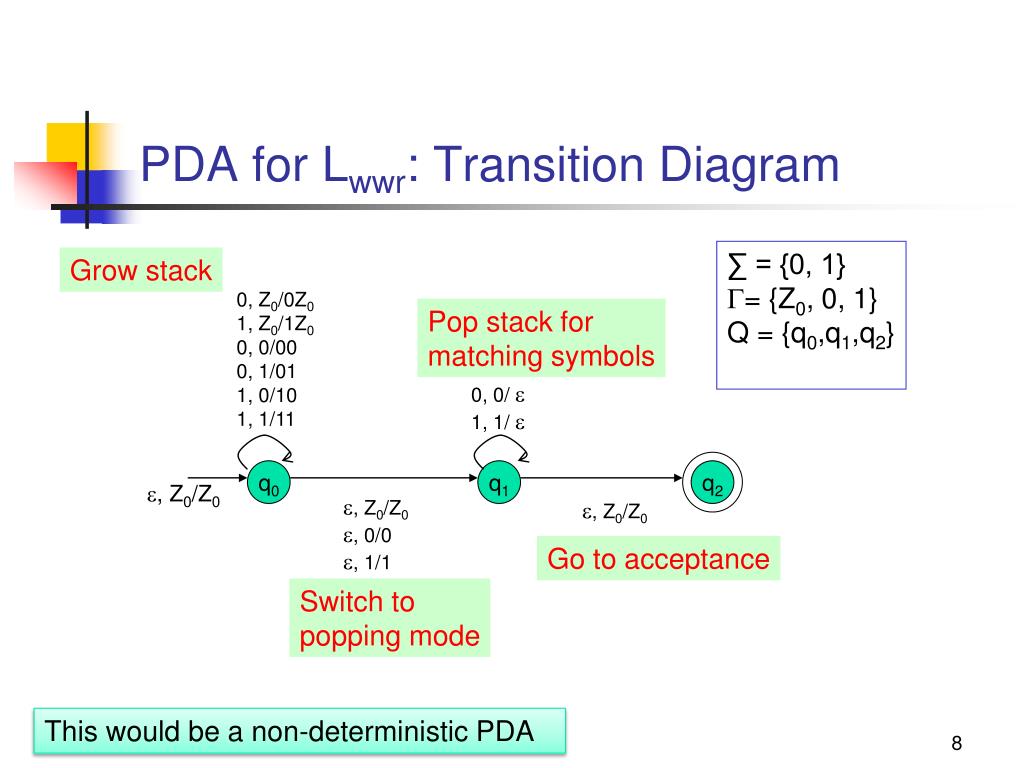
Here's how to interpret the diagram:
- State
q0(Grow stack): While in this state, the PDA reads input symbols (aorb) and pushes them onto the stack. - The
εtransition (Switch to popping mode): The arrow fromq0toq1labeledε, Z / Zrepresents the non-deterministic guess. At any point, without consuming input, the machine can jump toq1. (Note: a more general notation would beε, X / Xfor any stack symbolX, as the switch can happen anytime). - State
q1(Pop stack for matching symbols): In this state, the machine must match the input symbol with the symbol at the top of the stack and pop it. - Transition to
q2(Go to acceptance): Once the input is consumed, if the stack only contains the initial markerZ, the machine can move to the final stateq2and accept.
5. A Quick Refresher on Graphical Notation
You've seen a few diagrams now. The notation for transitions is crucial. Let's ensure it's perfectly clear.
A transition label a, b / c means:
a: Readafrom the input tape. Ifaisε, do not read any input.b: The symbolbmust be on top of the stack. Popb.c: Push the stringconto the stack. Ifcisε, nothing is pushed.
The following short video segment clearly explains this convention.
Pushdown Automata (Graphical Notation)
This short clip from Neso Academy provides a very clear and concise explanation of the graphical notation for PDA transitions.
Please watch from 00:51 to 03:25. This will solidify your understanding of how to read the labels on PDA transition diagrams.
Test your understanding!
Let's try designing a PDA for a slightly different language: . This language consists of one or more a's followed by twice as many b's.
Think about the strategy. For every a, you need to account for two b's. How can you use the stack to do this? Outline the states and transitions you would need.
Show answer
Strategy: For each a read from the input, push two symbols (say, X) onto the stack. Then, for each b read from the input, pop one X. If the input is consumed and the stack is empty (except for the initial marker), the string is accepted.
PDA Design Outline:
-
States: We can use four states:
q₀: The start state.q₁: The state where we reada's and pushXX.q₂: The state where we readb's and popX.q₃: The final (accepting) state.
-
Initial Stack Symbol:
-
Transitions:
δ(q₀, a, Z₀) = {(q₁, XXZ₀)}- This handles the first
a. We transition from the start state, consume thea, and pushXXonto the stack on top ofZ₀.
- This handles the first
δ(q₁, a, X) = {(q₁, XXX)}- For subsequent
a's, we stay in stateq₁. We pop oneXbut push threeX's, for a net effect of adding twoX's to the stack.
- For subsequent
δ(q₁, b, X) = {(q₂, ε)}- When we see the first
b, we pop anXand transition to the "popping" stateq₂.
- When we see the first
δ(q₂, b, X) = {(q₂, ε)}- For every subsequent
b, we stay inq₂and pop oneX.
- For every subsequent
δ(q₂, ε, Z₀) = {(q₃, Z₀)}- If we have consumed all the input (
ε) and the only thing on the stack is our markerZ₀, we can move to the final stateq₃and accept.
- If we have consumed all the input (
Conclusion
Today we've moved from being analysts to being architects of Pushdown Automata. You've learned how to devise a strategy for computation and translate it into the formal language of states and stack operations.
Key Takeaways:
- PDA design is strategy-driven, focused on using the stack as a specific kind of memory (LIFO).
- Common strategies involve using the stack for counting, matching, and reversing substrings.
- The bottom-of-stack marker () is a vital tool for initializing the process and detecting when the "working" part of the stack is empty.
- Non-determinism is a powerful tool for handling languages where the structure is ambiguous, such as guessing the midpoint of a palindrome.
- For acceptance by final state, the goal is to consume all input and end in an accepting state, regardless of the final stack contents.
Preview of the Next Lesson:
We've focused entirely on acceptance by final state. However, there is another, equivalent method for a PDA to accept a language: acceptance by empty stack. In our next lesson, we will explore this second criterion, learn how to design PDAs that use it, and, crucially, prove that the two methods of acceptance are equivalent in power by showing how to convert a PDA of one type into the other.