Introduction
Welcome to the first lesson of your course on ADHD and communication in relationships! Our goal throughout this course is to provide you with a mix of scientific understanding and practical strategies to help you navigate conversations with your partner more effectively and confidently.
This first module, "Understanding the ADHD Communication Blueprint," is all about building a solid foundation. Before we can develop new strategies, it's crucial to understand why communication can feel different or challenging with an ADHD brain.
Today, we'll focus on our first learning outcome: Explaining how ADHD impacts attention, working memory, and impulse control specifically within conversations. By the end of this lesson, you'll have a clearer picture of the neurological reasons behind common communication patterns, which will set the stage for identifying and managing them in future lessons.
The ADHD Brain's "Operating System"
It can be helpful to think of the ADHD brain not as "broken" or "deficient," but as running on a different, unique "operating system." This system has its own strengths, like creativity and the ability to hyperfocus, but it also processes information differently, which can have a significant impact on communication.
A key part of this operating system involves executive functions. Think of these as the brain's management team, responsible for tasks like planning, organizing, focusing, and controlling impulses. In ADHD, this management team works a bit differently.
To get a visual of what this means, take a look at the two infographics below.
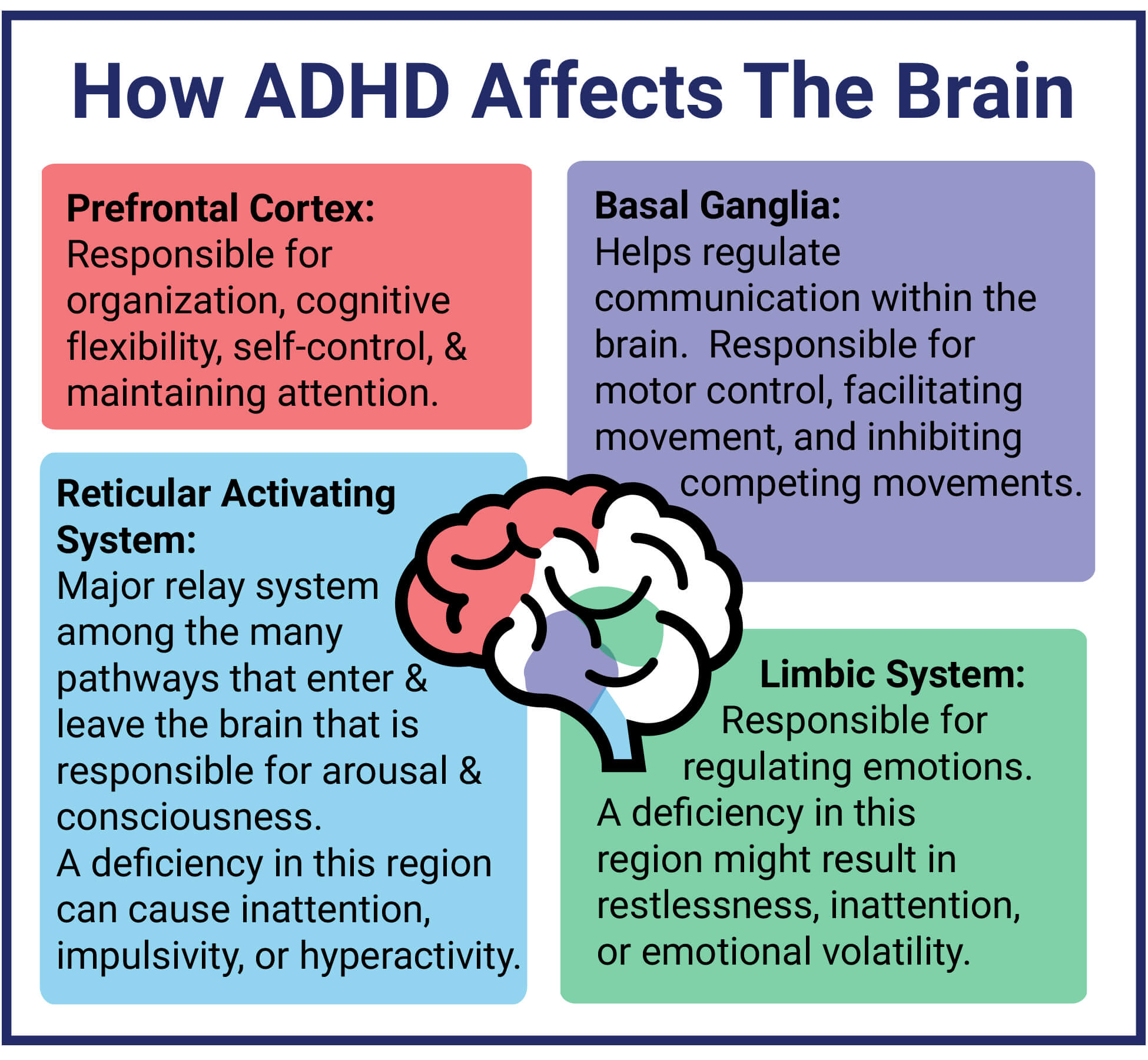
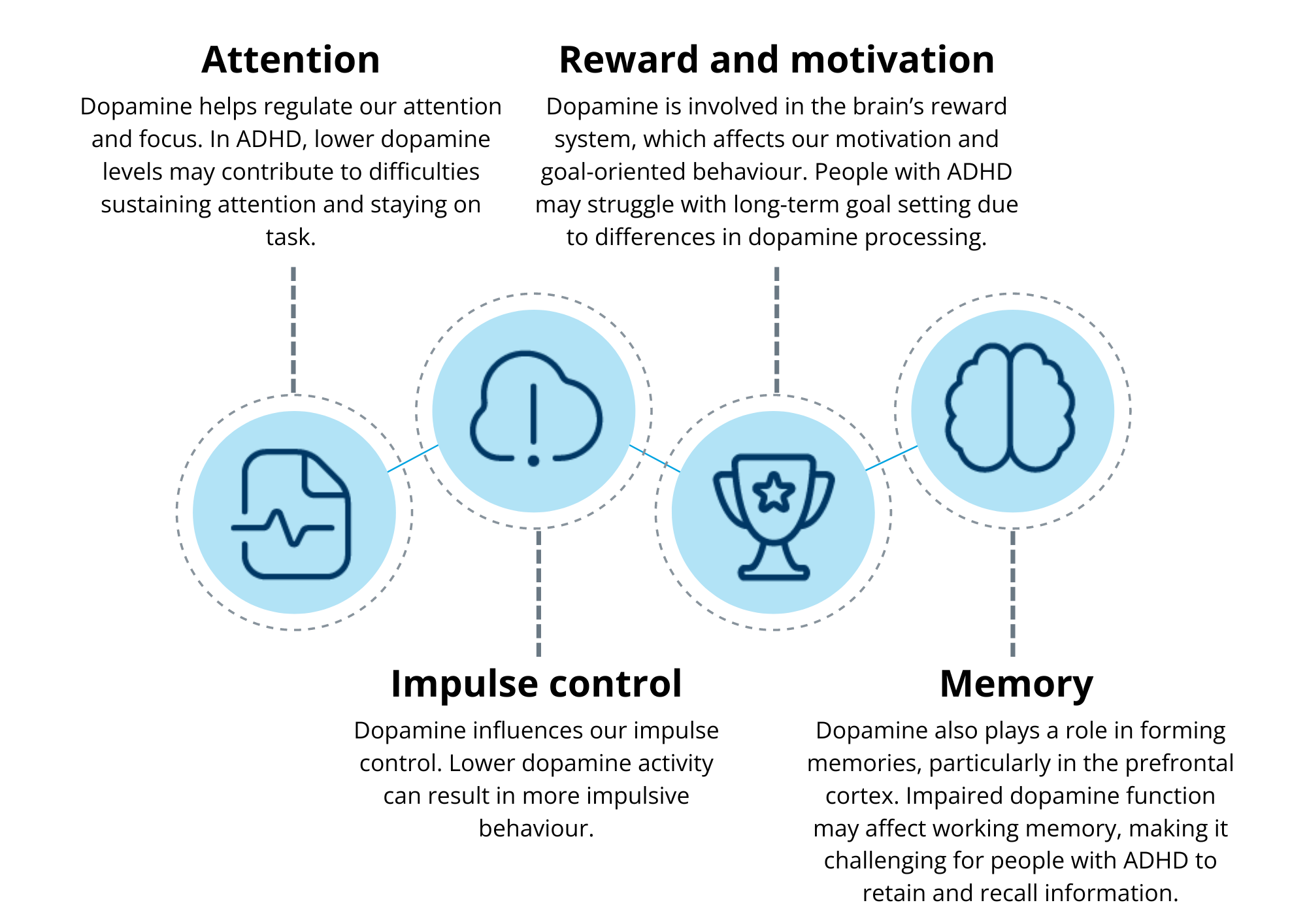
These images show that the communication differences you might experience have a biological basis. They aren't a matter of effort or character. With this foundation, let's explore the three core areas for today's lesson.
1. Working Memory: The Brain's RAM
Working memory is your brain's temporary storage—the mental space where you hold and manipulate information for a short period. It's like the RAM on a computer. You use it to remember the beginning of a sentence while listening to the end, to hold a thought while waiting for your turn to speak, or to recall what you wanted to say after an interruption.
To get a clear and relatable explanation of how this works, please watch the first couple of minutes of the following video.
Why I Can't Remember Things -- How ADHD Affects Working Memory
Jessica from the 'How to ADHD' channel provides an excellent analogy for working memory and explains why it's often impaired in ADHD.
Please watch from the beginning until timestamp 02:27. Focus on the computer RAM analogy and the explanation of how ADHD affects the number of 'slots' available for information.
As the video explains, the ADHD brain often has fewer "slots" in its working memory, especially for auditory information (like what someone is saying). Furthermore, distractions or even your own thoughts can easily "kick out" the information that's currently being held.
In a conversation, this can manifest as:
- Forgetting your point: You have a brilliant thought, but by the time there's a pause for you to speak, it has vanished.
- Losing track of the conversation: Your partner is explaining something with multiple steps, and by the end, you've forgotten the first part.
- Asking a question that was just answered: You were focusing so hard on one part of what was said that you didn't retain the next piece of information.
The article "ADHD Communication Problems" refers to this as "Verbal Instructions Vanishing." It’s not a lack of listening, but a challenge with information retention.
2. Attention Regulation: The Mental Juggling Act
A common misconception is that ADHD causes a deficit of attention. It's more accurate to describe it as difficulty with regulating attention. Your brain might struggle to filter out irrelevant stimuli (like a noise outside) or internal stimuli (a random memory or idea) and stay focused on the conversation at hand.
The Sachs Center article on communication problems offers a powerful analogy for this experience.
The ADHD Brain in Conversation: A Different Operating System
This brief reading from 'ADHD Communication Problems: Solutions That Actually Work' describes the internal experience of an ADHD brain during a conversation.
Please read the section titled 'The ADHD Brain in Conversation: A Different Operating System.' It starts with 'Imagine trying to concentrate on a lecture while simultaneously juggling a soccer ball...'
This "mental juggling act" means your brain is working overtime just to stay present.
In a conversation, this can lead to:
- "Zoning out": You're physically present and looking at your partner, but your mind has drifted to another topic entirely.
- Missing cues: Because your brain is busy processing words and managing internal distractions, you might miss non-verbal cues like facial expressions or tone of voice.
- Hyperfocus: The opposite can also happen. You might become so intensely focused on one detail of the conversation that you miss the main point or the emotional context.
3. Impulse Control: The Urge to Speak
Impulsivity in ADHD is the difficulty in stopping to think before acting or speaking. It's a "ready, fire, aim" tendency. In conversations, this often isn't about being rude or wanting to dominate the discussion. It's a brain-based urge that can be very difficult to inhibit.
The following video segments from a psychologist explain this dynamic and its consequences in relationships.
Psychologist on ADHD, Attachment Styles, and Relationships: Common Challenges & How to Overcome Them
In these clips from 'Psychologist on ADHD, Attachment Styles, and Relationships,' Dr. Maika Steinborn explains how impulsivity and difficulty with task-switching manifest in conversations.
First, watch from 02:14 to 03:05 to understand how impulsivity leads to saying things you might later regret. Then, watch from 03:31 to 05:06, which explains why it can be hard to stop talking once you've started.
As Dr. Steinborn explains, this difficulty with self-regulation can have two major effects on conversational flow:
- Interrupting: This often comes from a combination of factors. You have an exciting thought, you feel an urgent need to share it, and you're worried you'll forget it if you wait (a working memory issue!).
- Monologuing or over-explaining: The ADHD brain can struggle with shifting from one activity (speaking) to another (listening). Once you start talking, it can be hard to find the off-ramp and give your partner space to respond.
Another key aspect of impulsivity is emotional reactivity. A minor comment might trigger a disproportionate emotional response before you've had a chance to fully process it, which can quickly escalate a simple discussion.
Putting It All Together
As you've likely noticed, these three areas—working memory, attention, and impulse control—are deeply interconnected.
- The impulse to interrupt is often driven by a fear that your limited working memory will drop the thought.
- Distractibility from poor attention regulation means your working memory has to work even harder to hold onto the thread of the conversation.
- An impulsive emotional reaction can hijack your attention, making it nearly impossible to listen or process what your partner is saying.
The following table from the "ADHD Communication Problems" article provides a fantastic summary, directly linking common communication pitfalls to their underlying ADHD symptoms.
| Communication Pitfall | Underlying ADHD Symptom |
|---|---|
| Interrupting Others | Impulsivity / Racing Thoughts |
| Difficulty Following Multi-Step Instructions | Working Memory Deficits |
| Rambling or Going Off-Topic | Difficulty with Focus / Hyperactivity |
| Overreacting to Minor Issues | Emotional Dysregulation |
| Forgetting Appointments or Commitments | Working Memory Deficits / Time Blindness |
Understanding this framework is the first, most crucial step. It allows you to reframe these challenges not as personal failings, but as predictable outcomes of your brain's unique wiring.
Conclusion
In this lesson, we've established the foundational "why" behind ADHD's impact on communication.
Key Takeaways:
- ADHD affects core executive functions that are essential for smooth conversations: attention regulation, working memory, and impulse control.
- Working memory challenges can make it difficult to hold onto information, leading to forgotten points or misunderstood instructions.
- Attention regulation difficulties create a "mental juggling act," making it hard to stay focused and present.
- Impulse control issues can manifest as interrupting, over-explaining, or reacting with unintended emotional intensity.
- These brain-based differences are not character flaws, and understanding them is the first step toward building better communication patterns.
In our next lesson, we will build directly on this foundation. Now that you understand the neurological roots, we will focus on identifying these common ADHD-driven communication patterns—like interrupting, zoning out, and topic-jumping—as they happen in real life. This will help you build the self-awareness needed to start implementing new strategies.