Hello! Welcome back to our deep dive into advanced C pointers.
In our last lesson on unions, we saw how you could create a "zero-copy" workflow for communication packets by overlaying a structured view on a raw byte array. This allowed you to access protocol fields without memcpy-ing the data from a reception buffer. That was a specific application of a much broader and critically important principle in systems programming.
Today, we'll explore that principle in detail. This lesson is dedicated to the learning outcome: Explain the principles of zero-copy data transfer in communication stacks. We will dissect what "zero-copy" means, why it's a cornerstone of high-performance systems like the automotive communication stacks you work with, and what OS and hardware features make it possible.
The Problem: The High Cost of Copying
Before we can appreciate the solution, we must understand the problem. In a traditional I/O scenario, moving data from a source (like a file on disk) to a destination (like a network socket) is surprisingly inefficient. It involves multiple redundant data copies and context switches between your application's user space and the operating system's kernel space.
Let's visualize the traditional path for an application reading data from a file and sending it over the network:
- Disk to Kernel: A
read()system call is issued. The kernel tells the Direct Memory Access (DMA) controller to copy the file data from the disk into a kernel-owned memory buffer (the "page cache"). This is one copy (handled by DMA, so the CPU is free). - Kernel to User: The data is then copied by the CPU from the kernel's page cache into your application's buffer in user space. This is a second copy. This step also requires a context switch from kernel mode back to user mode.
- User to Kernel: Your application calls
send(). This triggers another context switch into kernel mode. The data is copied by the CPU from your user-space buffer into a kernel-owned socket buffer. This is a third copy. - Kernel to NIC: Finally, the DMA controller copies the data from the kernel's socket buffer to the Network Interface Card (NIC) for transmission. This is the fourth copy.
In this common scenario, we have four data copies (two by the CPU) and two context switches. This consumes significant memory bandwidth and CPU cycles, pollutes CPU caches, and adds latency.
System Design: Why is Kafka fast?
The YouTube channel ByteByteGo has an excellent animation that clearly illustrates this inefficient, copy-heavy process. Watching this will solidify your understanding of the problem we're trying to solve.
Watch the segment from 03:08 to 03:53. It walks through the four copy steps involved when zero-copy is not used, providing a clear visual of the overhead.
This diagram also shows the data flow, highlighting the expensive "CPU copy" step within the kernel that happens between the kernel's buffer cache and the socket buffer.
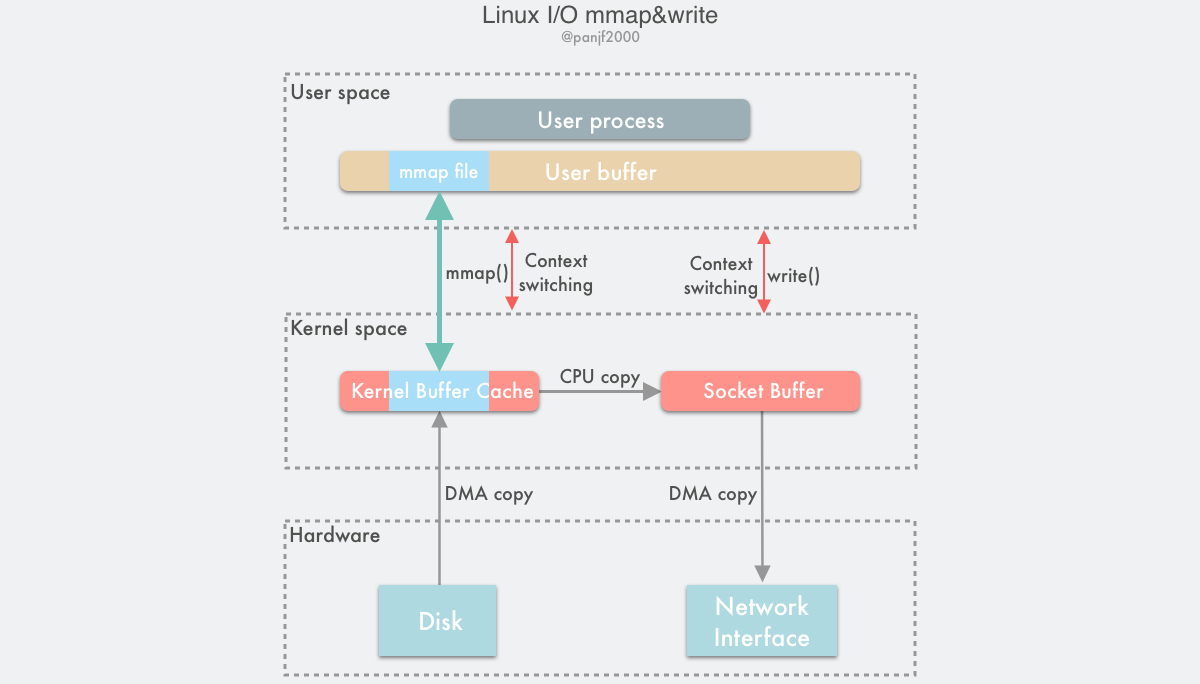
The Solution: Zero-Copy Principles
Zero-copy is not a single function call but a collection of techniques that aim to eliminate these redundant CPU copies, particularly between kernel and user space. The core idea is to let the CPU do what it does best—process data—and offload the task of simply moving data to specialized hardware (like DMA) or clever memory management.
Let's explore the primary mechanisms.
1. Kernel-Level Transfer: sendfile()
Modern operating systems provide specialized system calls to solve this exact problem. The most famous is sendfile(). Instead of reading data into your application just to write it back out, sendfile() tells the kernel: "Take the data from this file descriptor and send it directly to that socket descriptor."
The flow with sendfile() looks like this:
- Disk to Kernel Cache: The kernel reads the data from disk into the page cache via DMA (as before).
- Kernel Cache to NIC: The kernel then directly copies the data from the page cache to the NIC buffer. With modern NICs that support "scatter-gather" DMA, this can even be optimized further. The kernel doesn't copy the data at all; it just passes descriptors (pointers and lengths) of the data in the page cache to the NIC. The NIC's DMA engine then pulls the data directly from the cache.
This optimized path reduces the number of copies from four to two (both handled by DMA) and eliminates the CPU's involvement in moving data and the context switches for reading into user space.
System Design: Why is Kafka fast?
The same ByteByteGo video also explains how sendfile() optimizes this path beautifully.
Now, watch the segment from 03:53 to 04:43. It shows how sendfile() bypasses the user-space application, allowing the OS to move data directly from the OS cache to the network card, often using DMA to offload the CPU.
2. Shared Memory and Pointer Passing
While sendfile() is great for transferring files, it's less flexible for general-purpose communication between processes (IPC), which is central to your work in AUTOSAR and distributed systems. For IPC, the dominant zero-copy technique is shared memory.
The principle is simple: two or more processes map the same physical region of RAM into their own virtual address spaces.
- Process A writes data to the shared memory region.
- Process A then notifies Process B (using a semaphore, message queue, etc.) that data is ready.
- Process B can now read that data directly from its own address space.
No data was ever copied between the processes. They simply passed information by reference (using pointers into the shared memory segment).
This is precisely the philosophy behind high-performance middleware. In your domain, the AUTOSAR Adaptive Platform's ara::com API is explicitly designed to facilitate this.
Let's look at the official AUTOSAR documentation explaining the ara::com API. It directly discusses zero-copy implications and encourages implementations that avoid copying.
Please read two key sections from this document: Start at the section titled '7.1.1 Zero-Copy implications'. This section acknowledges that a memory-protected system usually needs one copy but explains how 'tricky shared memory approaches' can achieve zero-copy. Next, examine Figure 6.26 and the text around it, particularly the 'Binding implementer hint'. This section explains the Allocate()/Send() pattern. The idea is that the application asks the middleware to allocate a buffer (which it does in shared memory), fills it, and then 'sends' it by passing ownership of the smart pointer back to the middleware. This is a perfect real-world example of a zero-copy API design.
As you can see from the AUTOSAR document, the API is intentionally designed to pass data via pointers (SampleAllocateePtr), enabling a zero-copy implementation underneath. This is far more efficient than passing large data structures by value.
Advanced Implementations
User-Space Networking (DPDK)
The most extreme form of zero-copy is to bypass the kernel's networking stack entirely. Frameworks like the Data Plane Development Kit (DPDK) allow a user-space application to take exclusive control of a NIC. The application allocates its own memory buffers and interacts with a user-space driver that programs the NIC's DMA engine to send/receive packets directly to/from these buffers. This eliminates all kernel involvement and context switches, providing the absolute lowest latency.

Low-Level Buffer Management
Even within a kernel, the principle of passing pointers is key. In the Linux kernel, network packets are managed in structures called sk_buff (socket buffers). A naive implementation would copy packet data into these buffers. A zero-copy approach, however, modifies structures like sk_buff to contain pointers to the actual data location, along with length information. The TCP/IP stack then operates on these pointers, assembling headers and trailers around the data reference without ever copying the payload itself.
The paper "LyraNET: A Zero-Copy TCP/IP Protocol Stack for Embedded Operating Systems" describes exactly this. They modified the sk_buff structure to include a dataseg array, which holds pointers to user data, avoiding the copy. This is a prime example of how fundamental pointer manipulation enables this high-level performance principle.
Test your understanding!
Imagine you are designing a SOME/IP stack. A large camera image (several megabytes) needs to be sent from a camera application to an image processing application on the same ECU.
Based on the zero-copy principles we've discussed, which of the following approaches is the most efficient, and why?
- The camera app
mallocs a buffer, reads the image into it, and sends it to the processing app via a standard pipe. - The camera app
mmaps a large file containing the image data and sends the data over a TCP socket to the processing app running onlocalhost. The processing app reads from the socket into its own buffer. - The camera app requests a memory segment from a shared memory manager, writes the camera image directly into that segment, and then sends a message containing the handle/pointer for that segment to the processing app.
Show answer
Approach 3 is the most efficient.
Here's the breakdown:
- Approach 1 is the least efficient. It involves at least two CPU copies: one from the camera app's buffer into the kernel's pipe buffer, and another from the pipe buffer into the processing app's buffer.
- Approach 2 is better but still involves the overhead of the TCP/IP stack and likely at least one copy within the kernel (from the page cache for the file to the socket buffer). While
sendfile()could optimize this, it's more complex than necessary for IPC on the same machine. - Approach 3 is the true zero-copy solution for IPC. The data is written once into a shared memory location. The communication between the apps only involves passing a small message with a pointer/handle. The processing app can then access the multi-megabyte image data directly with no copying involved. This is the pattern advocated by the
ara::comexample.
Limitations: When Zero-Copy Fails
Zero-copy is not a universal solution. Its main limitation arises when the data payload needs to be inspected or modified in transit.
- Encryption/Decryption: If you are using TLS/SSL, the application must have the data in its user-space buffer to perform the cryptographic operations. You cannot simply
sendfile()an encrypted file and have it magically decrypted by the NIC. - Serialization: As the AUTOSAR document rightly points out, if the communicating applications have different data alignment requirements or endianness, the data must be serialized into a standard format and then deserialized. This process inherently requires reading the original data and writing out a converted copy, which negates the benefit of a zero-copy transport.
- Data Integrity Checks: If the application needs to compute a checksum or hash of the data before sending, it must first read the data into its address space.
In these cases, the data must be copied into the application's user space, and the performance cost is unavoidable.
Conclusion
We've moved from a brief mention of zero-copy to a comprehensive look at its core principles. It's a fundamental concept for building high-throughput, low-latency communication systems, and pointers are the essential tool that makes it work at a low level.
Key Takeaways:
- Traditional I/O is inefficient due to multiple data copies by the CPU and frequent context switches between user and kernel space.
- Zero-copy is a set of techniques to eliminate these redundant copies, primarily by passing data by reference (using pointers) rather than by value (copying).
- Key OS mechanisms include
sendfile()for direct kernel-level file-to-network transfer and shared memory for highly efficient Inter-Process Communication (IPC). - Your work with AUTOSAR
ara::comis a direct application of these principles, using shared memory and pointer-based APIs to avoid copying large data payloads. - Zero-copy is not always possible. Operations that require inspecting or modifying the data, like encryption or serialization, necessitate a data copy.
Preview of the Next Lesson:
Understanding the principles of zero-copy is the first step. The next is to see how it's done in practice. In our next lesson, we will implement a simplified zero-copy buffer passing mechanism using pointers and casting. We'll build a small buffer management system that mimics how a high-performance communication stack might pass packet data between software layers without ever copying the payload.