Hello! Welcome back.
In our last lesson, we explored how void* allows us to erase type information to create flexible, generic APIs. We saw that this power comes at the cost of compile-time safety, putting the full responsibility on the programmer.
Today, we're going to tackle a design pattern with the opposite goal. Instead of erasing type information for flexibility, we will deliberately hide it to build robust, stable, and encapsulated APIs. This lesson addresses the learning outcome: Implement opaque pointers ('pimpl' idiom) for information hiding and API encapsulation.
This technique is fundamental to creating clean, maintainable libraries and modules. In large-scale systems like the AUTOSAR middleware you work on, decoupling components and ensuring that a change in one module doesn't trigger a cascade of changes in others is paramount. The opaque pointer pattern is a primary tool for achieving this in C.
The Problem: Brittle Header Files
In a typical C module, you define a struct in a public header file (.h) and the functions that operate on it are implemented in a source file (.c).
// my_module.h
struct MyModule {
    int internal_counter;
    char buffer[256];
    // ... other private members
};

void my_module_do_work(struct MyModule* instance);
The issue here is that all the private implementation details (internal_counter, buffer) are exposed to every client that includes my_module.h. This has several major drawbacks:
- No True Encapsulation: A client can directly access and modify
instance->internal_counter, breaking the module's internal state. - Build Dependencies: If you change the size of
bufferor add a new member tostruct MyModule, every single file that includesmy_module.hmust be recompiled, even if they don't use the new member. - Unstable ABI: For shared libraries, changing the struct layout breaks the Application Binary Interface (ABI), forcing all dependent applications to be recompiled and relinked.
The Pointer to Implementation (Pimpl) idiom, known in C as the "opaque pointer" pattern, elegantly solves these problems.
The "Why": API Stability and True Encapsulation
The core idea is to hide the implementation details entirely within the .c file, exposing only a pointer to an incomplete type in the header.
To understand the motivation and benefits from a high level, let's watch a short video. Although it uses C++, the principles of API stability and hiding implementation are identical and highly relevant.
Classes Part 30 - pIMPL (pointer to implementation) - More Stable APIs| Modern Cpp Series Ep. 67
This video, 'pIMPL - More Stable APIs' by Mike Shah, clearly explains the 'why' behind this pattern. Focus on the problem he describes with exposing private members in the header and the benefits of hiding them.
Watch the following segments: 0:00 - 1:52: Introduction to the Pimpl idiom and its goals. 1:52 - 3:05: A look at a standard class that exposes its private members in the header. 7:55 - 9:22: A summary of the trade-offs, focusing on the benefits of API stability and reduced recompilation.
As the video highlights, the goal is to create a stable interface where the private data is not just access-controlled, but truly hidden from the client.
This diagram illustrates the structure: the header file contains only the public function declarations and a single pointer to a forward-declared implementation struct. The full definition of that struct lives exclusively in the implementation file.
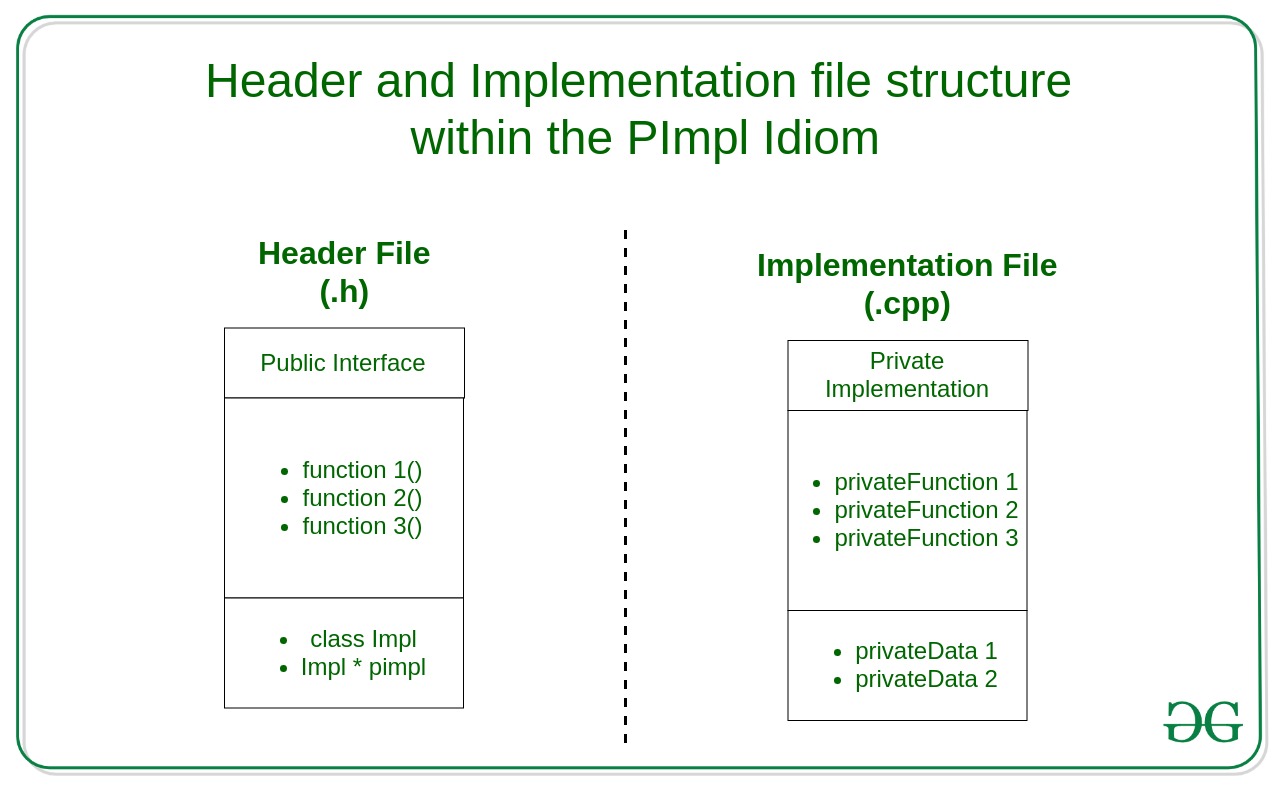
The "How": Opaque Pointers in C
Now, let's see how to implement this pattern in C. The key is using a forward declaration of a struct in the header file. This tells the compiler that a struct with a certain name exists, but provides no details about its size or members. This creates an incomplete type.
You can't declare a variable of an incomplete type (the compiler wouldn't know how much memory to allocate), but you can declare a pointer to it. This is the "opaque pointer."
Make your Data Type more Abstract with Opaque Types in C
The video 'Make your Data Type more Abstract with Opaque Types in C' by Jacob Sorber provides an excellent, step-by-step walkthrough of implementing this pattern in C.
Watch these two key segments: 0:36 - 3:45: He introduces abstraction and uses the standard C FILE* as a perfect real-world example of an opaque pointer. 9:56 - 13:12: This is the most crucial part. He refactors his code to make the queue type opaque by moving the struct definition into the .c file and leaving only a typedef to a pointer to an incomplete struct in the header. Pay close attention to how this prevents the client from accessing the struct's members directly.
To solidify this, let's examine a textual example.
Practical Design Patterns: Opaque Pointers and Objects in C
The article 'Practical Design Patterns: Opaque Pointers and Objects in C' from Memfault's Interrupt blog provides another excellent example using a ring buffer. It clearly shows the public header and private implementation.
Read the sections 'The Opaque Pointer Pattern', 'Object Life Cycle', and 'Encapsulation'. Notice the structure: ringbuffer.h: Contains the typedef for the opaque ringbuffer_t and the public function prototypes. ringbuffer.c: Contains the full struct ringbuffer_instance_t definition and the implementation of the functions. This reinforces the pattern we just saw in the video.
The core components of the pattern are:
- Public Header (
.h):- Forward-declare the implementation struct:
struct my_module_impl; - Create a
typedeffor the opaque pointer (the "handle"):typedef struct my_module_impl* my_module_handle_t; - Declare the public API functions, which accept this handle:
void my_module_do_work(my_module_handle_t handle); - Declare
createanddestroyfunctions for lifecycle management.
- Forward-declare the implementation struct:
- Implementation File (
.c):- Define the full implementation struct:
struct my_module_impl { int internal_data; }; - Implement the
createfunction, which dynamically allocates memory for the struct, initializes it, and returns the handle. - Implement the
destroyfunction, which frees the allocated memory. - Implement all other API functions, which cast the handle back to a
struct my_module_impl*to access internal members.
- Define the full implementation struct:
Adapting for Embedded and Safety-Critical Systems
Your work in automotive systems often involves environments where dynamic memory allocation is restricted or forbidden, as mandated by standards like MISRA-C (specifically, Directive 4.12: "Dynamic memory allocation shall not be used").
Does this mean we can't use the opaque pointer pattern? Not at all. We simply need to replace the dynamic allocation (malloc/calloc) with a static allocation strategy.
A common approach is to create a static pool of object instances within the .c file. The create function then finds an unused object from this pool and returns a handle to it, which could be its index or its address.
Practical Design Patterns: Opaque Pointers and Objects in C
Let's return to the Memfault article, which directly addresses this crucial issue for embedded developers.
Read the section titled 'What If I Don’t Want to Dynamically Allocate Memory?'. This section refactors the ring buffer example to use a statically allocated array of instances. Pay attention to how the create function now searches for an available slot in the g_instances array and how the handle is now an index (uint32_t) instead of a pointer.
This static pool approach perfectly resolves the tension between MISRA-C Directive 4.8 ("...the implementation of the object should be hidden") and Directive 4.12. You get the information hiding benefits of opaque types without violating the ban on dynamic memory.
This exact issue is a frequent topic of discussion among safety-critical software engineers.
How do I create a module in MISRAC:2012 that follows Dir 4.12 and 4.8?
To see how this plays out in a real-world compliance context, let's look at a discussion from the MISRA forum.
Read the first post by user 'crisls1'. He perfectly articulates the conflict between wanting opaque pointers (Dir 4.8) and being forbidden from using malloc (Dir 4.12). He then proposes the static pool solution. This shows you're learning a pattern that directly addresses complex, real-world constraints in your field.
Test your understanding!
The static allocation example from the Memfault article uses assert(false); when it runs out of instances. In a real system, this is often too drastic.
Modify the design. The ringbuffer_create function should not assert. Instead, it should communicate the failure to the caller. The ringbuffer_t handle is a uint32_t. How would you change the create function and what would the caller's code look like to safely handle this failure?
Show answer
A robust way to handle this is to define an "invalid handle" value. Since the handles are array indices, a value outside the valid range is a good choice. We can use MAX_NUM_RINGBUFFERS.
In ringbuffer.h:
#define MAX_NUM_RINGBUFFERS 10
#define RINGBUFFER_INVALID_HANDLE (MAX_NUM_RINGBUFFERS)

// Note: The handle type is still uint32_t
typedef uint32_t ringbuffer_t;

// ... function prototypes
In ringbuffer.c:
The ringbuffer_create function is modified to return the invalid handle on failure.
ringbuffer_t ringbuffer_create(uint32_t capacity) {
    // Search for an instance that is not in use
    for (uint32_t i = 0; i < MAX_NUM_RINGBUFFERS; i++) {
        if (!g_instance_in_use[i]) {
            g_instance_in_use[i] = true;
            // ... initialization ...
            return i; // Return the valid index
        }
    }

    // No available instances, return the invalid handle
    return RINGBUFFER_INVALID_HANDLE;
}
In the client code:
The caller must now check the returned handle.
#include "ringbuffer.h"
#include <stdio.h>

void main(void) {
    ringbuffer_t my_rb = ringbuffer_create(50);

    if (my_rb == RINGBUFFER_INVALID_HANDLE) {
        printf("Failed to create ringbuffer instance!\n");
        // Handle the error gracefully
    } else {
        printf("Ringbuffer created with handle: %u\n", my_rb);
        // ... use the ringbuffer
        ringbuffer_destroy(my_rb);
    }
}
This approach makes the API more robust by providing a clear, checkable error condition instead of terminating the program.
Conclusion
Today we've explored a powerful pattern for building clean, maintainable, and stable C APIs. By hiding implementation details, the opaque pointer idiom helps you write truly modular code.
Key Takeaways:
- The Goal: The opaque pointer (or Pimpl) idiom's purpose is to hide a module's implementation details, providing true encapsulation and API stability.
- The Mechanism: It works by defining a
structin the.cfile and exposing only a pointer to an incomplete (forward-declared)structin the public.hfile. - Benefits: This reduces compilation dependencies (improving build times) and creates a stable ABI, which is critical for libraries.
- Lifecycle: Instances are managed via
createanddestroyfunctions, analogous to constructors and destructors. - Embedded Adaptation: In environments where dynamic allocation is forbidden (like many automotive contexts), the pattern is implemented using a static pool of objects managed within the module's
.cfile.
Preview of the Next Lesson:
We've now seen how to manipulate type information with void* and how to hide it with opaque pointers. In our next lesson, we'll dive deeper into how compilers reason about pointers. We will explain pointer aliasing and the implications of violating the strict aliasing rule, a subtle but critical topic for writing correct and highly-optimized code.