Hello! Welcome to the next lesson in our journey through C pointers.
In our last session, we discussed the critical importance of deallocating memory with free() to prevent memory leaks. We established that for every malloc, there must be a free. We also touched upon a subtle but crucial side effect: free(ptr) deallocates the memory but leaves the ptr variable untouched, holding a now-invalid address. This turns ptr into what is known as a dangling pointer.
Today, we will confront the dangers of these dangling pointers head-on. This lesson will teach you to identify and prevent two of the most severe memory management errors in C: use-after-free and double-free. Understanding these issues is paramount in your field, as they are not just bugs but significant security and safety vulnerabilities that can have critical consequences in automotive systems.
The Dangling Pointer: A Ticking Time Bomb
A use-after-free (UAF) error occurs when a program attempts to access memory through a pointer after that memory has been deallocated. This is a form of undefined behavior, and the consequences can range from a clean crash to silent, catastrophic data corruption.
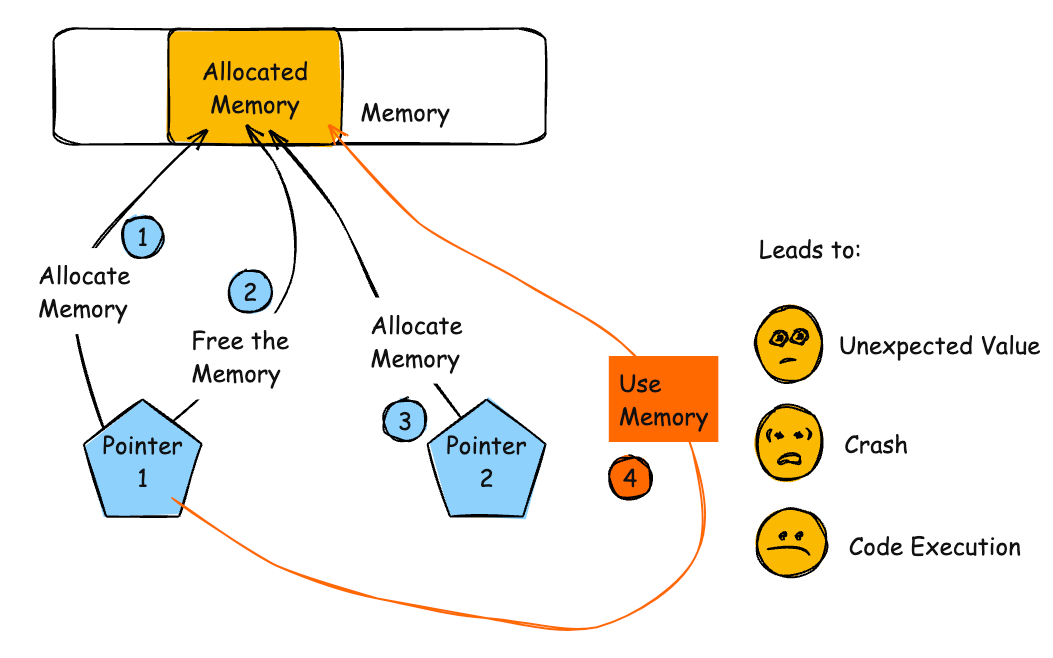
The sequence of a UAF error is straightforward:
- Memory is allocated on the heap, and a pointer (
ptr) stores its address. - The program finishes using the memory and calls
free(ptr). The memory is returned to the heap manager, butptrstill holds the address—it is now a dangling pointer. - Later, the program mistakenly dereferences this dangling pointer to read or write data.
Let's start by reading a clear definition of this vulnerability.
Demystifying Use-After-Free Vulnerabilities: A Deep Dive into ...
The article 'Demystifying Use-After-Free Vulnerabilities' provides an excellent, concise explanation of what a UAF is and the sequence of events that causes it.
Please read the sections 'What is a Use-After-Free Vulnerability?' and 'How Does Use-After-Free Occur?'. Pay close attention to the simple code example, as it perfectly illustrates the core problem.
The danger lies in what happens between steps 2 and 3. The heap manager, now considering that memory block free, might re-allocate it for a completely different purpose. The dangling pointer then points to what seems like valid memory, but it contains entirely unrelated data.
This diagram illustrates the scenario perfectly:
From Bug to Exploit: The Severity of UAF
To truly appreciate the danger, it helps to see how a use-after-free vulnerability can be exploited. In your work on ADAS and gateway systems, you handle complex data structures and communication protocols where such a bug could allow malicious data to overwrite critical system state.
The following video from LiveOverflow, a channel focused on computer security and exploitation, provides a fantastic deep dive into a UAF scenario. It's more complex than a simple example, but given your background, you'll find the step-by-step debugging insightful. It demonstrates how reallocating freed memory with controlled data can lead to unauthorized access.
The Heap: How do use-after-free exploits work? - bin 0x16
This video, 'The Heap: How do use-after-free exploits work?', analyzes a program with a UAF vulnerability. It uses GDB to show exactly how the heap's state changes and how a dangling pointer can be made to point to attacker-controlled data.
Watch from the beginning to 08:29. The video is dense, so focus on these key moments: 00:00 - 03:23: Understand the program's commands (auth, reset, service, login) and how the reset command creates a dangling pointer by calling free() without nullifying the auth pointer. 03:23 - 04:18: See how the service command, which uses strdup() (and thus malloc()), can get the exact same memory address that was just freed. 04:18 - 07:53: Follow the GDB debugging. This is the core of the video. You'll see the heap state before and after free(), and how a subsequent malloc() overwrites the old data structure with new data. 07:53 - 08:29: Witness the exploit: the new data placed by the service command alters a field in the old auth struct, leading to a successful but unauthorized login.
This demonstration should make it clear why UAF is classified as a severe security vulnerability. It breaks the conceptual boundary between different data objects in your program.
Preventing Use-After-Free: A Simple, Powerful Discipline
The primary cause of UAF is the existence of a dangling pointer. The solution, therefore, is to eliminate it.
The best practice is to set a pointer to NULL immediately after the memory it points to is freed.
free(ptr);
ptr = NULL; // Eliminates the dangling pointer
Why is this so effective?
- It destroys the dangling pointer. The
ptrvariable no longer holds the address of the deallocated memory. - It turns a subtle UAF bug into an obvious, immediate crash. On most modern systems, attempting to dereference a
NULLpointer (*ptrwhenptrisNULL) results in a segmentation fault, stopping the program instantly. This is far preferable to silent data corruption, which can be incredibly difficult to debug.
The following video provides a clear walkthrough of this prevention technique.
Dangling Pointers | C Programming Tutorial
The video 'Dangling Pointers' demonstrates the problem and presents the standard solution, including how to build safer utility functions.
Watch the following segments: 01:34 - 03:54: This part defines a dangling pointer and shows a live example of writing to memory after it has been freed. 03:54 - 05:11: Here, the crucial ptr = NULL; solution is introduced, explaining why it makes your program safer. 07:01 - 10:57: This advanced section shows how to create a safe_free_mem function and a macro to automate the process of freeing and nullifying. This is a practical pattern for building robust libraries.
The Double-Free Error
A closely related and equally dangerous error is the double-free. This occurs when free() is called more than once on the same memory address without an intervening allocation.
int *p = (int*)malloc(sizeof(int));
// ...
free(p);
// ... more code ...
free(p); // DOUBLE-FREE! Undefined behavior.
Why is this a problem? The heap manager maintains internal data structures, often a linked list, to keep track of free memory blocks. When you free(p), the block p points to is added to this free list. If you call free(p) again, the heap manager might try to add the same block to the list a second time. This can corrupt the free list's pointers, leading to bizarre crashes or security holes during subsequent malloc() calls.
Prevention: The solution to double-free is the exact same as for use-after-free: set the pointer to NULL after freeing it.
int *p = (int*)malloc(sizeof(int));
// ...
free(p);
p = NULL; // p is now NULL
// ... more code ...
free(p); // This is safe! free(NULL) does nothing.
The C standard guarantees that free(NULL) is a safe, valid operation that does nothing. By nullifying the pointer after the first free, you make any subsequent accidental free calls on that same pointer harmless.
Test your understanding!
Consider the following function, which manages a global resource represented by a dynamically allocated buffer.
#include <stdlib.h>
#include <stdio.h>

char *g_resource_buffer = NULL;

void initialize_resource() {
    if (g_resource_buffer == NULL) {
        g_resource_buffer = (char*)malloc(100);
        printf("Resource initialized.\n");
    }
}

void release_resource() {
    if (g_resource_buffer != NULL) {
        printf("Releasing resource...\n");
        free(g_resource_buffer);
        // A bug is here!
    }
}

void use_resource() {
    if (g_resource_buffer != NULL) {
        // Simulate using the resource
        g_resource_buffer[0] = 'A';
        printf("Resource used.\n");
    } else {
        printf("Cannot use released resource!\n");
    }
}

int main() {
    initialize_resource();
    use_resource();
    release_resource();

    // Some other part of the program accidentally releases it again
    printf("Attempting second release...\n");
    release_resource();

    // Later, an attempt to use the resource
    printf("Attempting to use after release...\n");
    use_resource();

    return 0;
}
- What two memory errors are present in this code?
- Explain how they manifest when the
mainfunction is executed. - How would you modify
release_resource()to fix both bugs?
Show answer
-
The two errors are a potential double-free and a use-after-free.
-
How they manifest:
- The first call to
release_resource()freesg_resource_buffer. However, it does not setg_resource_buffertoNULL. - When
release_resource()is called the second time, the checkif (g_resource_buffer != NULL)passes becauseg_resource_bufferis still a non-NULL dangling pointer. This leads to a double-free. - When
use_resource()is called at the end, the checkif (g_resource_buffer != NULL)also passes, leading to a write to deallocated memory: a use-after-free error.
- The first call to
-
The fix: The
release_resourcefunction must set the pointer toNULLimmediately after freeing it.void release_resource() { if (g_resource_buffer != NULL) { printf("Releasing resource...\n"); free(g_resource_buffer); g_resource_buffer = NULL; // This fixes both issues. } }With this change, the second call to
release_resource()will do nothing becauseg_resource_bufferis nowNULL. The final call touse_resource()will correctly print "Cannot use released resource!" and avoid the UAF error.
The Automotive and Safety-Critical Perspective
Given your work with AUTOSAR, ISO 26262, and MISRA C, you might be thinking that these dynamic memory issues seem too risky for safety-critical code. You are absolutely correct.
The surest way to prevent dynamic memory errors is to not use dynamic memory at all. This is the approach taken by high-integrity coding standards.
MISRA C Coding Standards & Guidelines
The MISRA C guidelines, which you are familiar with, take a strong stance on this topic. Let's look at the specific rule.
Find 'Rule 20.4' in the table for MISRA C:2004. Its text is simple and unambiguous: 'Dynamic heap memory allocation shall not be used'. This principle is carried forward in newer versions of the standard.
By forbidding malloc, calloc, realloc, and free, MISRA C eliminates the possibility of memory leaks, use-after-free, double-free, and heap fragmentation. In systems where predictability and provable correctness are paramount (like an airbag controller or braking system), all memory is allocated statically at compile time. While this may seem restrictive, it's a necessary trade-off for achieving the highest levels of functional safety.
Conclusion
Today, you've confronted some of the most dangerous bugs in C programming. These errors are subtle, have non-deterministic effects, and are a source of major security vulnerabilities. Mastering their prevention is a mark of a proficient C developer.
Key Takeaways:
- A dangling pointer points to memory that has been deallocated.
- Use-after-free is dereferencing a dangling pointer. This can cause crashes or, worse, silent data corruption and security exploits.
- Double-free is calling
free()twice on the same pointer. This corrupts the heap manager's internal state. - The single most effective prevention strategy for both errors is to set a pointer to
NULLimmediately after freeing it:free(ptr); ptr = NULL;. - In the highest-integrity systems, dynamic memory is often banned entirely to eliminate this class of errors, a rule codified in standards like MISRA C.
Preview of the Next Lesson:
We have now covered the complete lifecycle of dynamic memory: allocation, resizing, and the pitfalls of deallocation. In the next lesson, we will put this knowledge to practical use. You will implement a dynamic array data structure using malloc() and realloc(). This will require you to manage memory correctly across growth, shrinkage, and final destruction of the data structure, reinforcing all the concepts we've covered.