Hello! Welcome to your next lesson in our module on "Debugging, Best Practices, and Interview Patterns."
In our last lesson, we identified the three most common pointer pitfalls: uninitialized pointers, null pointer dereferences, and dangling pointers. We established the fundamental tactical fix for dangling pointers: setting the pointer to NULL immediately after calling free().
Today, we'll elevate this rule into a core part of a robust, professional coding strategy. Our goal is to apply defensive programming techniques, such as nulling pointers after deallocation, in a systematic and disciplined way. We'll explore why this practice is considered "defensive," discuss its benefits and limitations, and learn how to enforce it using wrappers and macros.
In your work on AUTOSAR platforms, you build systems with multiple interacting components. A defensive programming mindset is crucial for creating a barrier that protects the core logic from unexpected or invalid data from external interfaces.
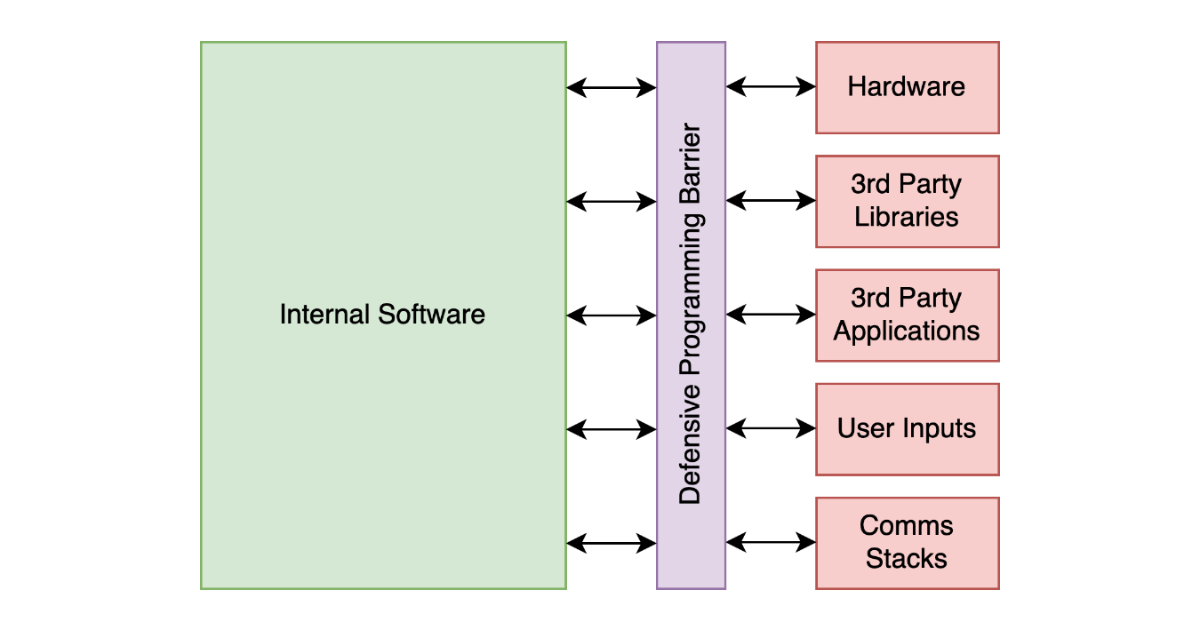
1. The "Why" of Nulling After Free: A Defensive Programming Perspective
In the previous lesson, we treated ptr = NULL; as a simple fix. From a defensive programming standpoint, it's more than that—it's an act of explicit state management. A non-NULL pointer implies it points to a valid resource, while a NULL pointer explicitly states it does not. By nulling a pointer after freeing it, you restore this invariant and prevent the pointer from holding an invalid state (a stale address).
This practice offers two primary defensive benefits:
- Fail-Fast by Preventing Use-After-Free: Dereferencing a dangling pointer can silently corrupt memory, leading to bugs that are difficult to trace. Nulling the pointer transforms this subtle, latent bug into a loud, immediate, and easily debuggable null pointer dereference. This "fail-fast" approach is a cornerstone of building robust systems.
- Mitigating Double-Free Errors: Calling
free()on a pointer that has already been freed results in undefined behavior, often a crash. However, the C standard guarantees thatfree(NULL)is a safe no-operation. If you null a pointer after the firstfree(), any accidental subsequent calls tofree()on that same pointer become harmless.
Should one really set pointers to `NULL` after freeing them?
This Stack Overflow discussion, 'Should one really set pointers to NULL after freeing them?', provides excellent real-world context on why this is considered a vital defensive technique, especially in large and complex codebases.
Please read the following sections: Start with the main question body, which summarizes the two key arguments: avoiding double-free crashes and preventing reuse of freed pointers. Read the top-voted answer. Pay attention to the anecdote about how this practice helped stabilize a buggy program. This highlights its practical value. Read the next answer, which frames the practice in the context of large, long-lived projects and defensive programming principles. This should align with your experience in automotive software development.
2. Implementing the Technique Systematically with Wrappers
Relying on developers to manually type ptr = NULL; after every free() is unreliable and error-prone. A more systematic approach is to encapsulate this logic in a reusable wrapper.
Let's explore how to create a safe_free utility.
Dangling Pointers | C Programming Tutorial
The video 'Dangling Pointers' by Portfolio Courses, which we touched on last time, demonstrates exactly how to build such a utility.
Please watch the following segments: Recap of the Solution (from 03:54 to 04:58): This is a quick review of the core idea of setting the pointer to NULL after free(). Creating a safe_free Utility (from 07:01 to 10:44): This is the key part. It explains how to build both a safe free function using a pointer-to-a-pointer (void **) and a more convenient function-like macro that provides a cleaner syntax.
As the video explained, there are two main ways to implement this:
A. Safe Free Function
A function that handles both freeing and nulling needs to modify the original pointer in the calling scope. This is achieved by passing a pointer to the pointer (void **).
#include <assert.h>
#include <stdlib.h>

void safe_free_mem(void **pp) {
    // Assert that we didn't get a NULL pointer-to-pointer
    if (pp == NULL || *pp == NULL) {
        return; // Or handle error appropriately
    }

    free(*pp);  // Free the memory pointed to by the original pointer
    *pp = NULL; // Nullify the original pointer in the caller's scope
}

// Usage:
int *my_ptr = malloc(sizeof(int));
// ... use my_ptr ...
safe_free_mem((void**)&my_ptr); // Pass the address of the pointer
B. Safe Free Macro
While the function is robust, the syntax safe_free_mem((void**)&my_ptr) is cumbersome. A function-like macro is often used to provide a cleaner interface that looks more like the standard free().
#define SAFE_FREE(p) \
    do { \
        if (p) { \
            free(p); \
            (p) = NULL; \
        } \
    } while(0)

// Usage:
int *my_ptr = malloc(sizeof(int));
// ... use my_ptr ...
SAFE_FREE(my_ptr); // Much cleaner!
// assert(my_ptr == NULL); // This would be true
The do-while(0) wrapper is a standard C idiom to ensure the macro behaves like a single statement, avoiding potential issues with if-else constructs.
3. A Critical Perspective: Limitations and Alternatives
Nulling pointers is a valuable defensive technique, but it is not a silver bullet. For a senior developer, it's crucial to understand its limitations and know when to employ more powerful tools.
The main limitations are:
- It masks some bugs: As noted in the Stack Overflow discussion, making a double-free a no-op might prevent you from discovering a logical error in your resource management.
- It doesn't solve aliasing: If you have two pointers (
p1andp2) pointing to the same memory, callingSAFE_FREE(p1)will nullp1, butp2remains a dangling pointer.
For finding memory errors during development, modern tools and older, time-tested tricks are often more effective.
Should you set free()-ed pointers to NULL?
The article 'Should you set free()-ed pointers to NULL?' from nrk.neocities.org offers a critical take on this practice and introduces superior alternatives for debugging.
This article provides a valuable counterpoint. Please read the following sections: Introduction: Understand the core argument—that nulling a single pointer does little to prevent use-after-free when multiple pointers are involved. Address-Sanitizer: This is the most important section. It introduces ASan, a powerful runtime tool built into GCC/Clang that reliably detects memory errors like use-after-free, even in cases where SAFE_FREE would fail. Old-school tricks: This section discusses a technique highly relevant to embedded systems: filling freed memory with a garbage value (e.g., 0xCD). This makes accidental reads from freed memory immediately obvious in a debugger. Conclusion: Read the final summary of recommendations.
To summarize the key alternatives for debugging builds:
- AddressSanitizer (ASan): This is the gold standard for dynamic analysis of memory errors. By compiling with
-fsanitize=address, you enable runtime checks that will immediately halt your program and provide a detailed report upon detecting a use-after-free, buffer overflow, or double-free. It's far more reliable than manual checks. - Memory Stomping (Trashing): Before sanitizers were common, a standard technique was to
memsetfreed memory with a known garbage pattern (like0xCDCDCDCDor0xDEADBEEF). If you later see this value in your variables during a debug session, it's a strong indicator you're reading from freed memory.
The SAFE_FREE macro is a lightweight technique for production code that makes the system more robust by promoting a fail-fast behavior. ASan and memory stomping are heavier-weight tools for development and testing to find and fix the bugs in the first place. A professional developer should be familiar with both.
Test your understanding!
Review the following code snippet. It allocates memory for a communications buffer, but the deallocation logic is incomplete.
#include <stdlib.h>
#include <stdio.h>

#define SAFE_FREE(p) do { if(p) { free(p); (p) = NULL; } } while(0)

void release_buffer(char *buf) {
    printf("Releasing buffer at %p\n", (void*)buf);
    free(buf); // Incomplete deallocation logic
}

int main() {
    char *comm_buffer = (char*)malloc(1024);
    char *buffer_alias = comm_buffer; // Another pointer to the same memory

    // ... code uses comm_buffer and buffer_alias ...

    release_buffer(comm_buffer);

    // Later in the code...
    if (comm_buffer) {
        comm_buffer[0] = 'A'; // Potential use-after-free
    }

    // Even later...
    if (buffer_alias) {
        buffer_alias[0] = 'B'; // Definite use-after-free
    }

    return 0;
}
- Refactor the
release_bufferfunction to use theSAFE_FREEmacro. How does this change the program's behavior whencomm_bufferis accessed after the release? - After your change, what is the status of the
buffer_aliaspointer? What does this demonstrate about the limitations of theSAFE_FREEtechnique?
Show answer
-
Refactoring
release_buffer:
You should changerelease_bufferto accept a pointer-to-a-pointer so it can nullify the caller's variable. However, since theSAFE_FREEmacro is already defined, it's much simpler to use it directly inmain. Let's refactor the call inmaininstead:// In main() // release_buffer(comm_buffer); <-- old call printf("Releasing buffer at %p\n", (void*)comm_buffer); SAFE_FREE(comm_buffer); // <-- new callAfter this change,
comm_bufferis set toNULL. The checkif (comm_buffer)will now evaluate to false, and the linecomm_buffer[0] = 'A';will not be executed. This prevents the use-after-free throughcomm_bufferand demonstrates the primary benefit of the technique. -
Status of
buffer_alias:
TheSAFE_FREE(comm_buffer)macro only affects thecomm_buffervariable. Thebuffer_aliaspointer is completely untouched and still holds the address of the freed memory. It remains a dangling pointer.The subsequent check
if (buffer_alias)will be true, and the linebuffer_alias[0] = 'B';will execute, causing a use-after-free and writing to deallocated memory. This clearly demonstrates the main limitation of nulling pointers: it does not solve the pointer aliasing problem. It only cleans up one pointer variable, leaving any other aliases as dangerous dangling pointers.
Conclusion
Today we've moved from a simple rule to a professional programming discipline. By consistently nulling pointers after deallocation, you are practicing defensive programming—making your code more predictable and robust by explicitly managing pointer state.
Key Takeaways:
- Nulling a pointer after
freeis a defensive technique that transforms subtle data corruption bugs into immediate, detectable null pointer dereferences (a "fail-fast" strategy). - To apply this reliably, use systematic wrappers like a
SAFE_FREEmacro, which eliminates the risk of forgetting to null the pointer manually. - This technique is a lightweight safety measure for production code but has limitations, especially with multiple pointers (aliases) to the same memory.
- For comprehensive bug-finding during development, more powerful tools like AddressSanitizer (ASan) are the modern standard and should be a part of your development workflow.
Preview of the Next Lesson
We've now discussed how to manually prevent pointer errors and how to use wrappers to enforce good habits. In the next lesson, we will focus on using static analysis tools (like Coverity, Helix QAC) and sanitizers (like AddressSanitizer) to detect pointer errors. We'll see how these tools automate the detection of the very issues we've been discussing, and how understanding the underlying errors helps you interpret their reports and write cleaner code from the start.