Hello! Welcome to the first lesson in our module on algorithmic design strategies.
In our previous module, we analyzed several sorting algorithms. You might have noticed a recurring pattern in algorithms like Merge Sort and Quicksort: they both work by breaking the problem down into smaller pieces, solving those pieces, and then putting the results back together. This powerful pattern is a formal algorithmic strategy called Divide and Conquer.
Today, we will dissect this strategy. Our goal is to identify problems amenable to divide and conquer and outline their recursive structure. By the end of this lesson, you'll understand the core components of this approach and be able to recognize when it can be applied to solve a problem efficiently.
What is Divide and Conquer?
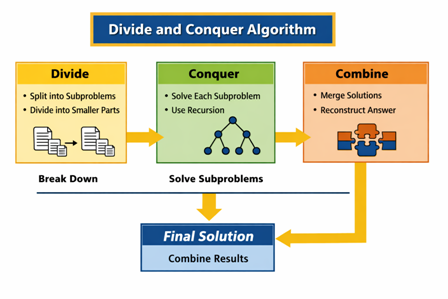
At its heart, Divide and Conquer is a recursive problem-solving paradigm. It involves breaking a large, complex problem into smaller, more manageable subproblems, solving them independently, and then combining their solutions to solve the original problem.
This high-level process is nicely captured in the following diagram.
To get a more formal introduction, let's watch the beginning of a helpful video from Abdul Bari that lays out the foundational ideas.
This video, titled 'Divide And Conquer', clearly introduces the strategy and its main steps.
Please watch from the beginning up to 02:52. Focus on the definition of the three main steps: Divide, Conquer, and Combine.
The Defining Characteristic of a Divide and Conquer Problem
As you just saw, the process involves three stages. However, there's a crucial condition that must be met for a problem to be solvable with this strategy. This condition is the key to identifying its applicability.
Let's continue with the same video to understand this critical point.
The next segment of the video highlights the single most important characteristic of problems suited for Divide and Conquer.
Watch from 02:52 to 04:34. Pay close attention to the distinction made between a valid Divide and Conquer approach (like sorting) and an invalid one (like organizing a workshop).
The video makes an excellent point: the subproblems must be smaller instances of the exact same problem. If you are sorting an array, your subproblems must also be about sorting smaller arrays. This self-similarity is what allows for a clean, recursive solution.
Based on this, we can formalize the complete Divide and Conquer process into four steps.
This article from EnjoyAlgorithms, 'Divide and Conquer Algorithm', provides a concise summary of the steps, including the all-important base case.
Read the introductory section, up to but not including 'Critical ideas to implement'. This will solidify the four steps: Divide, Conquer, Combine, and Base Case.
To summarize, the four steps are:
- Divide: Break the main problem into smaller, independent subproblems of the same type.
- Conquer: Solve the subproblems recursively.
- Base Case: Define the smallest possible subproblem that can be solved directly, which terminates the recursion.
- Combine: Merge the solutions of the subproblems to form the solution for the original problem.
A Simple Example: Finding the Maximum Element
Let's apply this framework to a simple problem: finding the maximum value in an array. While a simple loop would work, this problem provides a very clear illustration of the Divide and Conquer structure.
Divide and Conquer: The Art of Breaking Down Problems | Recursion Series
The video 'Divide and Conquer: The Art of Breaking Down Problems' by WilliamFiset uses the 'find maximum' problem to visually demonstrate the D&C process.
Watch the segment from 01:24 to 03:46. Observe how the array is recursively split and how the maximum values are passed back up the call stack.
Let's map this example to our four steps:
- Divide: Split the array
Ainto two halves,A_leftandA_right. - Conquer: Recursively call
find_max(A_left)andfind_max(A_right). - Base Case: If the array has only one element, that element is the maximum.
- Combine: The maximum of the original array is
max(find_max(A_left), find_max(A_right)). The "combine" step here is a simple comparison.
This structure defines the problem in terms of itself, a hallmark of recursion. A function implementing this would look something like find_max(array, start_index, end_index).
Recognizing the Pattern in Familiar Algorithms
Now that we have a clear framework, let's revisit some algorithms you're already familiar with. Recognizing the Divide and Conquer pattern in them is a key step toward mastering this strategy.
The image below uses Merge Sort, which we've studied, to illustrate the D&C workflow.

Merge Sort, Quicksort, and even Binary Search are classic examples of this paradigm. The following reading explores how each one fits the model.
Let's return to the EnjoyAlgorithms article. The next sections detail how several well-known algorithms implement the Divide and Conquer strategy.
Read the sections 'Divide and conquer using one subproblem' and 'Divide and conquer using two sub-problems'. For each algorithm mentioned (Binary Search, Merge Sort, Quicksort), focus on identifying the specific implementation of the Divide, Conquer, and Combine steps.
Here is a summary of how these algorithms map to the D&C structure. Notice the crucial differences in the "Combine" step.
| Algorithm | Divide | Conquer | Combine |
|---|---|---|---|
| Merge Sort | Split the array into two equal halves. | Recursively sort both halves. | Merge the two sorted halves into a single sorted array. This is the main work (O(n)). |
| Quicksort | Partition the array around a pivot, creating two (possibly unequal) subarrays. This is the main work (O(n)). |
Recursively sort both subarrays. | Trivial/None. The array is already sorted once the recursive calls return. |
| Binary Search | Compare the key with the middle element. | Recursively search in either the left or the right half (only one subproblem). | Trivial/None. The result from the recursive call is the final result. |
This comparison shows that identifying a problem as "Divide and Conquer" is just the start. The real algorithmic design work lies in defining the Divide and Combine steps. In Quicksort, the work is in the Divide step (partitioning), while in Merge Sort, the work is in the Combine step (merging).
The Recursive Structure and Analysis
The recursive nature of Divide and Conquer algorithms lends itself directly to analysis using recurrence relations, a topic we touched on in Module 1.
The running time for a problem of size can generally be expressed as:
Where:
- is the number of subproblems we create in the "Divide" step.
- is the size of each subproblem.
- is the cost of the "Divide" and "Combine" steps.
For example:
- Merge Sort: . (Two subproblems of half the size, with a linear time merge step).
- Binary Search: . (One subproblem of half the size, with a constant time comparison).
Understanding this structure is fundamental. The following resource provides a formal introduction to this concept.
[PDF] Divide-and-conquer algorithms
This excerpt from the classic textbook 'Algorithms' by Dasgupta, Papadimitriou, and Vazirani formally introduces recurrence relations as the tool for analyzing D&C algorithms.
Please read the beginning of Section 2.2, 'Recurrence relations', up to (but not including) the 'Master theorem' box. This short section provides the general form of a D&C recurrence.
Being able to formulate a problem's runtime as a recurrence relation is the first step toward analyzing its efficiency, often using methods like the Master Theorem which you studied previously.
Conclusion
In this lesson, we formalized the Divide and Conquer strategy, a powerful tool in your algorithmic toolbox. We moved from an intuitive understanding to a structured framework that you can use to design and analyze new algorithms.
Key Takeaways:
- Divide and Conquer consists of four key steps: Divide, Conquer, Base Case, and Combine.
- A problem is amenable to this strategy if it can be broken down into smaller, independent instances of the same problem.
- The real design effort lies in defining the
DivideandCombinesteps. The complexity of these steps dictates the overall efficiency of the algorithm. - The recursive structure of a D&C algorithm is naturally described by a recurrence relation, which is the starting point for complexity analysis.
Preview of the Next Lesson:
You now have a solid framework for identifying and structuring Divide and Conquer solutions. In our next lesson, we will apply this framework to a new problem that isn't as straightforward as sorting: finding the closest pair of points in a 2D plane. This will challenge us to think creatively, especially about how to design an efficient "Combine" step.