Welcome to your first lesson in the Generative AI for Product Managers course. Given your goal of developing an AI-powered fraud detection system for your device insurance company, our journey begins by establishing a clear understanding of the technological landscape. As a product manager, appreciating the fundamental differences between old and new methodologies is the first step to defining a robust product vision and strategy.
This lesson addresses the foundational learning outcome: contrasting traditional machine learning fraud detection with modern Generative AI approaches. We will explore how traditional systems operate, their limitations, and how Generative AI fundamentally changes the game by leveraging unstructured data—the very kind of data, like customer claim descriptions and adjuster notes, that is central to your use case. This foundation will be essential as we move forward to discuss the GenAI product lifecycle, model selection, and system architecture in later lessons.
The Established Approach: Traditional Machine Learning
For decades, the fight against insurance fraud has been an arms race. The first line of defense often consisted of manual reviews and static, rule-based systems. While your experience with SQL and data visualization tools like Power BI and Tableau gives you a strong intuition for working with structured data, it's important to see how this paradigm was applied in traditional fraud detection.
To begin, let's review the common methods that have been the backbone of fraud prevention. Please read the following excerpt from the Infosys whitepaper, "Harnessing the Power of Artificial Intelligence in Fraud Detection."
[PDF] Harnessing the Power of Artificial Intelligence in Fraud Detection
This document provides a great overview of the landscape. We'll start with the traditional methods.
In the PDF, please navigate to the section titled "Current Approaches in Fraud Detection" on page 4. Read the descriptions of the five traditional techniques, from "Manual investigations" to "Rules-based systems." As you read, consider how these methods rely on predefined rules and patterns in historical, structured data.
These traditional methods evolved with the rise of machine learning (ML). Instead of relying on manually coded rules (e.g., "flag any claim over $10,000 filed within 30 days of policy inception"), ML models could learn these patterns from historical data.
This approach, which we can call predictive ML, is primarily concerned with classification. It ingests structured data—data that fits neatly into the rows and columns of a database—and outputs a prediction.
The following video from IBM Technology provides a concise explanation of how these predictive models work in a fraud detection context.
Fraud Detection with AI: Ensemble of AI Models Improve Precision & Speed
This video breaks down the role of traditional ML models in fraud detection.
Watch the segment from the beginning. Pay close attention to the types of algorithms mentioned (logistic regression, decision trees, gradient boosting machines) and the kinds of data they use, such as transaction amount, time, and location.
As you saw, traditional ML for fraud detection operates on a clear principle:
- It uses structured data: Numerical and categorical features like claim amount, claimant's tenure, device model, and past claim frequency.
- It identifies known patterns: The models are trained on large datasets of past claims labeled as "fraudulent" or "legitimate" to recognize indicators that have been seen before.
- It outputs a score: The final product is typically a risk score or a probability (e.g., "This claim has a 73% probability of being fraudulent").
However, this approach has significant limitations, especially as fraudulent activities become more sophisticated.
[PDF] Harnessing the Power of Artificial Intelligence in Fraud Detection
Now, let's look at the shortcomings of these traditional systems.
On page 5 of the same PDF, read the section titled "Gaps in Existing Approaches." These points highlight why a new approach is necessary.
The core issue is that traditional models struggle with two things: novelty and nuance. They are inflexible when faced with new fraud schemes and are generally blind to the rich, contextual information locked away in unstructured data.
The Paradigm Shift: Generative AI
This is where Generative AI (GenAI) introduces a fundamental change. While often associated with creating text or images, its true power in an enterprise context like insurance comes from its deep understanding of human language and unstructured data.
For your device insurance use case, think about the data associated with a single claim:
- The initial claim form (structured fields).
- The customer's written description of how the device was damaged (unstructured text).
- Emails exchanged between the customer and the claims adjuster (unstructured text).
- Photos or videos of the damaged device (unstructured image/video data).
- The adjuster's summary notes (unstructured text).
A traditional model might only use the structured data. A GenAI system can analyze it all.
The following article provides an excellent contrast between the old and new worlds.
Generative AI in Insurance: Complete Guide for 2026 - V7 Labs
This guide from V7 Labs explains the shift in capabilities with a clear insurance focus.
Start by reading the section "Generative AI for Insurance." This part directly contrasts a predictive fraud score with the rich output of a generative model. Then, scroll down to the FAQ at the bottom and read the answer to the question "What is the difference between generative AI and traditional automation in insurance?". This reinforces the key distinction.
The difference isn't just incremental; it's architectural. Traditional AI is often built on proprietary, in-house datasets. Generative AI leverages massive, pre-trained Large Language Models (LLMs) and then adapts them to a specific business context.
This video from IBM Technology illustrates this architectural change.
The Evolution of AI: Traditional AI vs. Generative AI
This video visualizes the architectural differences between traditional and generative AI systems.
First, watch the explanation of the traditional AI architecture, which centers on an internal repository and feedback loop. Next, watch the segment on the Generative AI architecture. Notice how it starts with massive external data and LLMs, which are then refined through "prompting and tuning."
From Scoring to Reasoning
The most significant shift for your product is moving from simple fraud scoring to providing explainable fraud reasoning. A score tells an adjuster what to investigate, but reasoning tells them why.
GenAI models, specifically a class of non-generative LLMs called "encoder LLMs," are exceptionally good at this. They are designed for natural language understanding tasks like classification and sentiment analysis rather than content generation.
Fraud Detection with AI: Ensemble of AI Models Improve Precision & Speed
Let's return to the first IBM video to understand how a specific type of LLM handles this task.
Watch the segment from this timestamp. It explains how "encoder LLMs" can analyze unstructured text for contextual clues, like urgency or suspicious phrasing, that traditional models would miss.
By analyzing the claimant's narrative, cross-referencing it with the adjuster's notes, and even analyzing related claims, a GenAI system can identify subtle inconsistencies. It can then present these findings to the human adjuster in a structured summary.
This capability is detailed perfectly in the V7 Labs article.
Generative AI in Insurance: Complete Guide for 2026 - V7 Labs
This final reading provides a concrete example of how GenAI surfaces fraud patterns.
Find the subsection titled "Fraud Pattern Detection" under "AI Use Cases for Claims Processors." The key phrase here is that instead of a simple score, it generates structured reasoning. This is the core value proposition for your product.
Comparing the Two Approaches
To bring everything together, let's look at a high-level architecture diagram for an agentic fraud detection system. This represents the kind of system you aim to build.
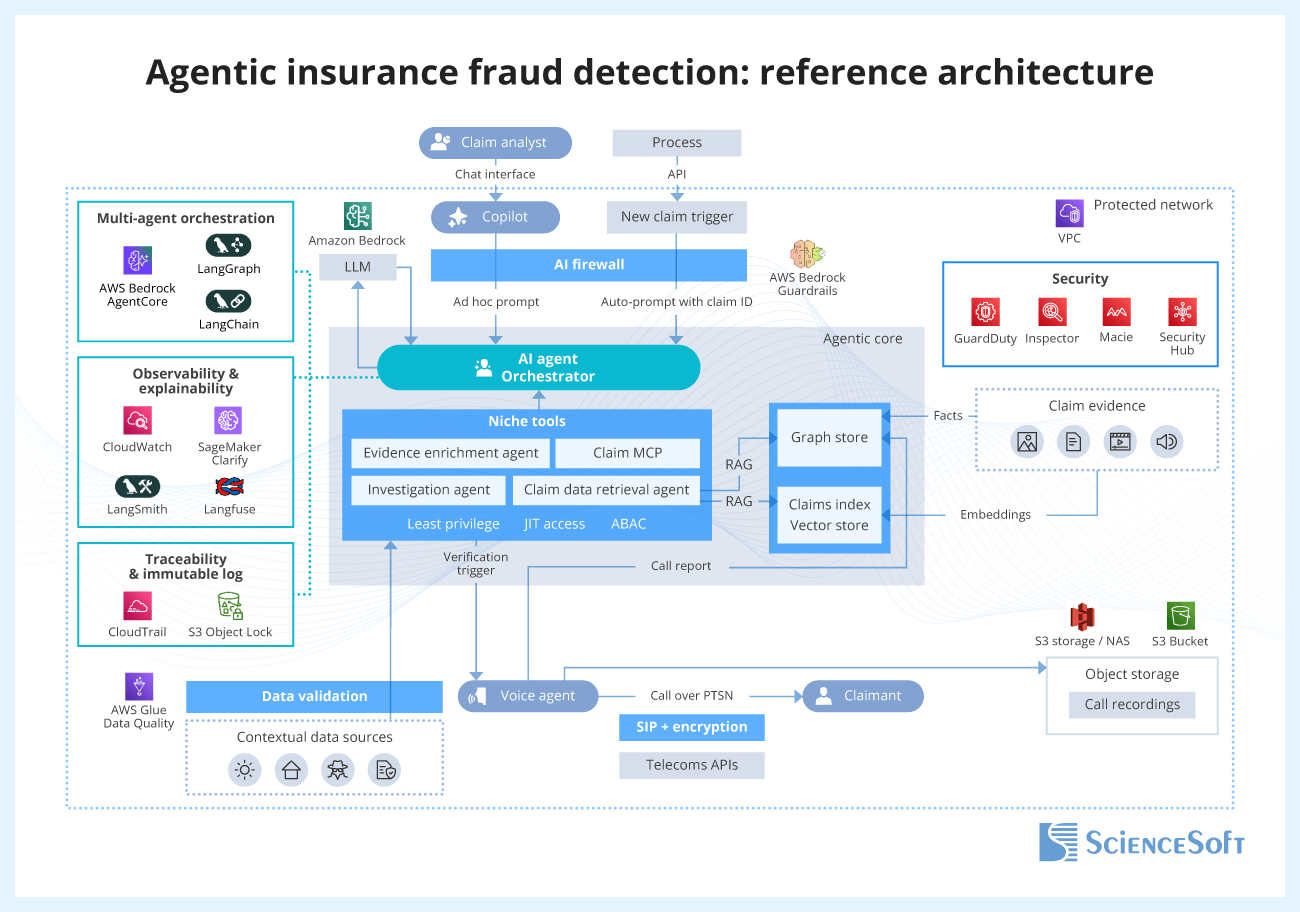
This diagram encapsulates the GenAI approach. It's not one model; it's a system of orchestrated agents and tools built around a powerful LLM. We will deconstruct this architecture piece by piece throughout the course.
For now, here is a summary comparison:
| Feature | Traditional Machine Learning | Generative AI |
|---|---|---|
| Primary Data Type | Structured Data (e.g., tables, numerical values from claim forms) | Unstructured Data (e.g., claim notes, emails, images, adjuster reports) |
| Core Task | Pattern Recognition & Classification (Is this pattern similar to past fraud?) | Contextual Understanding & Reasoning (Do these pieces of evidence contradict each other?) |
| Output | A risk score or a binary classification (Fraud/Not Fraud) | A natural language summary with structured reasoning and supporting evidence. |
| Detection Power | Best at identifying known and repeating fraud patterns. | Capable of detecting novel and subtle fraud schemes by identifying logical inconsistencies. |
| Human Interaction | Tells the expert what to investigate. | Tells the expert why something is suspicious, accelerating their investigation. |
| Example Models | Logistic Regression, Decision Trees, Gradient Boosting Machines | LLMs (e.g., GPT series, Claude, Llama) and Encoder Models (e.g., BERT, RoBERTa) |
It's also worth noting that these two approaches are not mutually exclusive. Many modern systems use an "ensemble" approach, where fast, efficient traditional ML models handle the clear-cut cases, and the more computationally intensive GenAI models are reserved for ambiguous claims that require deeper contextual analysis. This is a practical design pattern you will likely consider.
Conclusion
In this lesson, we established the critical distinction between traditional and Generative AI-based fraud detection. You now have a solid conceptual framework for discussing your product's unique value proposition.
Here are the key takeaways:
- Traditional ML relies on structured data to find known patterns and assign a predictive risk score. It is effective but rigid and blind to unstructured context.
- Generative AI fundamentally changes the process by understanding and reasoning over unstructured data like text and images, which constitute the bulk of evidence in an insurance claim.
- The key value shift is from prediction to explanation. GenAI systems don't just flag claims; they provide structured reasoning that empowers human adjusters to make faster, more accurate decisions.
As a product manager, your role will be to harness this new capability to build a tool that augments, rather than just automates, the work of your claims team.
In our next lesson, we will delve into the unique lifecycle of a GenAI product. We will explore the stages of building a system like the one in the architecture diagram, covering topics like prompt engineering, model evaluation, and continuous monitoring, providing you with a roadmap for your initiative.