Welcome to the final lesson of our first module. In our last session, we constructed a detailed KPI scorecard to measure the success of your fraud detection AI initiative. We established that success is multi-dimensional, spanning business impact, model quality, user adoption, and more. Now, it's time to craft the story that gives those numbers meaning.
As a product manager, one of your most vital roles is to build and articulate a compelling business case for your product. This lesson focuses on precisely that: articulating the value proposition of using Generative AI for fraud detection specifically within your device insurance domain. We will move from the "what" (the KPIs) to the "why" — why should your organization invest in this technology? We'll explore the limitations of older methods and demonstrate how GenAI offers a transformative solution, creating a clear and defensible argument for your initiative.
The Status Quo: Why Traditional Methods Fall Short
Before championing a new solution, it's crucial to understand the limitations of the current approach. For decades, fraud detection in insurance has been dominated by rule-based systems and traditional machine learning models. These systems are good at one thing: finding patterns in structured, tabular data.
Think about a typical insurance database. It has neat columns for policy number, claim amount, date, and customer location. A traditional system can be programmed with rules like:
IF claim_amount > $1500 AND new_policy_age < 30 days THEN flag for review.IF multiple claims filed from same_IP_address in 24 hours THEN flag for review.
These systems are fast and transparent, but they have a fundamental weakness: they are rigid and lack context. Fraudsters are adaptive; they learn the rules and design scams to fly just under the radar. More importantly, these systems ignore the richest source of information in a claim: the unstructured data.
In your device insurance context, unstructured data is everywhere:
- The free-text field where a customer describes how their phone was damaged.
- The chat logs from a customer service interaction.
- The notes an adjuster types after a phone call with the claimant.
- The photos submitted as evidence of damage.
Traditional systems cannot "read" or "understand" this information. A customer's story might sound suspicious, inconsistent, or use language common in known fraud schemes, but a rule-based system will miss these cues entirely. This leads to two costly problems:
- False Negatives: Sophisticated fraud goes undetected, leading to direct financial losses.
- False Positives: Legitimate but unusual claims are flagged, frustrating honest customers and wasting your adjusters' time.
The following video from IBM Technology provides a great overview of how traditional predictive models work and hints at their limitations.
Fraud Detection with AI: Ensemble of AI Models Improve Precision & Speed
This video explains the foundation of traditional machine learning in fraud detection.
Watch the section that introduces predictive ML models. Pay attention to how it emphasizes their reliance on structured data and their struggle with novel tactics and unstructured information. This sets the stage for understanding what GenAI does differently.
The GenAI Paradigm Shift: From Rules to Reasoning
Generative AI, particularly systems built on Large Language Models (LLMs), represents a fundamental shift from static rules to contextual reasoning. Instead of just checking numbers in columns, GenAI can analyze the unstructured text and data surrounding a claim to understand nuance, intent, and consistency.
This is the core of your value proposition. You are not just proposing a slightly better mousetrap; you are proposing a system that can understand the language of fraud.
The following article from LatentView Analytics tells a powerful story about this transition. It beautifully frames the problem and introduces the key ways GenAI changes the game.
Generative AI for Fraud Detection: Real-World Use Cases in Financial Security
This article provides an excellent narrative on why GenAI is a necessary evolution in fraud detection. It's written in a style that's perfect for communicating with business stakeholders.
Please read the following sections: The introduction, from the opening story to the end of the first section. It powerfully illustrates the failure of rule-based systems. The next two sections, What Is GenAI in Fraud Detection? and How Does GenAI Impact Fraud Detection?. Focus on the five key impacts listed—this is the heart of the "what's new" argument.
As the article highlights, GenAI's impact is transformative. For your device insurance use case, this means:
- Reasoning over rules: An LLM can read a claim description and spot inconsistencies a human would, like a story that doesn't physically make sense or uses overly dramatic, coached language.
- Dramatically reducing false positives: By understanding the full context, the AI can better differentiate a strange-but-true claim from a fraudulent one, leading to happier customers and more efficient operations.
- Adapting in real-time: As new fraud schemes emerge in device insurance (e.g., new ways to fake damage or stage thefts), the GenAI model can be updated with this new knowledge far more easily than rewriting a complex web of hardcoded rules.
The IBM video you watched earlier also explains this transition from the technical side, introducing the type of AI that excels at this "understanding" task.
Fraud Detection with AI: Ensemble of AI Models Improve Precision & Speed
Now let's look at the AI model that powers this new capability and how it works alongside traditional systems.
Watch the next few segments of the video: First, the introduction to encoder LLMs, which are specialized for understanding and classifying text. Next, the comparison between traditional ML and encoder LLMs. This clarifies their complementary strengths. Finally, see how they can be combined in a workflow. This tiered approach is a very practical architecture you might consider.
This multi-model approach is a powerful concept for your product strategy. It allows you to use cheap, fast traditional models for the easy 80% of claims and reserve the more powerful (and expensive) GenAI analysis for the ambiguous, high-risk cases where its contextual understanding provides the most value.
Building Your Value Proposition for Device Insurance
Now, let's synthesize these concepts into a clear, compelling value proposition for your stakeholders. Your business case can be built on four key pillars. The infographics below provide a high-level visual summary of these value drivers.

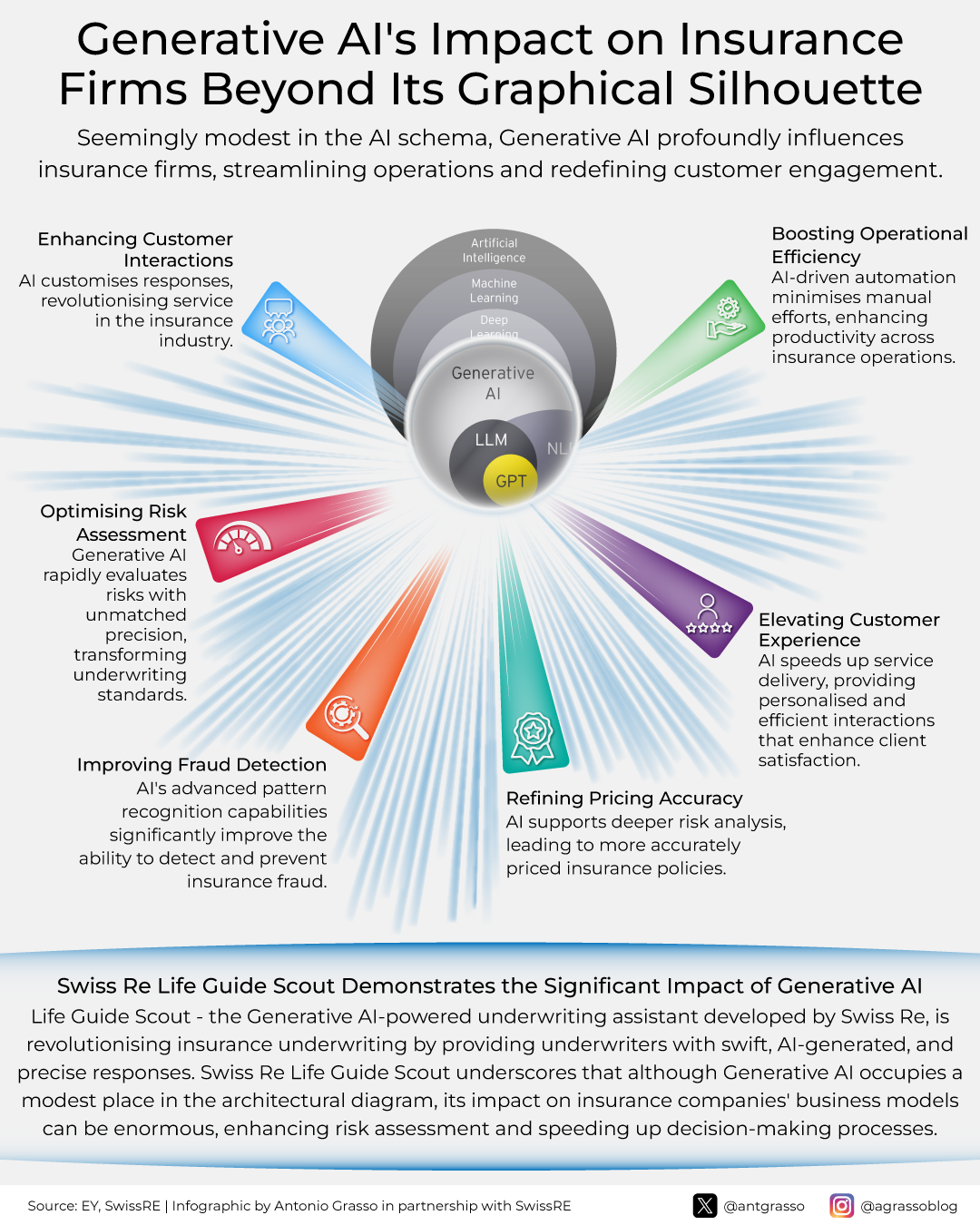
1. Increased Detection Accuracy and ROI
This is the most direct financial benefit. By analyzing unstructured data, GenAI can identify fraudulent claims that traditional systems miss. This directly impacts the bottom line by reducing fraud losses.
- Value Statement: "By leveraging Generative AI to analyze claim descriptions and customer communications, we can identify sophisticated fraud patterns that are invisible to our current rule-based system. This will allow us to reduce fraudulent claims payouts by an estimated 3-4%, generating millions in direct ROI."
2. Enhanced Operational Efficiency
A GenAI system doesn't have to operate in a fully autonomous "approve/deny" mode. One of its most powerful applications is as a co-pilot for your human claims adjusters. The AI can pre-process a claim, flag suspicious elements, summarize long documents, and present a concise risk assessment to the human expert.
- Value Statement: "Our GenAI tool will act as a co-pilot for our claims team, automating the initial review and summarizing key risk factors. This will supercharge analyst productivity, reducing claim handling time by over 20% and allowing our experts to focus their efforts on the most complex and highest-risk cases."
The insurtech company Lemonade provides a powerful real-world example of this principle in action.
Generative AI in Insurance: Lemonade Case Study | Devoteam
This case study on Lemonade demonstrates the tangible impact of AI on claims processing efficiency.
Read about Lemonade's approach and then focus on the sections detailing the role of its AI claims bot, "AI Jim," and the subsequent Impact on Profits and Operations.
3. Improved Customer and Adjuster Experience
A smarter system benefits everyone. Legitimate customers with unusual claims are no longer incorrectly flagged, leading to faster payouts and higher satisfaction. At the same time, claims adjusters are freed from tedious manual reviews of low-risk claims and are empowered with better tools to make confident decisions. This improves morale and reduces churn in a critical business function.
4. Strategic Necessity: Keeping Pace with Evolving Threats
This pillar creates urgency. The reality is that fraudsters are early adopters of technology. They are already using AI to generate fake documents, create synthetic identities, and craft convincing phishing attacks. Trying to fight AI-powered fraud with 10-year-old technology is a losing battle.
- Value Statement: "The fraud landscape is accelerating, with adversaries using AI to launch more sophisticated attacks. Adopting GenAI for defense is not just an opportunity for efficiency gains; it is a strategic imperative to protect our business and maintain trust in an evolving threat landscape."
The LatentView article provides strong supporting arguments for this point.
Generative AI for Fraud Detection: Real-World Use Cases in Financial Security
This section makes the business case for why this transformation is urgent.
Read the section "Why Do Enterprises Need GenAI for Fraud Detection?". The points about the accelerating landscape and compounding cost of inaction are particularly potent for your business case.
Conclusion
In this lesson, you've assembled the core components of a powerful value proposition for your GenAI fraud detection initiative. By moving beyond a purely technical discussion and framing the project in terms of clear business benefits, you can build the momentum and executive buy-in needed for success.
Here are your key takeaways:
- GenAI is a paradigm shift: It moves fraud detection from rigid, rule-based systems to dynamic, context-aware reasoning by understanding unstructured data.
- The value proposition is multi-faceted: It's not just about finding more fraud. It's a comprehensive story about ROI (reducing loss), Efficiency (supercharging adjusters), Experience (for both customers and employees), and Strategy (keeping pace with threats).
- Start with the "why": A clear articulation of value is the foundation upon which your product roadmap, KPI framework, and technical architecture will be built.
You have now completed the first module, establishing a solid foundation in the business and strategic aspects of building a GenAI product. You know how to differentiate it, how to plan its lifecycle, how to measure it, and how to articulate its value.
In our next module, "Core Concepts: Embeddings and Vector Databases," we will take our first major step into the technical "how." To unlock the value of analyzing all that unstructured text from claims, we first need a way to convert it into numbers that an AI can process. The next lesson will introduce you to text embeddings, the magical process that turns words into meaningful vectors.