Hello! Welcome back to our course on the corporate annual operating budget cycle.
In our last lesson, we mapped out the entire budget cycle, identifying the key phases and the roles of executives, finance, and department managers. We established that the process involves a "top-down" flow of strategic goals from leadership and a "bottom-up" flow of detailed budget requests from departments.
Today, we'll dive into the heart of the budgeting process: the reconciliation of these two forces. This lesson is designed to explain how companies bridge the gap between high-level strategic targets and the granular, ground-level needs of individual teams. Understanding this dynamic is crucial for any manager who needs to secure resources and align their team's work with the company's broader objectives.
1. Defining Top-Down and Bottom-Up Budgeting
Let's begin by sharpening our understanding of these two approaches. While we introduced them last time, it's important to see how they apply to different parts of the budget.
- Top-Down Forecasting: This approach starts with the big picture. Leadership sets high-level targets based on market trends, industry benchmarks, or overall company goals (e.g., "We need to grow revenue by 15% while holding SG&A expense growth to 5%"). These targets are then pushed down to the departments.
- Bottom-Up Forecasting: This approach starts with the details. Individual departments build their budget from the ground up, identifying specific needs—every new hire, every software license, every project—and rolling them up to create a total request.
To see clear examples of this in action, please watch the following short clip.
Annual Operating Plan Process - The Annual Budget
This clip from the 'Annual Operating Plan Process' video by Corporate Finance Academy provides excellent, concise examples of top-down versus bottom-up forecasting for both a sales budget and an administrative (SG&A) budget.
Please watch from 08:49 to 10:31. Notice the contrast between using a high-level percentage for SG&A growth (top-down) and building the budget by calculating the cost of each individual person needed (bottom-up).
2. The Problem with Extremes
What would happen if a company used only one of these methods? As you can imagine, neither approach works well in isolation.
- A purely top-down budget can feel arbitrary and disconnected from reality. If executives dictate a budget without understanding the operational requirements, teams may be set up to fail with unrealistic targets and insufficient resources.
- A purely bottom-up budget often results in an unaffordable "wish list." When every department submits its ideal budget without any initial constraints, the sum of the requests almost always exceeds what the company can realistically afford, leading to painful cuts and frustration.
The next video explains these pitfalls from the perspective of a finance leader.
Budgeting Process: Top-Down, Bottoms-Up, Zero-Based Budgeting - Deciding Which Method is Best
The speaker in this video from FutureView Systems shares his direct experience with the downsides of both pure top-down and pure bottom-up budgeting.
Watch from 00:17 to 01:43. Pay attention to the two key problems he describes: a top-down budget that isn't an 'actionable plan' and a bottom-up budget that is 'overwhelming and not at all palatable'.
3. The Hybrid Approach: Where Strategy Meets Reality
The most effective companies use a hybrid approach that combines the strengths of both methods. The process is a structured negotiation designed to align strategy with operational reality.
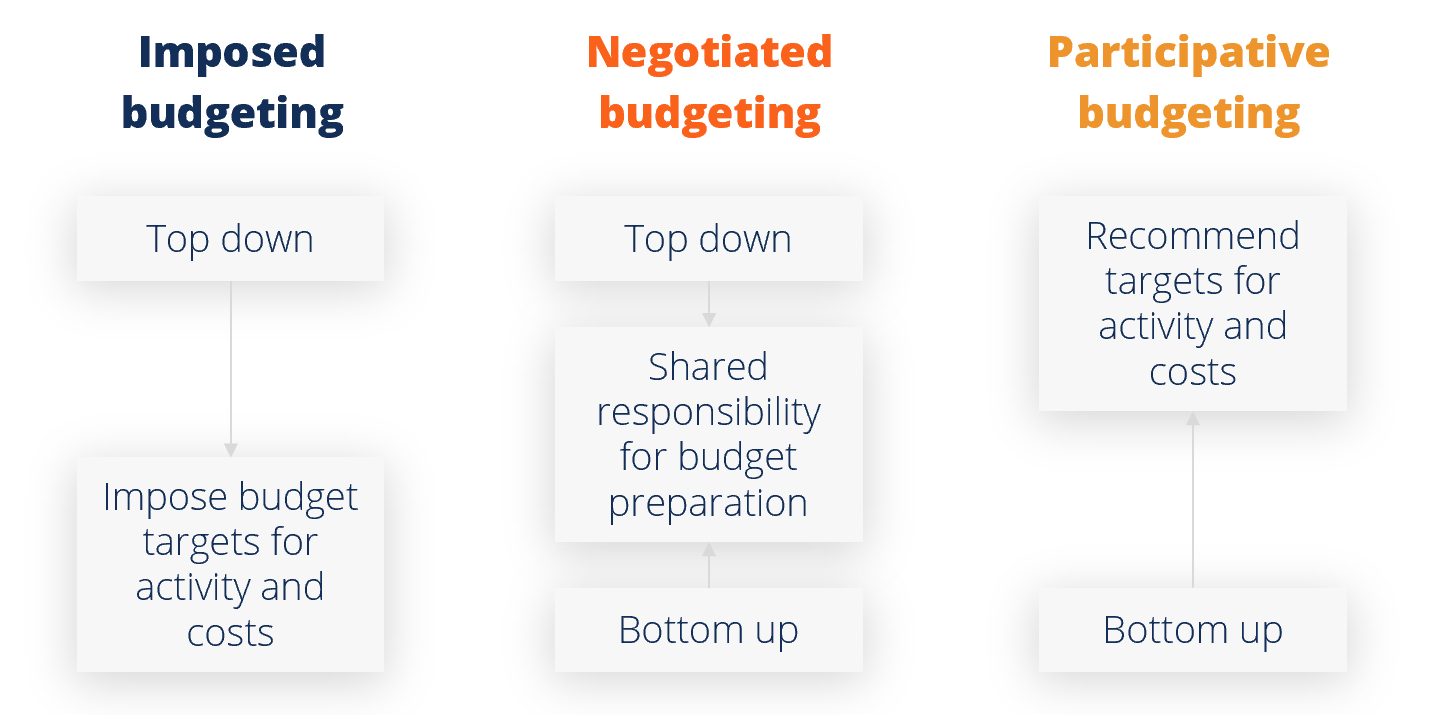
This "negotiated" or hybrid process typically works as follows:
- Top-Down Guidance: Leadership and finance establish the strategic priorities and broad financial parameters for the year (e.g., revenue targets, profit goals, overall investment envelope).
- Bottom-Up Planning: Department managers build detailed budgets that aim to achieve the strategic goals within the provided financial parameters.
- Reconciliation & Iteration: Finance consolidates the bottom-up plans. Leadership and department managers then engage in a dialogue to resolve the gaps between the initial requests and the top-level targets.
This reconciliation phase is not just about cutting costs; it's about making strategic decisions. It's a conversation that forces the company to prioritize.
4. A Practical Framework for Reconciliation
Let's make this tangible. Since your goal is to move into a people-manager role, we'll use headcount planning—a major component of any departmental budget—as a case study for this reconciliation process.
The following article provides an excellent, manager-focused framework for this. It reframes planning away from "How many people can we afford?" to "What do we need to achieve, and what does that require?"
How to Build a Headcount Plan That Actually Works
This article, 'How to Build a Headcount Plan That Actually Works' by Melissa Theiss, lays out a three-step process for reconciling top-down strategy with bottom-up headcount needs.
Please read the sections titled 'How to Build Headcount Plans That Actually Work' (including Steps 1, 2, and 3) and 'The Three Common Mistakes to Avoid'. Focus on how the process forces strategic conversations by comparing different views of the organization.
Let's break down the key steps from the article:
-
Step 1: Start with Top-Down Clarity. The process must begin with the leadership team agreeing on specific, non-negotiable goals for the year (e.g., a specific revenue number, launching a new product line). This provides the "north star" for all subsequent planning.
-
Step 2: Build Both Views. This is the core of the hybrid model.
- The Top-Down View (Strategic): Leadership creates a "zero-based" org chart. Instead of just adding to the current team, they start from scratch and ask: "To hit our $20M revenue target, and assuming industry-standard ratios, what should our organization look like?" This creates an ideal structure based on strategy and financial constraints.
- The Bottom-Up View (Operational): Simultaneously, each department head builds their own detailed plan. As the VP of Engineering, you would calculate the exact team size needed to deliver the product roadmap. As the VP of Sales, you'd calculate the number of reps needed to hit the quota. This adds operational detail and realism.
-
Step 3: The Reconciliation Conversation. The magic happens when you put three documents side-by-side:
- The Current Org Chart (where you are now)
- The Top-Down Zero-Based Org Chart (the ideal future state)
- The Bottom-Up Aggregated Org Chart (the operational request)
This three-way comparison forces the essential strategic conversations. Where do the views differ? Do we have gaps in talent? Do we have roles today that don't exist in the future-state plans? Is the bottom-up request significantly larger than the top-down model allows? Answering these questions leads to making necessary trade-offs: adjusting scope, changing timelines, or reallocating resources.
5. Facilitating the Dialogue: Asking the Right Questions
As a manager participating in these budget discussions, you are not just a passive recipient of decisions. You are an active participant in this reconciliation dialogue. Your ability to frame your requests and ask insightful questions is critical.
This is where your project management background is a real asset. You are used to defending a business case and discussing resource constraints. The key difference is that instead of a one-time project, you are justifying the ongoing "machine" of your department.
A great way to prepare for these conversations is to anticipate the questions that finance and leadership will ask.
12 questions smart finance leaders ask before setting ...
The article '12 questions smart finance leaders ask before setting departmental budgets' provides a fantastic playbook for turning budget requests into strategic conversations. We'll focus on a few key questions that drive the reconciliation process.
Please read questions 1, 4, 10, and 11. For each one, consider how you, as a department manager, would prepare to answer it. Focus on the 'Why this question is important' and 'How to frame the conversation' sections.
Let's synthesize those questions into a toolkit for you as a manager:
-
To Align to Strategy: "What are the strategic objectives your department is supporting with this budget?" (Question 1)
- This is your opening move. Don't start by listing heads you want to hire. Start by stating, "The company goal is to improve customer retention by 10%. To do that, my team needs to launch a new onboarding program, which requires one customer success manager and a $20k software tool." This directly links your bottom-up request to the top-down goal.
-
To Stress-Test Your Plan: "What assumptions are we making...and what could make them prove wrong?" (Question 4)
- This shows you've thought critically about your plan. For example: "This headcount plan assumes a 10% attrition rate and an average time-to-hire of 60 days. If attrition rises to 15%, we will fall behind on our product roadmap by Q3."
-
To Prepare for Trade-offs: "What's mission-critical vs. nice-to-have?" and "What trade-offs are you willing to make if our budget needs to be cut?" (Questions 10 & 11)
- Never go into a budget meeting with a single, all-or-nothing plan. Go in with a prioritized list. "Hiring the two senior engineers is non-negotiable to meet the product launch deadline. The junior engineer and the team training budget are highly important but could be deferred to Q3 if necessary." This signals you are a strategic partner, not just an advocate for your own silo.
Test your understanding!
Imagine leadership has set a top-down target to keep overall headcount growth to 10% for the year. Your bottom-up departmental plan requires 20% growth to meet all your stated objectives. During the reconciliation meeting, what is the least effective way to argue for your budget, and what is a more effective approach, using the principles we've discussed?
Show answer
-
Least Effective: "It's impossible. We can't hit our goals with a 10% increase. We need all of the requested headcount or the plan will fail." This is an all-or-nothing stance that doesn't show a willingness to engage in strategic trade-offs.
-
More Effective: "I understand the 10% company-wide target. To get there, we need to make some tough choices. My request for a 20% increase is based on delivering all three strategic initiatives. If we must stick to 10%, we can deliver initiatives A and B on time, but initiative C will need to be delayed until next year, or its scope reduced significantly. Here is my prioritized list of roles; the first 10% get us through initiatives A and B." This approach acknowledges the top-down constraint, demonstrates strategic thinking by connecting headcount to specific outcomes, and proactively proposes a trade-off for leadership to consider.
Conclusion
In this lesson, we moved from defining the budget process to understanding the critical push-and-pull dynamics at its core.
Key Takeaways:
- Effective budgeting relies on a hybrid approach, not a purely top-down or bottom-up method.
- Reconciliation is a structured negotiation designed to align high-level strategic goals with detailed operational realities.
- A powerful way to reconcile plans is to compare the current state, a strategic future state (top-down), and an operational future state (bottom-up) to force conversations about gaps and priorities.
- As a manager, your role is to be a strategic partner in this conversation by clearly linking your requests to company goals, testing your assumptions, and being prepared to discuss trade-offs.
Preview of the Next Lesson:
Now that you understand how departmental needs are balanced against company-wide strategy, we are ready to dive into the mechanics of building your department's budget request. In our next lesson, we will address the first learning outcome of Module 2: "Develop a departmental headcount plan and calculate the associated base salary and benefits costs." This will be the first step in creating the "bottom-up" plan we discussed today.