Introduction
In our last lesson, we focused on the critical input phase of the counseling process: Choice Filling and Choice Locking. You can think of that as meticulously crafting and sending a request to a server—the choice_list payload is finalized and dispatched to the MCC. Today, we'll analyze the server's response. This lesson is about what happens when the allotment results for Round 1 are published.
We will cover the participation rules for AIQ Round 1, describing the various scenarios your sister might face after the results are declared. The central concept we'll explore is the 'Free Exit'—a unique feature of Round 1 that provides a powerful strategic advantage. Understanding the implications of accepting a seat versus taking a Free Exit is fundamental to navigating the subsequent, more restrictive rounds of counseling.
The Round 1 Allotment: A Fork in the Road
After the choice-locking period concludes, the MCC's software processes the preferences of all registered candidates against their ranks and the available seats. This is a purely algorithmic process. Once it's complete, the results are published, and each candidate logs in to see their outcome.
Fundamentally, there are two initial possibilities:
-
No Seat Allotted: If, based on your sister's rank and the choices she provided, no seat was available, the portal will indicate this. In this scenario, the path is simple: she is automatically eligible to participate in Round 2. Her registration and security deposit are carried forward, and she will need to fill in her choices again when the Round 2 window opens.
-
Seat Allotted: The system has assigned a college from her preference list. This is the major decision point where understanding the rules is crucial. Upon receiving an allotment, a candidate has two primary courses of action.
The flowchart below provides a clear visual map of the process following a Round 1 seat allotment.
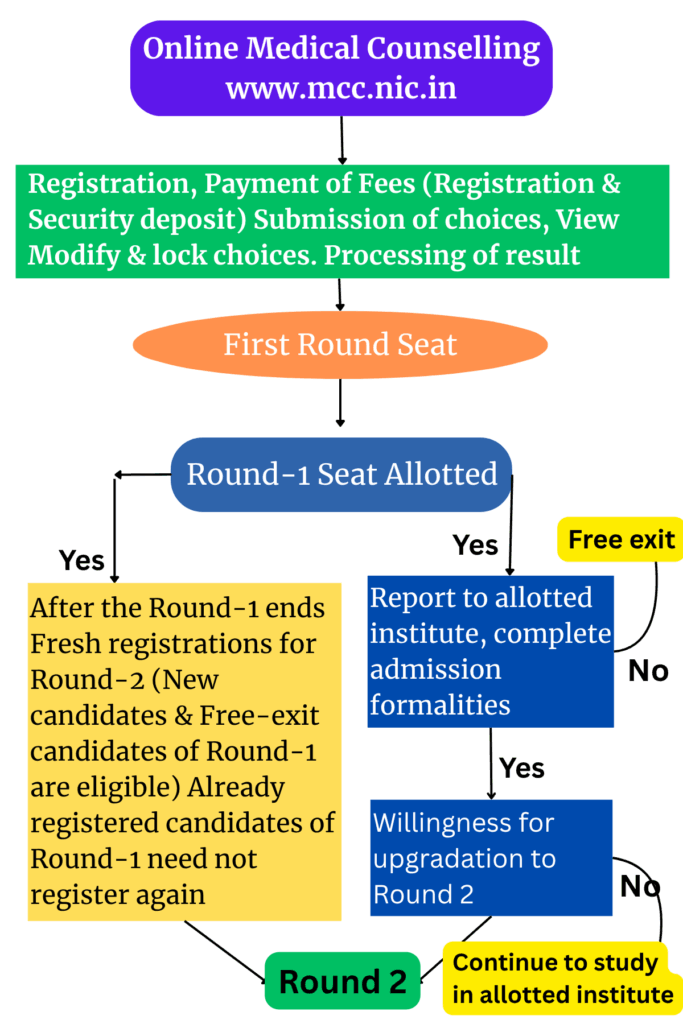
As you can see, once a seat is allotted, the candidate can either report to the institute or choose not to. The path of not reporting is what's known as the Free Exit.
The 'Free Exit': A No-Penalty Option
The most important rule of Round 1 is the existence of the Free Exit. It is a one-time opportunity in the entire AIQ counseling process.
A Free Exit means that a candidate who has been allotted a seat in Round 1 can choose not to report to the college and complete the admission formalities. They face no penalty for this decision.
- Their security deposit is not forfeited.
- They remain fully eligible to participate in Round 2.
Think of this from your developer perspective. Round 1 is like a non-blocking, fail-safe API call. You get a response (the allotted seat), but you have the option to gracefully ignore it without causing any side effects or losing your session token (your eligibility and security deposit). You can then make a new, potentially revised, call in the next cycle (Round 2).
Why would nearly half of the candidates who get a seat use this option? The article "NEET Counselling: How It Works" provides clear data on this.
NEET Counselling 2026: How It Works, Rounds, Deposits and Deadlines | Formity
This guide from Formity provides real-world context and data, addressing your question about what has happened in past years.
Read the short paragraph under "MCC's 4 rounds explained" titled Round 1 — Free exit. This explains the rule and gives you the key statistic on how many candidates used this option. Jump down to the section "What actually happens: 2025 data" and read the first sentence: 2025 data. This provides concrete numbers on the Free Exit strategy in action.
As the resource highlights, a significant number of candidates (46% in 2025) take the Free Exit. This is a strategic move, often because they:
- Are confident of securing a better seat through their 85% State Quota counseling, which runs concurrently.
- Are hopeful of getting a higher-preference college in AIQ Round 2, as seats from non-reporting candidates become available.
To solidify your understanding, it's useful to see how 'Free Exit' is formally defined and contrasted with the penalties in later rounds.
Difference Between Free Exit and Forfeiture in NEET Counselling 2025 | CollegeDekho
This article from CollegeDekho provides a very clear definition of 'Free Exit' and contrasts it with 'Forfeiture', a concept that will become important in Round 2.
Read the section What is Free Exit for a direct explanation of the concept as it applies to Round 1. Then, review the comparison table under "Key Differences Between Free Exit and Forfeiture". This table is an excellent summary. Focus on the first three rows, which compare the Applicability, Financial Penalty, and Eligibility for Next Rounds.
Path 2: Reporting to the Allotted College
The alternative to a Free Exit is to accept the allotted seat. This is a multi-step process:
- Download Allotment Letter: First, the candidate must download the official allotment letter from the MCC portal.
- Physical Reporting: The candidate must physically go to the allotted college within the specified timeframe.
- Document Verification & Admission: At the college, their original documents will be verified, and they will need to pay the first-year tuition fees to complete the admission formalities.
Once admission is confirmed, the candidate has another important choice to make, as shown in the flowchart:
- Willingness for Upgradation to Round 2: The candidate can indicate that while they are accepting the Round 1 seat, they wish to be considered for a better college from their original choice list in Round 2. If they are allotted a higher-preference seat in Round 2, the Round 1 seat is automatically cancelled and given to another candidate. If they are not upgraded, they retain their Round 1 seat. This is the most common choice for candidates who are happy but not ecstatic with their Round 1 allotment.
- Continue Study (No Upgradation): If the candidate is completely satisfied with the allotted college (e.g., they got their first choice), they can choose not to participate in further rounds. Their counseling journey ends here.
Conclusion
Today, we've dissected the outcomes of AIQ Round 1 and the critical decision points a candidate faces. You now understand the process that follows the seat allotment announcement and the powerful, penalty-free nature of the 'Free Exit'.
Here are the essential takeaways from this lesson:
- Round 1 is the only round with a 'Free Exit', which allows a candidate to decline an allotted seat without any financial penalty or loss of eligibility for Round 2.
- Many candidates strategically use the Free Exit to hold out for better options in either State Quota counseling or AIQ Round 2.
- If a candidate accepts the Round 1 seat, they must physically report to the college. They then have the option to either lock in their seat or express willingness for upgradation in Round 2.
- If no seat is allotted, the candidate automatically proceeds to Round 2.
In our next lesson, we will move on to the higher-stakes environment of AIQ Round 2. The rules change significantly, the 'Free Exit' option disappears, and the concept of security deposit forfeiture becomes a major factor. We will explain the eligibility for Round 2 and the serious consequences of accepting or declining a seat.