Introduction
Guten Tag! In our last lesson, we established a solid foundation for narrating past events by distinguishing between the Perfekt and Präteritum tenses. You now know to use Perfekt for most spoken contexts and Präteritum for formal writing and for specific verbs like sein, haben, and the modals.
Today, we add another layer of precision to your storytelling. We will explore the Plusquamperfekt, often called the "past perfect" or, more descriptively, the Vorvergangenheit (the "before-past"). This lesson is dedicated to learning how to form and use this tense to clearly narrate an event that happened before another past event. Mastering this allows you to create a logical sequence in your narratives, a key skill for the detailed descriptions and discussions expected at the B2 level and in the telc exam.
1. The Concept: Sequencing the Past
The fundamental purpose of the Plusquamperfekt is to establish a clear chronological order between two or more events that all took place in the past. Think of it as the "past of the past."
Imagine a timeline:
- An event happens (e.g., you prepare a presentation).
- A second event happens later, but still in the past (e.g., you hold the meeting).
- Now, in the present, you are talking about it.
The Plusquamperfekt is used for the first event in that sequence.
This timeline illustrates the concept of Vorzeitigkeit (anteriority). The Plusquamperfekt action occurs before the Präteritum/Perfekt action, which itself occurs before the Gegenwart (present).
The relationship between the two past events is often clarified by conjunctions like nachdem (after) and bevor (before).
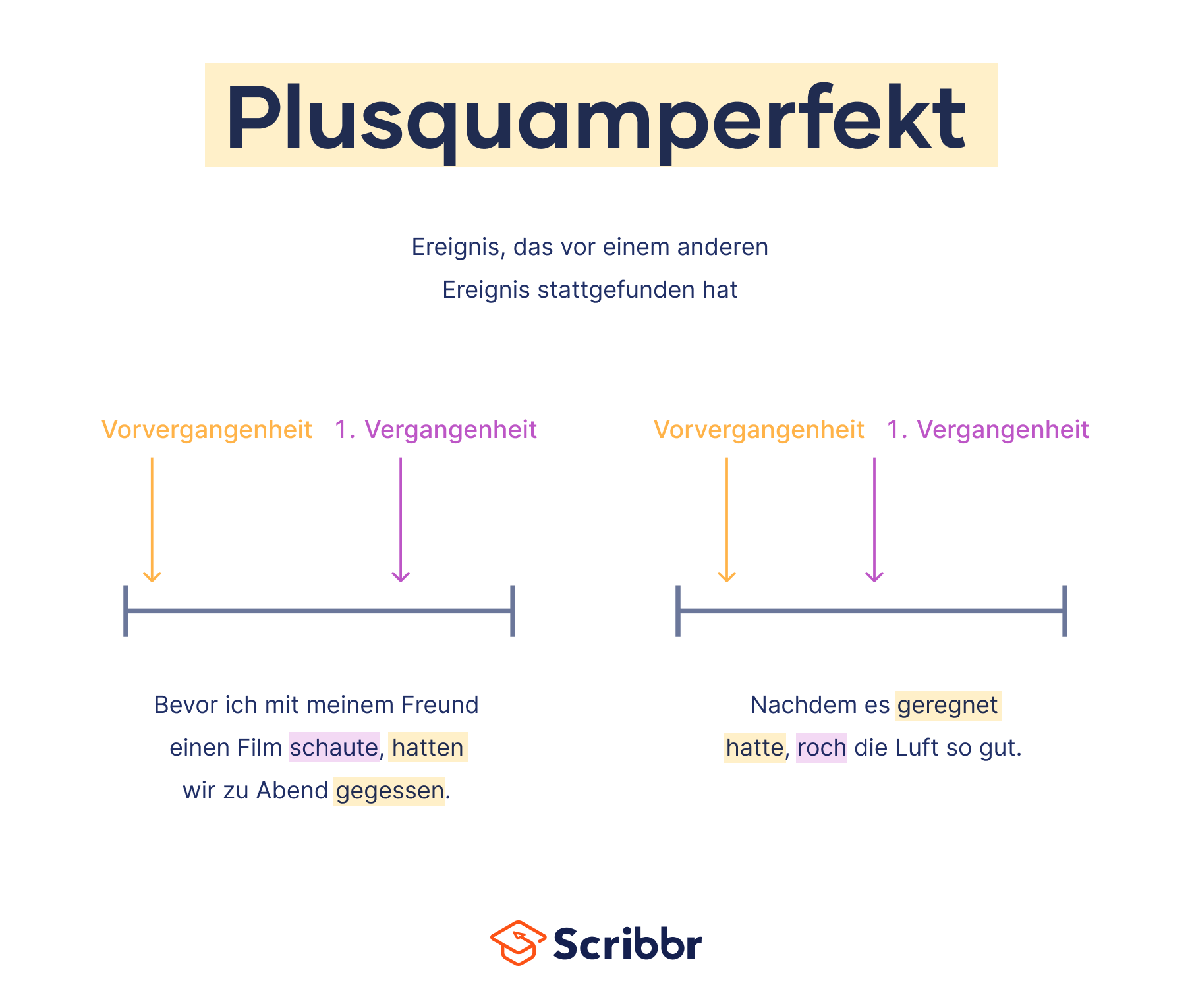
This image shows two timelines. The first action (Vorvergangenheit, in Plusquamperfekt) happens before the second action (1. Vergangenheit, in Präteritum/Perfekt). Notice the use of 'hatten gegessen' before 'schaute', and 'geregnet hatte' before 'roch'.
To get a more formal grasp of this concept, let's turn to a structured explanation.
Plusquamperfekt: Beispiele, Verwendung, Bildung und Übungen
This article from Scribbr clearly defines the Plusquamperfekt and its primary function.
Please read the first two parts of the article: Start with the introduction, from the beginning down to the table, to understand the definition of Vorvergangenheit. Then, read the section When to use the Plusquamperfekt, focusing on how it interacts with the Präteritum and the role of signal words like nachdem and bevor.
2. The Mechanics: How to Form the Plusquamperfekt
The good news is that if you understand the Perfekt tense from our last lesson, forming the Plusquamperfekt is a very small step. The structure is nearly identical. The only difference is that the auxiliary verb (haben or sein) is put into its Präteritum form.
Perfekt: Auxiliary in Präsens (habe/bin) + Partizip II
Plusquamperfekt: Auxiliary in Präteritum (hatte/war) + Partizip II
The rules for choosing between haben and sein are exactly the same as for the Perfekt tense:
sein(war) is for verbs of movement (e.g.,gehen,fliegen) and change of state (e.g.,aufwachen,einschlafen).haben(hatte) is for most other verbs.
Let's look at the conjugation of the auxiliaries you will need:
| Person | haben -> hatte |
sein -> war |
|---|---|---|
| ich | hatte |
war |
| du | hattest |
warst |
| er/sie/es | hatte |
war |
| wir | hatten |
waren |
| ihr | hattet |
wart |
| sie/Sie | hatten |
waren |
Now, let's solidify this with the article from Scribbr.
Plusquamperfekt: Beispiele, Verwendung, Bildung und Übungen
This part of the article details the formation, the choice of auxiliary verb, and the creation of the past participle, much of which will be a helpful review.
Continue reading the same article: Focus on the section How to form the Plusquamperfekt to see the formula and the conjugation table. Review the rules in When to use 'haben' and 'sein'. This reinforces what you already know from the Perfekt tense. Briefly look over Partizip Perfekt as a reminder of how past participles are formed for regular and irregular verbs.
3. The Application: Putting It into Context
Understanding the formation is one thing; using the tense correctly is another. A crucial rule is that the Plusquamperfekt almost never stands alone in a sentence. It needs a reference point in the past (an action in Präteritum or Perfekt).
The video below explains this "rule of dependency" very effectively.
Deutsch lernen: das Plusquamperfekt einfach erklärt B1/B2/C1
The presenter, Julia, from Lingster Academy provides an excellent, logical breakdown of how the Plusquamperfekt relates to other tenses.
Please watch these key segments: Formation and the Golden Rule: This part quickly covers the structure and emphasizes that Plusquamperfekt is always combined with another past tense. Analysis of Examples: Pay close attention here. The presenter analyzes several sentences, breaking down the sequence of events logically ("Which action happened first?"). This aligns well with the analytical thinking used in software engineering. Timeline Diagram: This visual diagram clearly shows the relationship between the present, the past, and the "time before the past" (Vorvergangenheit). Using 'nachdem': This final segment demonstrates the most common use case with the conjunction nachdem.
The nachdem Rule
As you saw in the video, one of the most important use cases for Plusquamperfekt is in subordinate clauses with nachdem. There is a strict tense sequence rule here:
If the main clause is in Präteritum or Perfekt, the nachdem clause must be in Plusquamperfekt.
Nachdemer die Prüfung bestanden hatte,feierteer mit seinen Freunden. (Plusquamperfekt->Präteritum)- Er
hatmit seinen Freundengefeiert,nachdemer die Prüfung bestanden hatte. (Perfekt->Plusquamperfekt)
This structure makes the sequence of events completely unambiguous. While in casual speech, you might hear Germans simplify this, in written German and formal speech (like in the telc exam), getting this right is essential.
4. Practice
Let's apply what you've learned. The following exercise asks you to connect two events using bevor or nachdem, which will require you to correctly form the Plusquamperfekt and place it in the right clause.
Plusquamperfekt: Beispiele, Verwendung, Bildung und Übungen
This exercise will help you practice forming sentences that correctly sequence past events.
In the article we've been using, scroll down to the section "Plusquamperfekt Übungen". Complete Übung 3. The task is to form logical sentences from the pairs of actions provided, using nachdem or bevor. For each pair, identify which action happened first (this one goes into Plusquamperfekt) and which happened second (this one goes into Präteritum).
After writing down your answers, read each complete sentence out loud. This will help you get used to the sound and rhythm of these complex sentences, which is crucial for your speaking goal.
Here's an example for the first one: einen Kuchen backen / die Gäste kommen
- Action 1: einen Kuchen backen (Plusquamperfekt)
- Action 2: die Gäste kommen (Präteritum)
- Sentence:
Nachdemsie einen Kuchengebacken hatte,kamendie Gäste.
Conclusion
In this lesson, you've added a powerful tool for chronological narration to your German grammar toolkit. You can now not only talk about the past, but also precisely order events within the past.
Key Takeaways:
- Function: The Plusquamperfekt (
Vorvergangenheit) describes an action that happened before another past action.
- Formation: It's formed with the
Präteritumof the auxiliary verb (hatteorwar) plus thePartizip II. - Application: It is rarely used alone and is typically paired with an action in the
PräteritumorPerfekt. - Signal Words: It is most frequently used in subordinate clauses, especially with the conjunction
nachdem, which requires this tense sequence.
Preview of the Next Lesson:
We've spent this lesson building sentences with clauses introduced by nachdem and bevor. You may have noticed that the verb in these clauses moves to the end (e.g., "...nachdem er gegessen hatte."). In our next lesson, we will focus squarely on this phenomenon: the rules for verb-final word order in common subordinate clauses (Nebensätze), a fundamental concept for building complex and accurate German sentences.