Introduction
In our last lesson, we explored the fascinating neurobiology of the flow state, delving into concepts like transient hypofrontality and the neurochemical cocktail that makes the experience so profound. We answered the question of why flow feels the way it does. Today, we shift our focus from the internal mechanisms to the external conditions that bring them about. We will answer the question: how do we create the circumstances for flow to emerge?
This lesson is designed to be highly practical. Our goal is to identify and thoroughly understand the three key preconditions that act as the primary triggers for entering a flow state. Think of these as the initial parameters you would set in a statistical model; by correctly defining these inputs, you dramatically increase the probability of achieving the desired output—in this case, a state of optimal performance and deep enjoyment. Understanding these triggers is the first step toward engineering flow into your daily work and creative pursuits.
The Three Foundational Triggers of Flow
Mihaly Csikszentmihalyi, the pioneering researcher of flow, identified a core set of conditions that are consistently present when people report being in the state. These aren't just abstract ideas; they are concrete features of an activity that you can learn to recognize and cultivate.
To begin, let's hear from Csikszentmihalyi himself as he outlines these fundamental requirements.
This short video, "Flow Theory," features Mihaly Csikszentmihalyi himself explaining the three most critical preconditions for the flow experience to occur.
Watch the following three short segments where he outlines each condition: First, listen for the importance of a clear goal. Next, he explains the necessity of the goal being well-matched to your skills. Finally, he describes the role of immediate feedback.
These three conditions—clear goals, a balance between challenge and skill, and immediate feedback—form the bedrock of flow. They work together as a system to capture and hold our attention completely.
Modern researchers, like Steven Kotler, often refer to these as "flow triggers" because they reliably precede the neurobiological cascade we discussed in our previous lesson. The following video provides a concise summary of these triggers and uses the compelling example of surfing to illustrate how they manifest in a real-world activity.
How To Unlock Insane Focus On Command
In his video "How To Unlock Insane Focus On Command," performance expert Rian Doris explains how these preconditions act as direct triggers for flow.
Please watch from 07:02 to 07:39. Notice how he explicitly lists the three triggers and then demonstrates how each one is present in the act of surfing.
Now, let's dissect each of these three preconditions in more detail.
1. The Challenge-Skill Balance: The Razor's Edge
The most crucial and dynamic of the three preconditions is the balance between the challenge of a task and your perceived ability to meet it. Flow occurs in a very specific cognitive and emotional space.
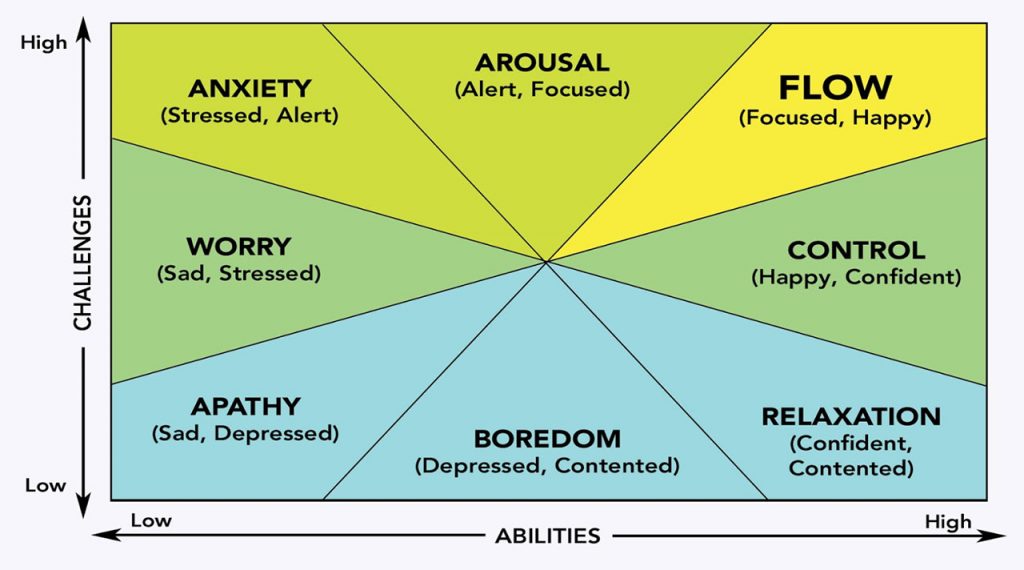
As the diagram shows, if a task is too difficult for your current skill level, it leads to anxiety and stress. If the task is too easy, you'll experience boredom and your mind will wander.
- Anxiety: Challenges significantly outweigh skills.
- Boredom: Skills significantly outweigh challenges.
- Apathy: Both challenges and skills are low.
- Flow: Both challenges and skills are high and in equilibrium.
This state of equilibrium is fragile. To understand the dynamics, let's turn to a foundational text on flow theory.
[PDF] 7 The Concept of Flow - Nuovo e Utile
This chapter from the Handbook of Positive Psychology, co-authored by Csikszentmihalyi, provides a clear description of this dynamic balance.
Please read the section that begins here. It explains how your subjective state shifts between anxiety and boredom, providing feedback that prompts you to adjust your skill or the challenge level to re-enter flow.
The key insight is that this balance isn't static; it's a process of dynamic equilibrium. To stay in flow, you must constantly seek slightly greater challenges as your skills improve. This leads to growth and mastery.
The 4% Rule:
So, what is the optimal gap between challenge and skill? While there's no universal constant, performance research suggests a practical heuristic. As mentioned in the video "How To Unlock Insane Focus On Command," flow seems to be triggered when a task is approximately 4% more difficult than your current skill level. This "4% rule" is a useful guideline for pushing yourself just outside your comfort zone—enough to command full attention, but not so much as to trigger a debilitating stress response.
2. Clear Goals: Knowing What to Do Next
The second precondition is the presence of clear, proximal goals. This does not refer to your long-term ambitions (e.g., "get a promotion"), but to the immediate, well-defined objective of the task at hand.
When you're in a flow state, you are not thinking about what to do; you simply know. This is because the goal for each moment is unambiguous.
- A rock climber's goal is the next handhold.
- A programmer's goal is to resolve a specific bug or implement a function.
- A surgeon's goal is to complete the next step of a procedure.
Without this clarity, your attentional system—specifically the executive control network we discussed in Module 1—spends energy figuring out what to do and what's important, leaving fewer resources for the task itself.
3. Immediate Feedback: Knowing How You're Doing
Clear goals are necessary, but not sufficient. You also need immediate feedback on your progress toward those goals. This feedback loop allows your brain to continuously adjust its actions to stay on track and maintain the challenge-skill balance.
Some activities have this feedback loop built-in:
- Playing a musical instrument provides auditory feedback—a note is either in tune or it isn't.
- Playing a video game provides constant visual and auditory feedback on performance.
- Your hobby of designing lingerie provides immediate visual and tactile feedback as the pattern comes together.
However, many knowledge work tasks lack such inherent feedback. When writing a report or analyzing a dataset, the feedback (e.g., a manager's review, the project's outcome) is often delayed by days or weeks. In these cases, it becomes crucial to engineer your own feedback loops. This can include:
- Setting a timer for a specific section of work.
- Tracking your word count as you write.
- Creating a checklist of sub-tasks and marking them off as you go.
The combination of clear goals and immediate feedback creates a self-contained reality where the rules are clear and your performance is constantly reported, allowing you to become completely absorbed. A detailed research review summarizes this interplay nicely.
A Review on the Role of the Neuroscience of Flow States in ... - PMC
This scientific review connects the preconditions to the experience of complete absorption.
Please read the short paragraph that starts with this sentence. It perfectly summarizes how the three triggers work in concert to eliminate distractions and create the conditions for immersion.
Synthesis: A System for Complete Absorption
These three preconditions don't operate in isolation. They form a synergistic system that directs your brain's resources toward a single point of focus.

Here is how they work together to create the neurobiological state we learned about previously:
- Clear Goals tell your brain's Salience Network what is important, directing the Central Executive Network to focus attention on the task.
- The Challenge-Skill Balance ensures the task is engaging enough to keep the Salience Network locked on, preventing it from switching back to the self-referential Default Mode Network (i.e., it prevents mind-wandering).
- Immediate Feedback provides a continuous stream of data, allowing you to make micro-adjustments to your performance. This keeps you perfectly poised in the challenge-skill sweet spot and reinforces the Salience Network's decision that the task is the most important thing to monitor.
This system is what drives the brain into transient hypofrontality, quieting your inner critic and allowing for total immersion in the activity.
Conclusion
Today, we've moved from the "why" of flow to the "how," identifying the three essential preconditions you can manipulate to make this optimal state more accessible: challenge-skill balance, clear goals, and immediate feedback. You now understand that flow is not a matter of luck but the outcome of a well-structured environment and a careful selection of tasks. These triggers are the levers you can pull to initiate the powerful neurological and chemical cascade that produces peak performance.
In our next lesson, we will refine our understanding further by distinguishing flow from its common cousin, hyperfocus. While they can feel similar, they have different triggers and long-term effects, and knowing the difference is crucial for sustainable high performance.
Cheat Sheet: The Three Preconditions for Flow
Flow can be triggered by engineering three specific conditions into an activity.
-
1. Challenge-Skill Balance:
- The Idea: The task should be hard enough to be interesting but not so hard it causes anxiety. It should stretch your skills.
- The Rule of Thumb: Aim for tasks that are roughly 4% beyond your current skill level. This is the sweet spot between boredom and anxiety.
-
2. Clear Goals:
- The Idea: You must know exactly what you need to do from moment to moment.
- The Application: Break down large, ambiguous projects into small, concrete, and sequential sub-goals.
-
3. Immediate Feedback:
- The Idea: You need real-time information on how you are performing relative to your goals.
- The Application: If an activity doesn't have inherent feedback (like sports or music), build your own. Use timers, checklists, progress bars, or other metrics to see your progress as it happens.