In our last lesson, you built a powerful tool: a personal, step-by-step checklist to systematically engineer the three core preconditions for flow. This is your "pre-flight check" to ensure your work sessions are primed for deep focus. Now, we will expand that toolkit by creating a comprehensive "cheat sheet" that summarizes a wider array of flow triggers and conditions.
The goal of this lesson is to move beyond the foundational checklist and equip you with a flexible menu of research-backed strategies. Think of the checklist as the rigid procedure for takeoff, while this cheat sheet is the pilot's handbook—a quick-reference guide you can consult to diagnose issues, enhance conditions, and navigate your way back into the flow channel. By the end of this lesson, you will have a consolidated summary of practical entry strategies for achieving optimal performance.
Beyond the Preconditions: A World of Flow Triggers
While clear goals, immediate feedback, and the challenge-skill balance are the essential pillars for entering flow, a broader set of factors, known as "flow triggers," can help you establish and maintain these conditions. These triggers are specific actions or environmental tweaks that drive your attention into the present moment, making flow more likely.
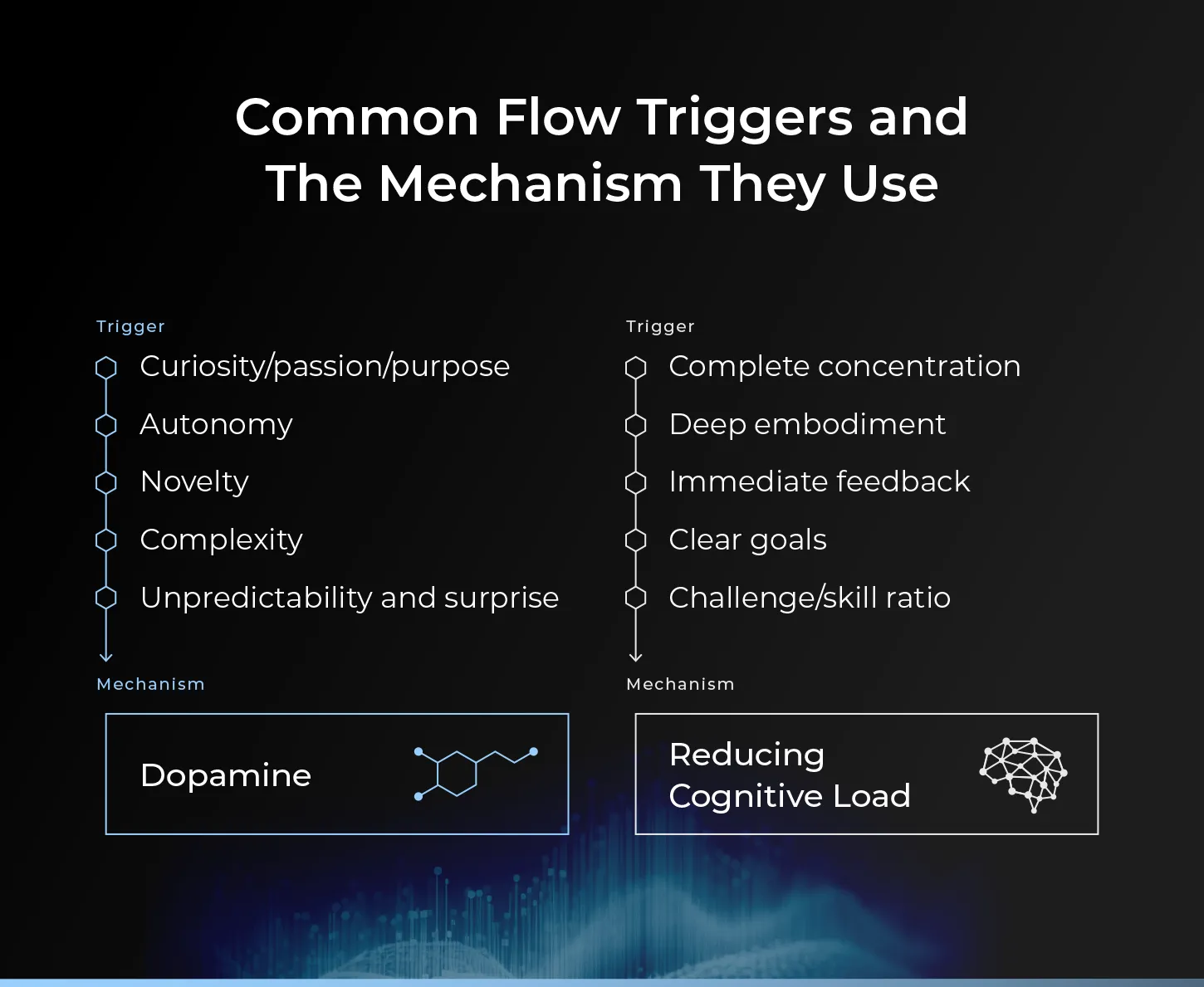
Neuroscientist and flow expert Steven Kotler explains that these triggers work primarily through two mechanisms: they either boost focus-enhancing neurochemicals (like dopamine and norepinephrine) or they reduce your cognitive load, freeing up mental resources for the task at hand.
Let's start by hearing Kotler introduce the concept of triggers and their underlying biology.
The science of effortlessness: How to activate flow | Steven Kotler: Full Interview
This clip from Steven Kotler's interview with Big Think provides a concise explanation of what flow triggers are and the two main ways they function.
Please watch the section where he explains that "flow follows focus" and details the neurobiological mechanisms of triggers, from preconditions for flow.
As Kotler described, triggers either add neurochemical fuel to your attentional fire or clear away the mental clutter that consumes energy. The image below visualizes these two pathways.
Let's explore some of the most potent triggers you can add to your toolkit.
A Tour of Key Flow Triggers
We can group these triggers into practical categories to make them easier to remember and apply.
1. Psychological Triggers: Priming Your Mindset
These triggers are internal and relate to your motivation and emotional state. They provide the "why" that fuels engagement.
- Curiosity, Passion, and Purpose: These are arguably the most powerful intrinsic motivators. When you're genuinely curious about a problem, passionate about a craft, or driven by a larger purpose, your brain provides "focus for free." Dopamine and norepinephrine are released, signaling that the activity is worth your attention. This is evident in both of your key domains: the purpose behind your social research and the passion you bring to lingerie design.
- Autonomy: The freedom to choose your approach and direct your own work is a potent flow trigger. It gives you a sense of control and ownership, which reduces the psychological friction of feeling constrained.
- Risk: Taking calculated risks—be they intellectual (tackling a novel statistical method), creative (using a difficult fabric), or social—heightens attention. The brain releases dopamine in anticipation of a challenge, not just as a reward, which sharpens focus to help you meet that challenge.
The following resource provides a detailed look at these internal triggers.
What are Flow Triggers? 22 Examples to Unlock Flow State
This article from the Flow Research Collective, founded by Steven Kotler, provides an excellent deep-dive into the various categories of triggers.
Focus on the sections covering the internal triggers. Read about Passion, Purpose, and Curiosity, and then read about Autonomy.
2. Environmental Triggers: Shaping the Task and Space
These triggers involve manipulating the external world—the task itself or your environment—to make it more flow-conducive.
- The Challenge-Skill Balance: This is the "golden rule" of flow and the centerpiece of the checklist you created in our last lesson. The ideal zone is a challenge that stretches your skills by about 4%. If a task is too easy, you get bored; if it's too hard, you become anxious.

- Novelty, Complexity, and Unpredictability: Our brains are novelty-seeking machines. Introducing new elements—a new environment, a new tool, a complex problem, or an unpredictable outcome—releases dopamine and heightens focus. This is why learning a new technique in your design work or discovering an unexpected pattern in your data can be so absorbing.
- Deep Embodiment: This refers to a full-body awareness and immersion in a physical task. It's particularly relevant for you in powerlifting and lingerie design, where the direct sensory feedback from your body, the fabric, and the machine creates a tight loop between action and awareness.
3. Flow Blockers: What to Avoid
Understanding what prevents flow is as important as knowing what triggers it. Being mindful of these blockers can help you diagnose why you might be struggling to focus. Steven Kotler identifies several key inhibitors:
- Distraction: The most obvious flow killer. As research on coders shows, even a brief interruption can take over 15 minutes to recover from.
- Excessive Anxiety or Boredom: Being too far outside the challenge-skill channel.
- Self-Consciousness: Flow is characterized by a temporary quieting of the prefrontal cortex, a state known as transient hypofrontality. This is why your inner critic and sense of self fade away. Any thought that brings the self "back online"—worrying about how you look, what others think, or if you're doing it "right"—can instantly kick you out of flow.
The science of effortlessness: How to activate flow | Steven Kotler: Full Interview
In this clip, Kotler discusses common reasons people get knocked out of flow, including a fascinating personal example related to self-consciousness.
Watch his explanation of flow blockers. Note his story about skiing and how shifting his focus from an internal metric ("how do I look?") to an external one ("how fast am I going?") made all the difference.
Your Flow Trigger Cheat Sheet
Now, let's synthesize everything into the concise, actionable cheat sheet you requested. This is your quick-reference guide to complement the more structured checklist from our previous lesson.
The Flow Trigger Cheat Sheet
I. The 3 Core Conditions (Non-Negotiable)
- Clear Goals: Define a SMART goal for your session. What exactly am I doing for the next 90 minutes?
- Immediate Feedback: Ensure your task provides real-time information on your progress. How will I know if I'm on track?
- Challenge-Skill Balance: Aim for the "4% stretch." The task should feel demanding but achievable. Is this too easy or too hard?
II. Psychological Triggers (Priming Your Mindset)
- Activate Curiosity: Start with a question you genuinely want to answer.
- Connect to Purpose: Briefly remind yourself why this work matters to you or others.
- Embrace Autonomy: Take ownership of the task. If you feel constrained, identify one aspect you can control.
- Leverage Passion: If motivation is low, spend 15 minutes on a passion project (like design) to get the "flow feeling" before tackling a less engaging task.
III. Environmental Triggers (Shaping Your Task & Space)
- Inject Novelty: Change your environment (work from a different spot), use a new tool, or try a different approach to a familiar problem.
- Increase Complexity: If bored, add a constraint or raise the quality standard.
- Seek Unpredictability: Tackle a problem with an unknown outcome or engage in a brainstorming session where ideas can go anywhere.
- Engage in Deep Embodiment: For physical tasks (design, exercise), focus on bodily sensations and the direct feedback from your materials and movements.
IV. Practical Readiness (Setting the Stage)
These foundational habits, which we'll explore in later modules, ensure you have the energy for flow.
- Manage Energy, Not Just Time: Align deep work with your peak alertness periods (more on this in Module 5).
- Physiological Basics: Ensure you are well-slept, hydrated, and properly nourished.
- Mental Prep: A 5-minute gratitude or mindfulness practice can calm the nervous system and reduce the anxiety that blocks flow.
The science of effortlessness: How to activate flow | Steven Kotler: Full Interview
Kotler calls these the "positive psychology basics." They are the foundation upon which peak performance is built.
For a brief overview of these foundational practices, watch the segment on readiness for flow. This will serve as a great preview for upcoming modules on energy, nutrition, and stress management.
V. Common Flow Blockers (What to Avoid)
- Distraction: Zero-tolerance policy for notifications and non-essential tools during a focus block.
- Self-Consciousness: Shift focus from internal evaluation ("Am I good enough?") to external task metrics ("Is the code running? Is the seam straight?").
- Task-Switching: Respect "attention residue." A single task for a single block of time.
Conclusion
You have now completed Module 4 by building both a systematic flow-entry checklist and a comprehensive cheat sheet of flow triggers. You understand that flow is not a mystical state you passively wait for, but an optimal state of consciousness you can actively and reliably cultivate by engineering the right internal and external conditions. This cheat sheet is your practical, at-a-glance menu for doing just that.
This concludes our deep dive into flow. We've defined what it is, explored its benefits, identified its preconditions, and created tools to access it more frequently. However, knowing how to enter flow is only half the battle. Knowing when to apply these strategies is equally critical.
In our next module, "Energy Management: Circadian and Ultradian Rhythms," we will shift our focus to your underlying biology. You'll learn how to identify your natural peaks and troughs of energy throughout the day, enabling you to schedule your deep work sessions for when your brain is most capable of achieving flow.