Introduction
In our last lesson, we delved into the cognitive cost of task switching, establishing that "attention residue" can significantly impair your performance long after an interruption has passed. We concluded that managing transitions, particularly by seeking closure on a task, is crucial for maintaining focus. This brings us to a popular and somewhat paradoxical technique: the Pomodoro method, which enforces regular task switching between work and breaks.
This lesson will critically evaluate the Pomodoro technique. We will not treat it as a universal panacea but as a specific tool with a distinct set of costs and benefits. Drawing on cognitive science research, we will analyze its theoretical underpinnings, examine the evidence for its effectiveness, and, most importantly, develop a framework for deciding when its structured interruptions are helpful and when they are a hindrance to deep work. This evaluation will equip you to strategically apply—or pointedly avoid—this method based on the cognitive demands of your tasks.
What is the Pomodoro Technique? The Basic Mechanism
At its core, the Pomodoro Technique is a simple time management system designed to break down work into focused intervals. Let's start with a clear, concise overview of its mechanics.
POMODORO TECHNIQUE - My Favorite Tool to Improve Studying and Productivity
The video "POMODORO TECHNIQUE" from Med School Insiders provides a straightforward introduction to the method's history and its step-by-step process.
Please watch the first two minutes to grasp the fundamental structure. Focus on the explanation of the basic cycle from 00:46 to 01:02. Then, watch the detailed breakdown of the steps from 01:25 to 02:05, which covers setting the timer, working, and the pattern of short and long breaks.
As the video explains, the classic Pomodoro cycle consists of:
- Choosing a task.
- Working on it with intense focus for 25 minutes.
- Taking a 5-minute break.
- Repeating this cycle four times.
- Taking a longer break of 15-30 minutes after the fourth cycle.
The theoretical justification for this structure is multifaceted and draws from several psychological principles. A comprehensive scoping review on the topic helps illuminate these foundations.
Assessing the efficacy of the Pomodoro technique in enhancing ...
This research paper provides an excellent summary of the educational theories that support the Pomodoro Technique. As a researcher, you'll appreciate how it connects a practical method to established cognitive frameworks.
Please read the section titled "Educational theories and cognitive frameworks". As you read, notice how the technique aligns with: Cognitive Load Theory: Breaking work into small chunks to avoid overwhelming working memory. Self-Regulated Learning (SRL) Theory: Providing a structure for planning and self-monitoring. Behavioral Psychology: Using the break as a built-in reward to reinforce task persistence.
Essentially, Pomodoro offers an external scaffold for attention, which can be particularly useful when internal motivation or focus is flagging. But this enforced structure introduces a fundamental tension.
The Central Conflict: Structured Pacing vs. Uninterrupted Flow
The Pomodoro Technique's primary feature is its rigid, timed interruption. This directly conflicts with what we know about attention residue and the requirements for entering a deep "flow state," which often demands long, uninterrupted periods of concentration.
So, which is better? The data suggests it's not a simple binary choice. The answer depends entirely on the context.
The Case for Structure:
Research shows that for certain tasks, structured breaks outperform self-paced breaks. The same scoping review you just read summarizes several studies that found statistically significant benefits.
Assessing the efficacy of the Pomodoro technique in enhancing ...
This paper consolidates findings from multiple studies, providing quantitative evidence for Pomodoro's benefits.
First, read the Results section of the Abstract for a high-level summary. Note the reported improvements in fatigue, distractibility, and motivation. Next, examine Table 3 and Figure 2 in the "Statistical analyses" section. As a statistician, you'll find the presentation of Pearson Correlation Coefficients (r) and comparative analyses particularly interesting. Notice the strong positive correlations between PT use and focus (r = 0.72) and the negative correlation with fatigue (r = -0.55).
The evidence suggests that by forcing you to take breaks, the Pomodoro technique can reduce cognitive fatigue and maintain more consistent motivation over long periods, especially when compared to unstructured work where you might push yourself to the point of burnout.
The Case for Flow:
The primary drawback of Pomodoro is its potential to disrupt a state of flow. If you are deeply immersed in a complex problem, the sound of the timer can be a jarring interruption that breaks your concentration, creating the very attention residue we aim to avoid. Re-entering that deep state of focus can take a significant amount of time.
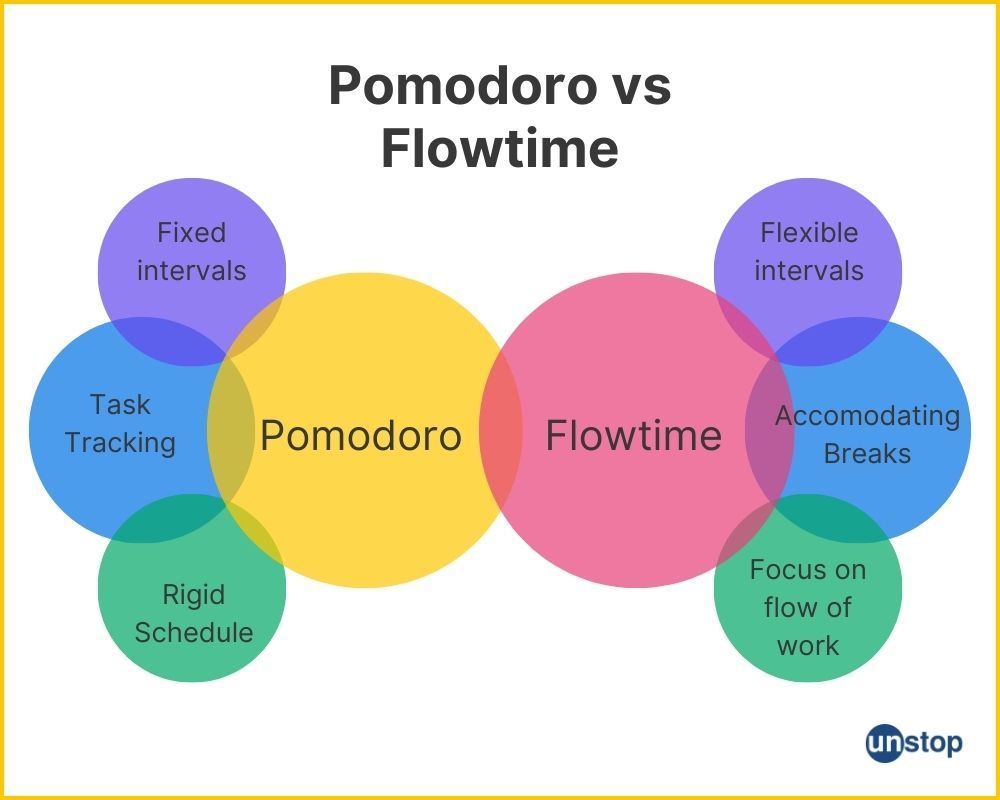
This critique—that the rigid 25-minute block is often at odds with achieving deep focus—is the most common argument against a dogmatic application of the technique.
Does Pomodoro actually work for flow? (thanks Huberman)
The video "Does Pomodoro actually work for flow?" directly addresses this conflict.
Please watch the segment from 00:50 to 03:18. The creator argues that the 25-minute block can be both too long (when you lack motivation to start) and too short (when you've found your flow). This highlights the technique's inflexibility.
This brings us to the core of today's lesson: a decision framework for when to use which approach.
An Evidence-Based Framework: Matching the Method to the Task
The most effective strategy is not to choose one method, but to build a toolkit and select the right tool for the job. The choice between a fixed-interval timer like Pomodoro and a more flexible approach depends on the task's cognitive complexity, your personal state, and your immediate goal.
Pomodoro vs Flexible Study Timers: Which Yields Better Results?
This article from PomoCool provides a comprehensive, research-backed analysis of when to use fixed versus flexible timing. It's rich with data and aligns perfectly with your request for evidence-based recommendations.
Please read the following sections to build your decision framework: Task Demands: Start with the section "Matching Method to Task Demands". Pay close attention to the subsections on Creative Work and Analytical Tasks. Notice the specific recommendations for tasks like data analysis versus creative writing. This directly addresses our learning outcome. Optimal Conditions: Next, read the subsections "Pomodoro Optimal Conditions" and "Flexible Timer Advantages". This provides a clear, actionable list of contexts suited for each method. Personalization: Finally, skim the section "The Personalization Imperative" to understand how factors like chronotype and even neurodiversity (e.g., ADHD) influence the ideal timing strategy. The mention of effect sizes (e.g., Cohen's d = 2.62 for adaptive scheduling) highlights the significant performance gains from personalization.
Synthesizing this research, we can establish some clear guidelines:
Use the Pomodoro Technique when:
- The task is routine or analytical, but not deeply complex. Examples include processing emails, reviewing code for bugs, data cleaning, or memorizing information. The structure helps maintain focus and prevents attention from drifting on tasks that are not inherently captivating.
- You are procrastinating or have low motivation. The low barrier to entry ("I just have to focus for 25 minutes") makes it easier to start a task you've been avoiding.
- You are in a high-distraction environment. The timer provides an external anchor for your focus, helping you resist interruptions.
- Your goal is to get a high volume of work done where consistent output is more important than creative insight.
Use Flexible, Long-Form Timing (e.g., 90-minute ultradian cycles) when:
- The task is creative or requires deep problem-solving. This includes writing a research paper, designing a statistical model, exploratory data analysis, or engaging in your hobby of lingerie design. These tasks benefit from uninterrupted immersion.
- You are already in a state of flow. The worst thing you can do when you're "in the zone" is to obey an arbitrary timer.
- Your goal is insight and innovation. Creative breakthroughs often occur during prolonged, unstructured periods of thought. Research shows that interrupting a flow state can take 20-45 minutes to recover from.
Evolving Pomodoro: Adaptive and Hybrid Models
Recognizing the limitations of the rigid "Original Pomodoro," more flexible and adaptive systems have been proposed. These approaches aim to combine the structure of timers with the need to protect flow.
1. The Progressive Pomodoro
This model adapts the work interval based on your real-time focus level.
Does Pomodoro actually work for flow? (thanks Huberman)
Let's return to the video "Does Pomodoro actually work for flow?" to see this adaptive model in action.
Watch the explanation of Progressive Pomodoro from 03:18 to 06:20, which details the four-step process: Start small: Begin with a short interval (e.g., 5-10 minutes). Rate your focus: After the block, assess your concentration. Break or extend: If you're in flow, skip the break and extend the timer. If not, take the break. Adjust the next block: Lengthen or shorten the next focus block based on your momentum. Then, watch the key takeaways from 07:36 to 09:16 for practical tips on implementing this.
This iterative approach is essentially a real-time optimization algorithm for your focus, which should appeal to your analytical mindset.
2. The Hybrid Strategy
This is perhaps the most practical approach for a modern knowledge worker. It involves using different timing strategies for different types of work throughout the day.
- Morning: Schedule a long, 90-120 minute uninterrupted block for your most cognitively demanding, creative task.
- Afternoon: Use Pomodoro cycles to work through administrative tasks, emails, and more routine analytical work.
This strategy, mentioned in the PomoCool article, allows you to match your timing method to the cognitive requirements of the task at hand, harnessing the benefits of both structure and flexibility.
Conclusion
The Pomodoro technique is not a one-size-fits-all solution for productivity. Its effectiveness is highly contingent on the task you're performing. While its structured intervals can be a powerful tool for managing fatigue, fighting procrastination, and tackling routine work, its rigid timing can be actively detrimental to the deep, uninterrupted focus required for creative and complex problem-solving.
The key takeaway is to move from a dogmatic application of one method to a strategic deployment of a varied toolkit. By evaluating the cognitive demands of your tasks, you can decide whether to use a classic Pomodoro for structure, a long-form block to cultivate flow, or an adaptive model like Progressive Pomodoro to build momentum.
In our next lesson, we will dive deeper into the state that flexible timing aims to protect: flow. We will explore Mihaly Csikszentmihalyi's model, the neurobiology of this optimal performance state, and the precise, evidence-based conditions you can manipulate to enter it more consistently.
The Pomodoro Evaluation Cheat Sheet
Here is a distilled decision framework for applying timed work intervals.
-
Pomodoro Technique (Fixed, Short Intervals)
- Conditional Rule:
- Objective: Maximize consistent output, manage fatigue, and lower the barrier to starting.
- Mechanism: Leverages Cognitive Load Theory and behavioral reinforcement.
-
Flexible Timing (Uninterrupted, Long Intervals)
- Conditional Rule:
- Objective: Cultivate and protect flow states for creative insight and deep problem-solving.
- Mechanism: Aligns with ultradian rhythms and avoids the cognitive cost of attention residue from premature interruption.
-
Progressive Pomodoro (Adaptive Intervals)
- Conditional Rule:
- Objective: Dynamically adjust work intervals to match real-time focus levels.
- Mechanism: An iterative, feedback-driven approach to focus management.
-
General Heuristic (Hybrid Model):
- Deep Work Blocks (AM): Use Flexible Timing for your most important, cognitively demanding task.
- Shallow Work Batches (PM): Use Pomodoro for administrative, routine, or less demanding tasks.