Welcome to the first lesson of our course. We'll begin our journey into the science of focus and relaxation by building a solid foundation in the neuroscience of attention. Your goal is to find research-backed habits, and the most effective way to start is by understanding the fundamental brain systems you'll be training.
In this lesson, we will deconstruct the concept of "attention" from a monolithic idea into its core, distinct components. You will learn to describe the three major attention networks—alerting, orienting, and executive control—which together form the biological basis for how you engage with the world, select information, and sustain focus on your goals. Think of this as learning the core axioms of probability theory before tackling complex statistical models; by understanding this foundational framework, you'll be better equipped to interpret the evidence behind various focus-enhancing techniques we'll cover later.
The Big Picture: Attention as an Information Filter
Before diving into the specific networks, it's useful to appreciate the sheer scale of the problem your brain's attention system solves every moment.
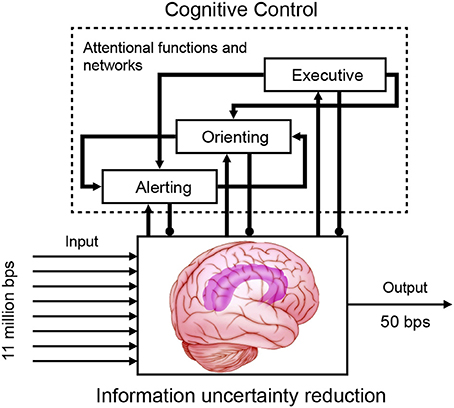
This diagram illustrates the role of cognitive control, orchestrated by the attention networks, in managing the flow of information. It dramatically reduces the massive sensory input to a manageable stream for conscious processing.
As the diagram shows, our senses are bombarded with an estimated 11 million bits of information per second. However, our capacity for conscious awareness is limited to a mere 50 bits per second. Attention is the elegant, powerful biological mechanism that performs this drastic filtering. It is the process of "information uncertainty reduction," selecting the tiny fraction of data that is most relevant to our current thoughts and goals, and discarding the rest.
This idea of attention as a set of interacting networks was pioneered by psychologist Michael Posner. To get a high-level overview of this concept from the source himself, let's watch a brief segment of an interview with Dr. Posner.
Michael Posner on the anatomy of attentional networks - a historical perspective
In this clip from an interview, Dr. Michael Posner introduces his influential three-component model of attention and explains how the ability to study the brain's anatomy revolutionized the field.
Please watch the section from this segment. Pay attention to how he distinguishes the three networks: alerting, orienting, and a higher-level executive system responsible for self-regulation.
As Dr. Posner explained, advances in neuroimaging allowed researchers to move beyond purely behavioral observations and map the distinct brain circuits underlying these functions. Now, let's formalize these definitions based on the paper "Research on Attention Networks" by Posner and Rothbart.
[PDF] Research on Attention Networks as a Model for the Integration of ...
This short excerpt from a review article provides concise, formal definitions for each of the three attention networks.
Please read the first paragraph of the "IMAGING ATTENTION NETWORKS" section, specifically the definitions that begin with the descriptions of each network.
With this framework in place, let's explore each network in detail. For a comprehensive tour, we will use a lecture that breaks down the function, neuroanatomy, and experimental tasks associated with each system.
Neurophysiology of Attention: Attention Networks
This video, "Neurophysiology of Attention" by Dr. Paul Merritt, provides a clear, structured overview of Posner's three networks. We will watch it in three parts, one for each network.
We will start with the introduction from the beginning to set the stage.
1. The Alerting Network: Achieving Readiness
The first and most fundamental system is the alerting network. Its primary job is to achieve and maintain a state of vigilance or arousal, preparing you to respond to incoming information. It's the "on" switch for the other attention systems.
- Function: General readiness, arousal, and vigilance.
- Analogy: Think of it as the engine of a car idling at a stoplight. It's not moving yet, but it's running and ready to accelerate the moment the light turns green.
- Key Brain Regions: This is a primitive, subcortical system. The locus coeruleus, a small nucleus in the brainstem, is a critical hub. It releases the neurotransmitter norepinephrine throughout the brain, increasing overall arousal.
- In Practice: You experience this network when a sudden noise puts you on high alert in a quiet house, or when you drink a cup of coffee and feel more "awake" and sensitive to your surroundings.
Let's delve deeper into the alerting network.
Neurophysiology of Attention: Attention Networks
This segment of Dr. Merritt's lecture details the alerting system.
Please watch the section on the alerting system, from this point. Notice the distinction between tonic alerting (sustained vigilance, like a radar operator) and phasic alerting (a brief increase in readiness after a warning cue).
2. The Orienting Network: The Spotlight of Attention
Once the alerting network has prepared you, the orienting network takes over to direct your attention to a specific source of sensory information. It's what allows you to select a particular object or location to focus on from the vast sensory field.
- Function: Selection of information from sensory input. It can be overt (moving your eyes and head) or covert (shifting attention without moving your eyes).
- Analogy: If the alerting network is the idling engine, the orienting network is the driver turning the steering wheel and aiming the car's headlights at a specific street sign.
- Key Brain Regions: This system involves areas in the parietal lobe, such as the superior parietal lobe and the temporoparietal junction (TPJ), as well as the frontal eye fields.
- In Practice: This network is active when you pick out a friend's face in a crowd, follow the path of a moving ball, or direct your listening to one conversation at a noisy party.
A classic method for studying this network is the Posner cueing task. As a statistician, you will appreciate how this experimental design uses reaction time as a dependent variable to make inferences about an unobservable cognitive process.
Neurophysiology of Attention: Attention Networks
Now, let's examine the orienting system.
Watch the next segment, from this point. Pay close attention to the explanation of the Posner cueing task. The difference in reaction time between valid trials (when the cue correctly predicts the target location) and invalid trials (when it doesn't) provides a quantifiable measure of orienting efficiency, known as the "validity effect."
3. The Executive Control Network: The CEO of the Brain
Finally, the executive control network is the highest level of attentional regulation. It is responsible for monitoring your internal state and the external world, resolving conflicts among competing thoughts and responses, and keeping you on task toward your goals. This is the network most associated with what we commonly call "focus" or "concentration."
- Function: Monitoring and resolving conflict, error detection, inhibiting distractions, and managing goal-directed behavior.
- Analogy: This is the driver making a conscious decision to ignore a flashy billboard (a distraction) and focus on navigating a complex intersection to reach their destination (the goal).
- Key Brain Regions: Key nodes include the anterior cingulate cortex (ACC) and the dorsolateral prefrontal cortex (DLPFC).
- In Practice: You engage this network when you force yourself to read a dense academic paper instead of checking your phone, resist the urge to eat a cookie when on a diet, or perform any task that requires overriding an automatic habit or impulse.
Tasks like the Stroop test and the flanker task are designed specifically to create conflict and tax this network, allowing researchers to measure its effectiveness.
Neurophysiology of Attention: Attention Networks
Lastly, we'll explore the executive control network.
Please watch the final segment from this point. Note how tasks like the flanker task create conflict (e.g., a central arrow pointing right, surrounded by flanker arrows pointing left), forcing the executive network to intervene and select the correct response.
Conclusion
In this lesson, we have established that attention is not a single faculty but a complex system composed of three distinct, interacting neural networks. By moving from a vague notion of "paying attention" to a precise model of alerting, orienting, and executive control, we now have a powerful framework for understanding the mechanics of focus.
Key Takeaways:
- Attention is a biological system that filters vast amounts of sensory information to select what is relevant for conscious processing and goal-directed action.
- The Alerting Network (driven by norepinephrine) is responsible for achieving and maintaining a state of arousal and readiness.
- The Orienting Network acts like a spotlight, directing sensory resources to specific locations or objects.
- The Executive Control Network is the "CEO," managing goals, resolving conflict between competing stimuli, and inhibiting distractions to enable sustained, deliberate focus.
- Cognitive scientists use carefully designed experiments (like the cueing and flanker tasks) that measure reaction times to quantify the efficiency of these individual networks.
To distill these concepts into the "cheat sheet" you requested, the following table, adapted from Posner and Rothbart's 2007 review paper, provides a concise summary of each network's function, key brain structures, and primary chemical modulator.
| Function | Key Brain Structures | Primary Modulator |
|---|---|---|
| Alert | Locus Coeruleus, Right Frontal Cortex, Parietal Cortex | Norepinephrine |
| Orient | Superior Parietal Lobe, Temporal Parietal Junction, Frontal Eye Fields | Acetylcholine |
| Executive Control | Anterior Cingulate Cortex, Lateral Prefrontal Cortex, Basal Ganglia | Dopamine |
We've now mapped the "what" and "where" of the attention networks. In our next lesson, we'll dive into the "how" by exploring the specific roles of these key chemical messengers—norepinephrine, acetylcholine, and dopamine—in modulating the activity of these networks and fine-tuning our ability to focus.