In our previous lesson, we journeyed into the cell to uncover the molecular gears of your internal clock—the transcription-translation feedback loop within the suprachiasmatic nucleus (SCN). We established that your body has an innate, self-sustaining timekeeper. However, for this clock to be effective, its ~24-hour rhythm must be precisely synchronized with the 24-hour rotation of the Earth. This process of synchronization is called entrainment.
This lesson focuses on the single most powerful signal for entraining your clock. Our learning outcome is to explain how the timing of light exposure regulates circadian entrainment and alertness. We will trace the specific pathway that light uses to communicate with your brain, introduce the formal model that describes its time-dependent effects, and translate this science into a clear set of rules for managing your daily energy and sleep.
From Photon to Pacemaker: The Retinal Pathway
Your ability to see the world is mediated by rod and cone photoreceptors in your retina. For decades, it was assumed these were the only light-sensitive cells in the eye. However, the discovery of blind individuals who could still synchronize their circadian rhythms to a light-dark cycle hinted at another pathway.
The key lies in a special class of neurons you were briefly introduced to before: the intrinsically photosensitive Retinal Ganglion Cells (ipRGCs). These are your body's dedicated light meters for non-visual functions.
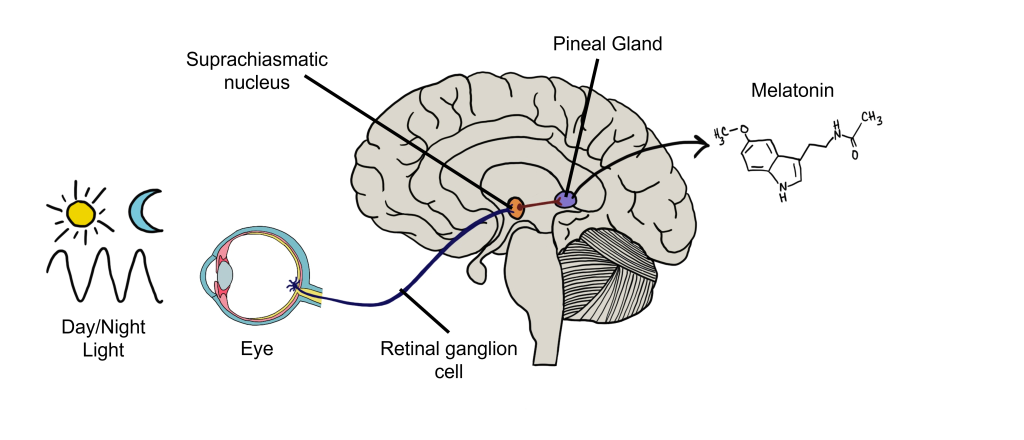
These ipRGCs contain a photopigment called melanopsin, which is most sensitive to blue light (around 480nm). When struck by photons of sufficient intensity, these cells send a signal directly to the SCN via the retinohypothalamic tract (RHT). This is the master switch that sets your clock.
To understand the practical implications of this system, it's essential to watch this segment from neuroscientist Dr. Andrew Huberman.
Master Your Sleep & Be More Alert When Awake | Huberman Lab Essentials
In this excerpt from the Huberman Lab Essentials series, Dr. Huberman explains the fundamental link between light, your internal clock, and the key hormones that govern your daily cycle of alertness and sleepiness.
Please watch the following three clips: First, watch the introduction to the circadian force. Next, watch the explanation of the hormonal rhythm and the pathway from the eyes to the central clock. Pay attention to the relationship between the morning cortisol pulse and the evening melatonin release. Finally, watch the short segment that clarifies the role of blue light and melatonin.
As Dr. Huberman explains, a key function of morning light is to time the healthy release of cortisol, which promotes wakefulness. This cortisol pulse, in turn, acts like starting a stopwatch that dictates when melatonin—the hormone of darkness and sleepiness—will be released about 12-14 hours later. By getting light exposure right, you are not just waking up for the day; you are programming the timing of your sleep later that night.
The Logic of Light: The Phase Response Curve (PRC)
The most crucial concept in circadian entrainment is that the effect of light is entirely dependent on when it arrives at your retina. The same light pulse that can help you wake up in the morning can disrupt your sleep if seen at night. This relationship is formally described by a Phase Response Curve (PRC).
A PRC plots the magnitude and direction of a "phase shift" (how much your internal clock is moved forward or backward) against the circadian time at which the stimulus (light) is delivered.
- Phase Advance: Light exposure in the subjective morning (roughly the second half of your sleep period and the first few hours of wakefulness) shifts your clock earlier. This makes you want to wake up and go to sleep earlier on subsequent days.
- Phase Delay: Light exposure in the subjective evening and early night shifts your clock later. This makes you want to stay up and wake up later.
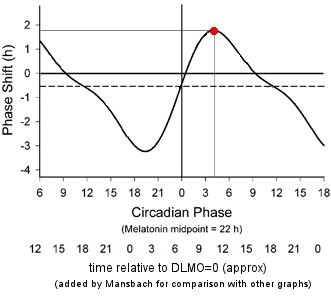
This is not just a theoretical model. It's derived from meticulous human experiments. Given your background in statistics, you'll appreciate seeing how such a curve is generated. The following resource is a landmark paper that did just that.
A phase response curve to single bright light pulses in human subjects
This paper from the Journal of Physiology details an experiment to construct a human PRC under highly controlled laboratory conditions. It provides a robust, data-driven foundation for the principles we are discussing.
First, read the Abstract to get an overview of the study's design and findings. Next, examine Figure 3 and the accompanying text in the Results section. Start reading from the description of the PRC. This is the graphical representation of their findings, showing the measured phase shifts in response to a 6.7-hour bright light exposure timed at different points across the circadian cycle.
As the study demonstrates, the transition from the delay zone to the advance zone is quite sharp, occurring around the time of the core body temperature minimum (which happens about 2 hours after the onset of melatonin secretion, or DLMO). This is the clock's moment of maximum sensitivity and the critical pivot point for daily resetting.
Practical Application: A Rulebook for Light Exposure
The science of the PRC gives us a clear set of rules for using light to anchor our circadian rhythm, enhance alertness during the day, and protect sleep at night.
Rule 1: View Bright Sunlight Early in the Day
This is the most important action you can take. Getting bright light in your eyes within the first hour of waking triggers a strong phase advance, locking your clock to the day.
- Why sunlight? The intensity of outdoor light is orders of magnitude greater than indoor lighting. As you'll see in the next video, sunlight on a clear day can be over 100,000 lux, while a brightly lit office may only be 500-1000 lux. Windows and windshields filter out a significant portion of the relevant wavelengths and can reduce the effective intensity by 50 times or more.
- How long? On a clear day, 5-10 minutes is sufficient. On a very overcast day, you may need 20-30 minutes because your clock is essentially a "photon counter," and it needs to integrate enough light to trigger the signal.
- How? Go outside. Don't wear sunglasses (unless the glare is painful). You don't need to stare at the sun; simply being outside and looking in its general direction is enough.
The following discussion between Dr. Peter Attia and Dr. Huberman provides excellent quantitative details and explains why morning (and evening) light is so special.
How light exposure affects circadian rhythms and mental health | Peter Attia and Andrew Huberman
This conversation delves into the specific properties of sunlight and the mechanisms of the retinal cells that detect it.
Watch the following three segments: Begin with the discussion on light intensity (Lux) and the photon-summing nature of your clock. Next, watch the practical recommendations for viewing sunlight safely and effectively. Finally, listen to the fascinating explanation of the color-comparison mechanism that makes your clock exquisitely sensitive to the unique spectrum of light when the sun is low in the sky (low solar angle).
The key insight from that last clip is that the ipRGCs are not just looking for brightness; they are performing a color-contrast calculation between blue and yellow/red wavelengths. This contrast is maximal at sunrise and sunset, which is why "low solar angle" light is such a potent signal for marking the beginning and end of the day. Midday light, while bright, lacks this specific contrast and falls in a "circadian dead zone" for shifting the clock (though it is still beneficial for alertness and mood).
Rule 2: Avoid Bright Light in the Evening and at Night
Just as morning light is a powerful "go" signal, light at night is a powerful "delay" signal. It tells your SCN that it's still daytime, suppressing melatonin release and pushing your desire for sleep later.
Crucially, your visual system adapts throughout the day. The longer you have been awake, the more sensitive your retina becomes to light. This means that even a small amount of light at night can have a large phase-delaying effect.
Effects of light on human circadian rhythms, sleep and mood - PMC
This review article provides a robust summary of the research on light's effects, including the impact of modern artificial lighting.
Please read two sections from this paper: First, read the section on the "Effects of light on the circadian clock". This reinforces the concepts of melatonin suppression and phase shifting. Next, read about artificial lighting and screens. Notice the mention that dimming your phone is far more effective at reducing melanopic stimulation than using "night shift" modes.
The period between roughly 11 PM and 4 AM is particularly sensitive. Bright light exposure during this window not only delays your clock but has also been shown to directly suppress the brain's dopamine circuits via a connection to a structure called the habenula. This can negatively impact mood, motivation, and your ability to learn the following day.
Practical steps for nighttime:
- Dim indoor lights in the evening.
- Avoid using bright overhead lights. Use lamps with warm-toned bulbs placed low in your environment. Remember, the ipRGCs are primarily in the bottom half of your retina, looking up at the sky (and overhead lights).
- If you must use screens, dim them to the lowest possible setting.
- If you wake in the middle of the night, use as little light as possible.
Conclusion
In this lesson, we have established the direct, mechanistic link between environmental light and your internal biological clock. You now understand not only that light is important, but precisely how and when it exerts its powerful influence on your daily rhythms of energy and sleep.
Here are the key takeaways and your "cheat sheet" for this topic:
- The Sensor: Your brain's clock, the SCN, is synchronized to the day primarily by light signals from intrinsically photosensitive retinal ganglion cells (ipRGCs) in your eyes.
- The Logic: The effect of light is time-dependent, as described by the Phase Response Curve (PRC).
- Morning Light → Phase Advance: Shifts your clock earlier, promoting earlier waking and sleep times.
- Night Light → Phase Delay: Shifts your clock later, promoting later waking and sleep times.
- The Formula for Entrainment:
- GET SUNLIGHT: Upon waking, view direct sunlight for 5-10 minutes (longer if overcast). This is the primary anchor for your day.
- AVOID BRIGHT LIGHT: In the 2-3 hours before bed, dim all lights and screens. Avoid bright, overhead lighting. This allows melatonin to rise naturally.
- PROTECT THE NIGHT: Absolutely avoid bright light exposure between 11 PM and 4 AM. This protects your sleep timing and dopamine levels.
We have now covered the master ~24-hour cycle. However, your energy fluctuates in shorter cycles within that 24-hour period. In our next lesson, we will explore these ultradian rhythms, approximately 90-minute cycles of focus and fatigue that punctuate your day, adding another critical layer to your energy management toolkit.