Welcome back. In our previous lesson, we established the body's two-pronged acute stress response: the lightning-fast SAM axis that unleashes adrenaline for "fight-or-flight," and the more deliberate HPA axis that deploys cortisol for sustained energy mobilization. We concluded that this system is a masterpiece of evolutionary design for short-term survival. This naturally leads to a critical question for modern life: what happens when this emergency system is activated not for a brief, life-threatening event, but day after day in response to deadlines, traffic, and social pressures?
Today, we will answer that question by exploring the concept of allostatic load. You will learn to define this term as the cumulative "wear and tear" that chronic stress inflicts on your body and, most importantly for your goals, your brain. We will examine how this load is measured and detail its specific, cumulative consequences for your cognitive performance, including attention, memory, and executive function.
From Homeostasis to Allostasis
To grasp the impact of chronic stress, we first need to refine our understanding of physiological balance. You're likely familiar with the term homeostasis, which describes the body's ability to maintain a stable internal environment—like keeping body temperature at a steady 37°C. This concept, however, implies a static set-point.
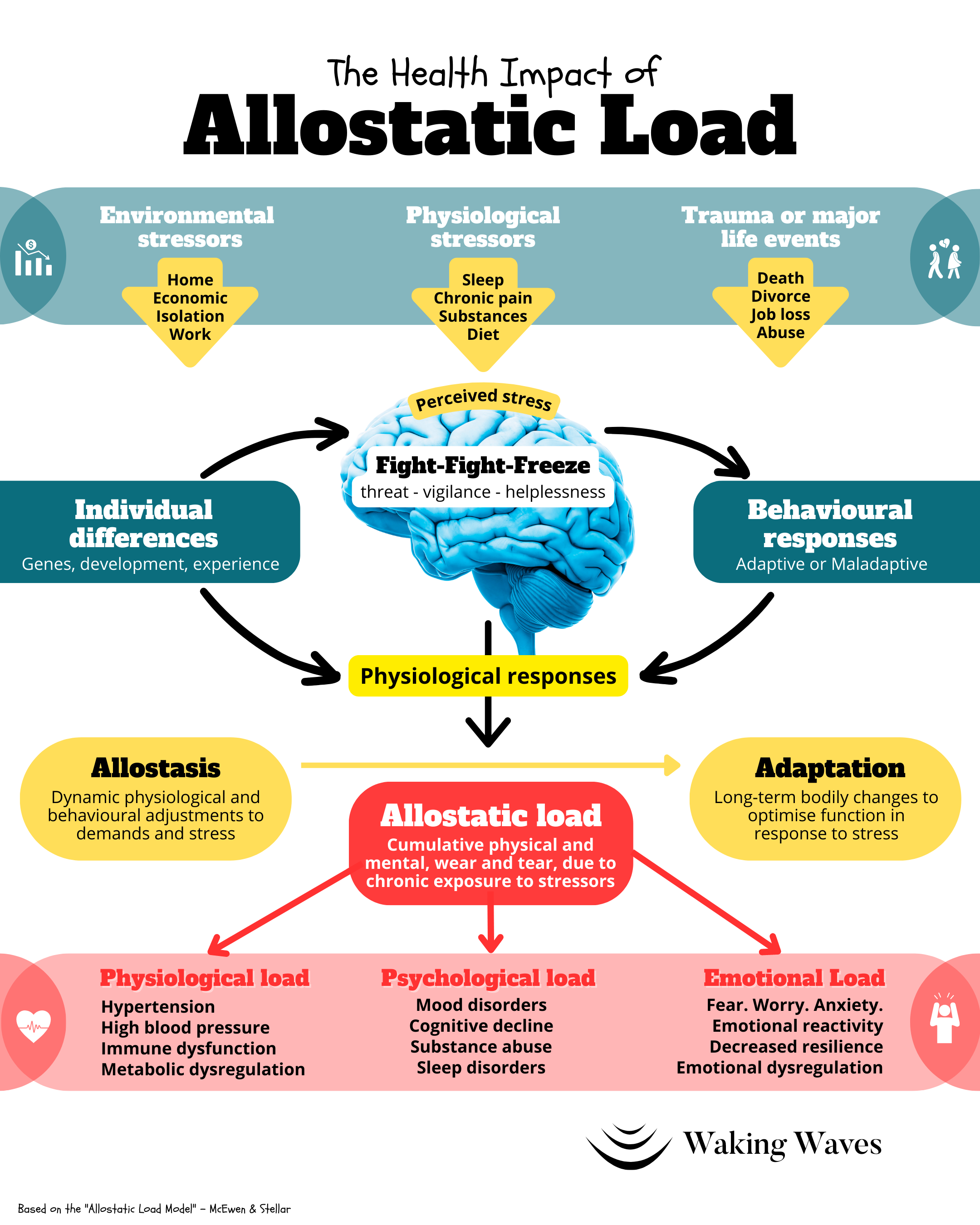
In the 1980s, physiologists Peter Sterling and Joseph Eyer introduced a more dynamic concept: allostasis. Allostasis, meaning "stability through change," describes the active, adaptive processes the body uses to maintain stability by responding to and anticipating challenges. While a house's thermostat maintains homeostasis, your body achieves allostasis by making constant, predictive adjustments—mobilizing energy, changing heart rate, and adjusting hormone levels to meet expected and actual demands.
The acute stress response we discussed is a powerful allostatic process. But when the demand is relentless, the very systems that promote adaptation can begin to cause damage.
Allostatic Load: The Cost of Adaptation
The term allostatic load was coined by neuroscientist Bruce McEwen to describe the cumulative cost—the biological "wear andtear"—that results from chronic over-activation or dysregulation of these allostatic systems. It is the price the body pays for being forced to adapt continually to a stressful environment.
To get an intuitive feel for this idea, let's hear from Dr. Robert Sapolsky, who masterfully explains why our ability to anticipate and worry about psychological stressors is at the root of the problem.
"Why Zebras Don't Get Ulcers: Stress and Health" by Dr. Robert Sapolsky
In his famous lecture "Why Zebras Don't Get Ulcers," Dr. Sapolsky contrasts the acute physical stress of animals with the chronic psychosocial stress of humans. This provides a compelling foundation for understanding why allostatic load is such a significant issue for us.
Please watch three segments from this video: First, watch the introduction to psychological stress. Pay close attention to the distinction he makes between a stressor that knocks you out of homeostasis and thinking you are about to be knocked out of homeostasis. Next, he discusses the historical context and early theories of stress. This provides background on Hans Selye's work. Finally, and most critically, watch the section explaining how the stress response itself becomes damaging. This is the conceptual core of allostatic load: the solution is more harmful than the problem over the long term.
As Dr. Sapolsky argues, the problem isn't that the stress response runs out of fuel (the "exhaustion" theory). The problem is that the chronic mobilization of energy, increased cardiovascular activity, and suppression of long-term projects like immunity and digestion are incredibly costly when sustained. This cost is allostatic load.
Mechanisms of Allostatic Load
Allostatic load doesn't arise from a single type of system failure. Dr. McEwen identified four primary patterns of dysregulation that contribute to the cumulative burden.

These four patterns are:
- Repeated Hits: Frequent, multiple novel stressors that constantly activate the SAM and HPA axes.
- Lack of Adaptation: The failure to habituate to a recurring stressor. The body should mount a smaller response each time it encounters the same challenge, but sometimes it doesn't.
- Prolonged Response: The inability to shut off the stress response after the stressor has passed. This can be due to dysfunction in the negative feedback loop where cortisol normally signals the brain to stop producing CRH and ACTH.
- Inadequate Response: A blunted or insufficient hormonal response (e.g., low cortisol) which can lead to over-activation of other allostatic systems, such as inflammation.
To formalize this, researchers developed a model of primary, secondary, and tertiary outcomes.
Advancing the allostatic load model in military training research
This research review provides a clear, structured definition of the allostatic load model, which will be useful for your analytical approach.
Please read the section that begins with the definition of allostatic load. Focus on understanding the distinction between primary outcomes (e.g., changes in hormone receptors), secondary outcomes (e.g., high blood pressure, altered sleep), and tertiary outcomes (e.g., disease, injury).
Measuring the "Wear and Tear"
Since allostatic load represents multisystem dysregulation, it cannot be measured by a single biomarker like cortisol. Instead, as a statistician, you'll appreciate that it's operationalized as a composite index. Researchers typically create an Allostatic Load Index (ALI) by measuring a panel of biomarkers across several key physiological systems and counting how many fall into a high-risk quartile.
A recent study on AL and brain aging provides a great example of the biomarkers used.
Allostatic load, a measure of cumulative physiological stress, impairs ...
This paper by Poisnel et al. (2025) clearly lays out how a modern AL index is constructed.
Read the section titled "2.2. Allostatic load". You don't need to memorize the biomarkers, but notice the five categories they represent: neuroendocrine, immune, metabolic, cardiorespiratory, and anthropometric. This illustrates the multi-system nature of the index.
This approach allows researchers to quantify the cumulative physiological burden and then use it as a variable in statistical models to predict health and cognitive outcomes.
The Cumulative Cognitive Consequences
Now we arrive at the heart of the matter for our course: How does this accumulating physiological burden affect the brain and our ability to think? The evidence is clear and points to both structural and functional decline. The brain is the central organ of the stress response—it decides what is stressful, launches the response, and is in turn a primary target of that response.
Let's turn to the originator of the concept, Dr. Bruce McEwen, for a detailed explanation of how chronic stress remodels the brain.
Bruce McEwen - The Resilient Brain: Epigenetics, Stress and the Lifecourse
This lecture by Dr. McEwen provides a definitive look at how stress impacts the brain's plasticity. His explanation of the changes in the hippocampus, prefrontal cortex, and amygdala is foundational.
Watch the segment from the beginning of the brain section. Focus on the three key brain regions he discusses and the opposite effects that stress has on them: Hippocampus: Shrinkage of dendrites, reduced neurogenesis. Prefrontal Cortex: Shrinkage of dendrites. Amygdala: Growth of dendrites and increased branching.
As Dr. McEwen explains, chronic stress leads to a brain that is literally rewired for anxiety and vigilance at the expense of memory and executive control.
- Hippocampal Atrophy: The hippocampus is crucial for memory formation (especially episodic memory) and helps regulate the HPA axis. Chronic exposure to cortisol is toxic to hippocampal neurons, leading to impaired memory consolidation and a weakened ability to shut off the stress response.
- Prefrontal Cortex (PFC) Atrophy: The PFC is the seat of your executive functions—planning, decision-making, working memory, and top-down attentional control. When its connections weaken, your ability to regulate impulses, stay focused on a goal, and think flexibly is diminished.
- Amygdala Hypertrophy: The amygdala is your brain's alarm center. Under chronic stress, it becomes larger and more active, making you more prone to anxiety, fear responses, and perceiving threats where there may be none.
Dr. Sapolsky provides a complementary and stark summary of these cognitive consequences.
"Why Zebras Don't Get Ulcers: Stress and Health" by Dr. Robert Sapolsky
This final clip from Dr. Sapolsky's lecture directly links the brain changes we've just discussed to clinical and cognitive outcomes like PTSD, depression, and anxiety.
Please watch the concluding segment on stress and the brain. Note his powerful summary: stress atrophies the hippocampus (damaging memory), grows the amygdala (promoting fear and anxiety), and depletes dopamine (leading to anhedonia, the inability to feel pleasure).
These structural changes translate directly into measurable cognitive deficits. The same 2025 study by Poisnel et al. that we reviewed for its methodology found a direct link between their Allostatic Load Index and cognitive performance in healthy older adults.
Allostatic load, a measure of cumulative physiological stress, impairs ...
This final reading provides the empirical punchline, connecting the theoretical construct of AL to a concrete cognitive outcome.
First, look at Section 3.3 and the accompanying Table 3. Note the significant positive beta coefficient for "Selective attention," indicating that higher AL was associated with poorer attentional performance. Then, read the first three paragraphs of the Discussion section. This will summarize the key finding and place it in the context of brain aging and stress.
The study's finding is a powerful demonstration of this lesson's main point: a higher cumulative physiological burden (allostatic load) is directly associated with a diminished capacity for selective attention—a cornerstone of the deep work and focus you are aiming to cultivate.
Conclusion
Today we have traced the path from the adaptive acute stress response to the maladaptive consequences of its chronic activation. You've learned that allostasis is the process of maintaining stability through change, while allostatic load is the cumulative wear and tear that results from the sustained or dysregulated activity of these allostatic systems. This load, quantified by a multi-system Allostatic Load Index (ALI), causes predictable remodeling of the brain, ultimately undermining the very cognitive functions—memory, executive control, and attention—that are critical for high performance.
Here is your cheat sheet for this lesson:
The Allostatic Load Formula
-
Allostasis: The body's active and adaptive process of maintaining stability in response to stressors ("stability through change").
-
Allostatic Load (AL): The cumulative physiological "wear and tear" on the body and brain resulting from chronic activation or dysregulation of allostatic systems.
-
The Cognitive Cascade:
This framework paints a sobering picture, but it also illuminates a path forward. By understanding stress not just as a feeling but as a physiological process with cumulative consequences, we gain leverage to manage it.
However, it's crucial to remember that not all stress is harmful. In our next lesson, we will explore the difference between debilitating distress and performance-enhancing "eustress," using the famous Yerkes-Dodson law to understand the optimal level of arousal for peak performance.