Introduction
Welcome back. In our last lesson, we introduced the "dual-process" model of the mind, distinguishing between the fast, intuitive System 1 and the slow, deliberate System 2. We defined cognitive biases as predictable "bugs" in our mental operating system that arise from System 1's reliance on mental shortcuts.
Today, we're zooming in on two of the most common and costly biases that affect personal and financial decisions. Your goal for this lesson is to learn to identify confirmation bias and the sunk cost fallacy in realistic scenarios. Recognizing these biases in action is the critical next step toward mitigating their influence on your choices.
Confirmation Bias: The Echo Chamber in Your Head
Confirmation bias is the tendency to search for, interpret, favor, and recall information in a way that confirms or supports your pre-existing beliefs. Once an idea is in our head, our brain works to protect it rather than challenge it.
Given your background in ethical hacking, you can think of this as a flawed testing strategy. Instead of running a full suite of penetration tests designed to find vulnerabilities, confirmation bias is like only running tests that you know will produce a "pass" result, giving you a false sense of security.
To see how this applies to your interest in investing, let's get a formal definition.
Behavioral Finance | Investor Irrationality
This short clip from the video 'Behavioral Finance' by The Plain Bagel provides a concise explanation of confirmation bias within an investment context.
Watch from 03:04 to 03:55. Focus on how the video describes this as a 'belief perseverance' bias and the specific example of using a single positive research report to justify a stock purchase while ignoring ten negative ones.
This bias isn't limited to finance; it permeates our daily lives. The following infographic provides clear examples across various personal domains.

Before moving on, take a moment to reflect: can you think of a recent decision—perhaps a large purchase, a new tech tool you adopted, or even a strong political opinion you hold—where you might have spent more time looking for reasons you were right than reasons you might be wrong?
Sunk Cost Fallacy: Trapped by the Past
The sunk cost fallacy describes our tendency to continue with an endeavor because we have already invested time, money, or effort. The key insight is that these past costs are "sunk"—they are gone and cannot be recovered. Therefore, they should not be a factor in deciding the best course of action moving forward. Rational decision-making should be based on future prospects, not past expenses.
This bias is powerful because it plays on our deep-seated aversion to waste and feelings of guilt.
Clutter Psychology - why DECLUTTERING makes you feel GUILTY, STRESSED & ANXIOUS / Sunk Cost Fallacy
For a great explanation of this fallacy, let's turn to a video from psychologist Nena Lavonne. She defines the concept and provides numerous examples that you'll likely find very familiar.
Watch from the beginning to 03:33. Pay close attention to the definition and the wide range of examples, which include finishing a bad movie, staying in an unfulfilling career, and holding onto expensive but unused items.
The core challenge of the sunk cost fallacy is reframing the decision. Instead of thinking about what you've already lost, you must ask what you stand to gain or lose in the future.
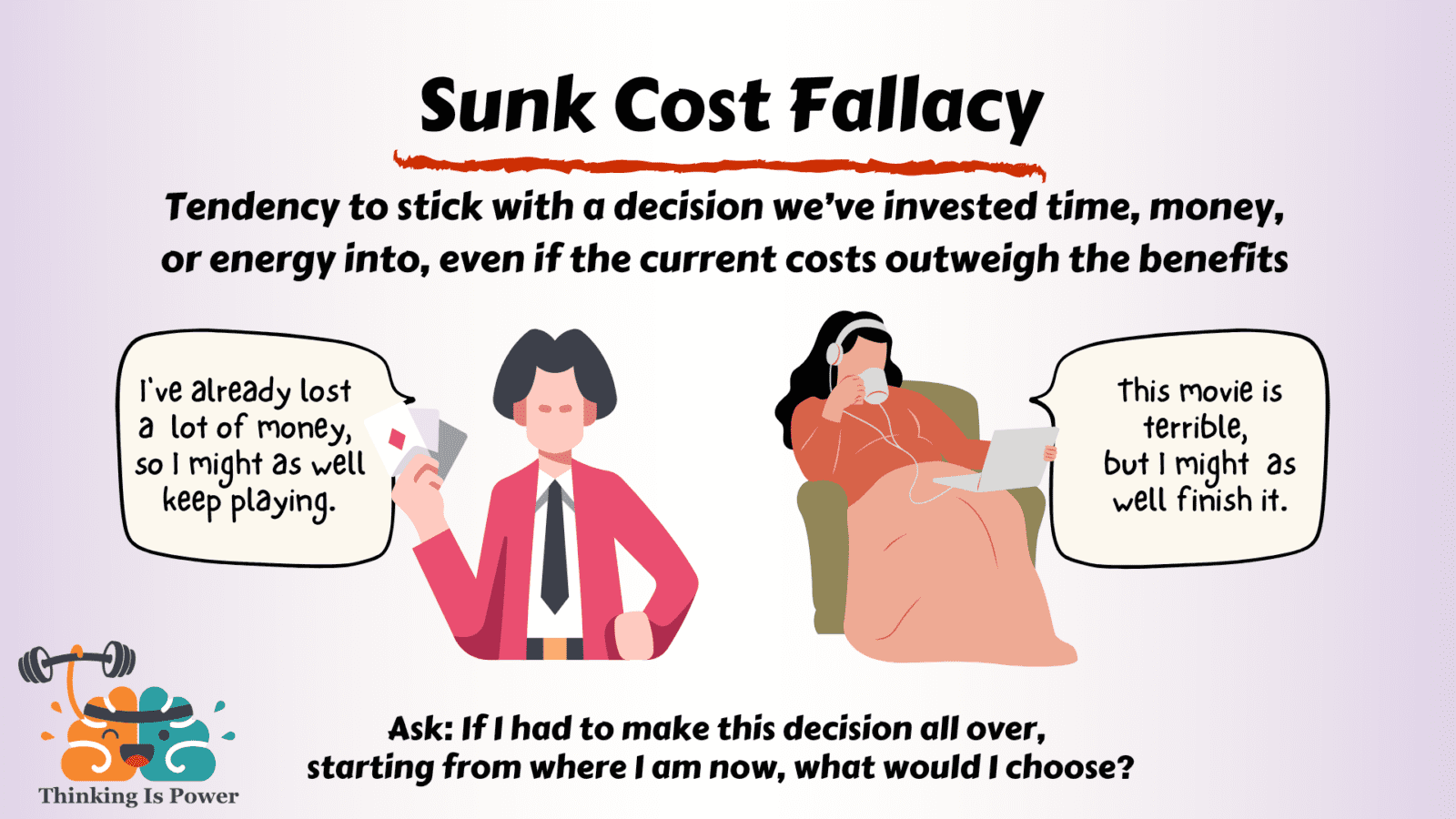
For another perspective, this article from UC Berkeley's Greater Good Science Center connects the sunk cost fallacy directly to our fear of loss and dislike of waste.
How the Sunk Cost Fallacy Can Drive Bad Decisions
This article explores the psychological roots of the sunk cost fallacy and provides some compelling real-world examples.
Please read the section titled 'Sinking ever deeper'. Notice how the amount of prior investment influences the willingness to continue, and consider the examples of the ophthalmologist's laser and Boeing's 737.
The Vicious Cycle: How Sunk Costs and Confirmation Bias Team Up
These two biases are particularly dangerous because they often reinforce each other, creating a powerful psychological trap.
- Sunk Cost Fallacy makes you stick with a failing course of action because of your past investment.
- Confirmation Bias then kicks in to make you feel better about that decision. You start actively seeking and over-valuing information that suggests sticking with it is the right move, while dismissing any information to the contrary.
This creates a vicious cycle where you double down on a bad decision, digging yourself into a deeper hole.
Why Sunk Cost Fallacy And Confirmation Bias Go Hand In Hand
The following article is dedicated to explaining how this toxic partnership works.
Read the sections 'How Sunk Cost Fallacy and Confirmation Bias Reinforce Each Other' and 'Examples of Sunk Cost Fallacy and Confirmation Bias in Action.' The stock investment example is a perfect illustration of this cycle and directly relevant to your goals.
Identify the Bias: A Practical Exercise
Now, let's practice identifying these biases. For each scenario below, determine which bias (or both) is most prominently at play and briefly justify your answer.
Scenario 1: You invested $5,000 in a cryptocurrency. It has since dropped 80% in value. Your friends show you analysis suggesting the project is failing, but you ignore it. Instead, you spend your time on the project's Reddit forum, focusing only on posts from optimistic holders and dismissing all negative analysis as "FUD" (Fear, Uncertainty, and Doubt). You decide to hold on.
Scenario 2: You've been in your current job for five years. The pay is decent, but you find the work unfulfilling and the culture draining. You receive a promising offer for a new role at a different company that seems much more aligned with your interests. However, you turn it down, thinking, "I've put five years into this company and built up so much seniority. It would be a waste to just throw that all away and start over."
Scenario 3: You bought an expensive, high-end home gym system two years ago for $3,000, determined to get in shape. You've used it fewer than ten times. It now takes up a significant amount of space in your spare room. When a friend offers to buy it from you for $800, you refuse, saying, "No way, I paid $3,000 for this. Selling it for that little would be a huge loss."
Click to see the analysis
-
Scenario 1: This is a classic example of the vicious cycle. The initial decision to hold on despite a massive loss is driven by the sunk cost fallacy (not wanting to accept the $4,000+ loss). This is then immediately reinforced by confirmation bias, as you actively seek out information that confirms your decision to hold (optimistic Reddit posts) and ignore information that challenges it (negative analysis).
-
Scenario 2: This is primarily the sunk cost fallacy. The "five years" and "seniority" are past investments of time and effort. The rational choice would be to compare the future prospects of the old job versus the new job. Instead, the decision is being made based on the reluctance to "waste" the past five years, even though that time is already spent and cannot be recovered.
-
Scenario 3: This is another clear case of the sunk cost fallacy. The original $3,000 price is a sunk cost. The rational decision now is whether you prefer to have $800 and a free room, or keep an unused piece of equipment. Anchoring the current value to the original purchase price is irrational, as the money is already gone.
Conclusion
In this lesson, we dissected two critical cognitive biases that derail rational decision-making in both personal and financial contexts.
Key Takeaways:
- Confirmation Bias: We tend to favor information that confirms what we already believe. To counter it, actively seek out dissenting opinions and evidence that could prove you wrong. Ask, "What's the strongest argument against my position?"
- Sunk Cost Fallacy: We tend to stick with things we've invested in, even when it's no longer rational. To counter it, focus on future costs and benefits, ignoring past investments. Ask, "Knowing what I know now, would I still make this choice today?"
- Vicious Cycle: These biases often work in tandem, creating a powerful trap where you justify a bad decision based on past costs by seeking out confirming evidence.
Now that you can identify these common decision-making "bugs," you're ready to learn about a proactive tool to help prevent them from taking hold in the first place. In the next lesson, we will learn how to use a weighted decision matrix, a systematic framework for evaluating complex choices with multiple criteria, which forces a more deliberate, System 2 approach.