Hello! Welcome back to our course on algorithmic game theory.
In our previous lesson, we established the "easy direction" of the minimax theorem, proving that for any game, the maximin value is always less than or equal to the minimax value:
This inequality confirms the intuition that having to commit to a strategy first (maximin) cannot be more advantageous than reacting to an opponent's move (minimax).
Today, we take a major step forward. We will focus on the remarkable result by John von Neumann that for two-player zero-sum games, this inequality becomes a strict equality. This lesson addresses the learning outcome: State von Neumann's minimax theorem and relate the value of the game to Nash Equilibrium. We will define the "value of the game" and establish its fundamental connection to the Nash equilibria of zero-sum games.
1. Von Neumann's Minimax Theorem
The proof that maximin ≤ minimax was quite general. The much more profound result, which applies specifically to finite, two-player, zero-sum games, is that these two values are in fact equal.
This is the celebrated Minimax Theorem.
The Minimax Theorem: For any finite two-player zero-sum game with payoff matrix for the row player (Player 1), the following equality holds:
Here, and are the mixed strategy vectors for the row and column players, respectively.
This common value is called the value of the game, often denoted by . It represents the best possible guaranteed expected payoff for Player 1, assuming both players play optimally. Since the game is zero-sum, Player 2's payoff is then .
To see a formal statement of this theorem, you can consult the following resource.
1 Minimax equilibria through linear programming
These lecture notes by Tim Sandholm provide a concise statement of the Minimax Theorem.
Please read the short section titled 'Theorem 1.1 (von Neumann, 1928)'. Note that the notation is slightly different, but the principle is identical: the maximin and minimax values are equal.
The equality of maximin and minimax is a powerful concept. It implies that in a zero-sum game, there's no advantage to playing second or having your opponent know your strategy, provided you are both playing optimally. The outcome is pre-determined by the game's structure. Visually, this corresponds to the idea of a "saddle point" on the payoff surface.
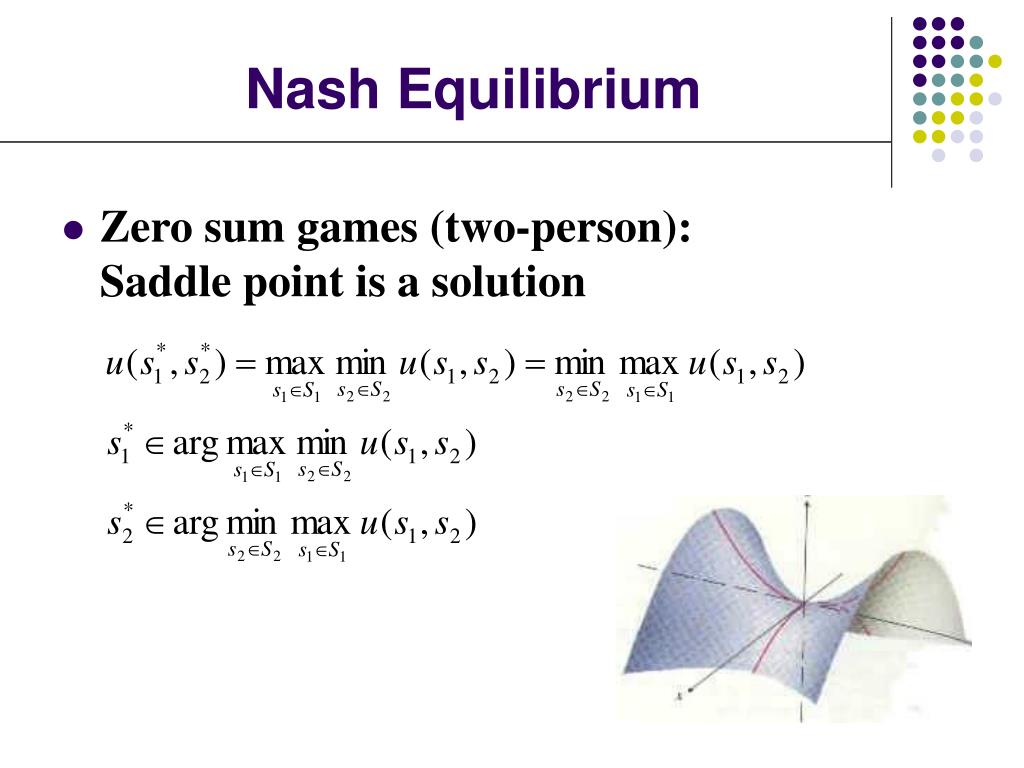
Proving this theorem is non-trivial. As foreshadowed by your course goal, we will construct a full proof in a later module using the Strong Duality Theorem of Linear Programming. For now, we will take the theorem as given and explore its profound implications.
2. The Link Between Minimax Solutions and Nash Equilibrium
We now have two central solution concepts:
- Nash Equilibrium (NE): A strategy profile where no player can unilaterally deviate and improve their payoff.
- Minimax Solution: A pair of strategies where is a maximin strategy for Player 1 and is a minimax strategy for Player 2.
What is the relationship between them? For two-player zero-sum games, they are fundamentally the same. A pair of maximin/minimax strategies is a Nash Equilibrium, and vice-versa.
Let's explore why a minimax solution must be a Nash Equilibrium. Let be a pair of maximin/minimax strategies. By the Minimax Theorem, we know:
From the definitions of and :
- . This means that if Player 1 plays , their payoff is guaranteed to be at least , no matter what Player 2 chooses. for all .
- . This means that if Player 2 plays , Player 1's payoff can be at most , no matter what Player 1 chooses. for all .
Now, let's check the conditions for Nash Equilibrium for the profile , where the payoff is . From the properties above, we know that , which implies the payoff must be exactly .
- Can Player 1 do better? If Player 1 deviates to some other strategy , their payoff will be . But we know from property (2) that . Since their current payoff is , there is no incentive to deviate.
- Can Player 2 do better? If Player 2 deviates to some other strategy , Player 1's payoff will be . From property (1), we know this payoff is . Since this is a zero-sum game, Player 2's payoff is the negative of Player 1's. A higher payoff for Player 1 means a lower payoff for Player 2. Since Player 2's current payoff is , and any deviation leads to a payoff of , there is no incentive for Player 2 to deviate.
Since neither player can improve their payoff by unilaterally changing their strategy, the minimax solution is a Nash Equilibrium.
The following reading provides a concise summary of this crucial argument.
1 Minimax equilibria through linear programming
This brief remark from the lecture notes we saw earlier elegantly proves that a pair of minimax strategies forms a Nash Equilibrium.
Please read 'Remark 1.2 (Minimax equilibria are Nash equilibria)'. The argument uses inequalities to show that neither player has an incentive to deviate from their minimax strategy.
3. The Uniqueness of the Value of the Game
A game can have multiple Nash Equilibria. For example, some pure strategy profiles might be equilibria, and there might also be a mixed strategy equilibrium. However, in a zero-sum game, a remarkable property emerges: the payoffs are the same in all Nash Equilibria.
This directly connects the value from the Minimax Theorem to the payoffs in any Nash Equilibrium.
The following resource formally states this property and uses it to define the value of a game.
[PDF] Lecture 1.1: The Minimax Theorem
These lecture notes by Constantinos Daskalakis, which we will use extensively later, clearly state the uniqueness of payoffs in zero-sum game equilibria.
In the document, find the end of the proof of Theorem 2. Read 'Corollary 6 (Uniqueness of Payoffs)' and 'Definition 2 (Value of a Zero-Sum Game)'. This solidifies the link between the Nash Equilibrium payoff and the value of the game.
As the text states, the value of a zero-sum game is precisely the unique payoff that the row player receives in any of the game's Nash equilibria. This beautifully ties together the minimax solution concept and the Nash Equilibrium concept. The value we find via the minimax equality is not just an abstract quantity; it is the concrete payoff outcome at equilibrium.
Conclusion
Today, we've explored one of the cornerstones of game theory and its relationship with Nash Equilibrium.
Key Takeaways:
- Von Neumann's Minimax Theorem: For any finite, two-player, zero-sum game, the maximin value equals the minimax value. This common value is known as the value of the game ().
- Minimax and NE Equivalence: A pair of maximin/minimax strategies constitutes a Nash Equilibrium in a zero-sum game.
- Value of the Game and NE Payoffs: The value of the game, , is the unique payoff for Player 1 across all possible Nash Equilibria of the game. The corresponding payoff for Player 2 is .
Preview of the next lesson:
We've established that a minimax solution is a Nash Equilibrium. To complete the picture, in our next lesson we will formalize this relationship by proving the full equivalence: a strategy profile in a zero-sum game is a Nash equilibrium if and only if it is a minimax solution. This will cement the interchangeability of these concepts, a crucial step before we learn how to compute these solutions using linear programming.