Hello! Welcome to the final lesson of our first module.
In our last session, we defined the concept of a Nash Equilibrium (NE) and developed a method for finding pure-strategy NEs by looking for points of mutual best response. However, we left an important question unanswered: what happens in games where no such equilibrium exists? Consider the simple game of Matching Pennies, where no matter the outcome, one player always wishes they had chosen differently.
This lesson addresses that gap by introducing mixed-strategy Nash Equilibria. This will complete our foundational understanding of Nash Equilibrium and equip us with the tools to solve a much broader class of games.
Our learning outcome is to: Compute mixed-strategy Nash Equilibria in 2x2 games using the indifference principle.
Specifically, we'll cover:
- The core theoretical insight that makes mixed-strategy equilibria work: the Indifference Principle.
- The formal definition of the support of a mixed strategy.
- A step-by-step method to calculate the equilibrium probabilities in any 2x2 game.
1. The Indifference Principle
Let's start with the central idea. In a mixed-strategy Nash Equilibrium, a player is randomizing their choice between two or more pure strategies. Why would they do this? If one of those pure strategies gave a strictly higher expected payoff than the others (given the opponent's strategy), a rational player would abandon the mix and just play that single best strategy.
Therefore, for a player to be willing to mix, they must be indifferent between all the pure strategies they are choosing to play with a positive probability. This powerful insight is the key to finding mixed-strategy equilibria.
First, let's formally define the set of strategies a player is actively using.
Definition: Support of a Mixed Strategy
The support of a player's mixed strategy is the set of pure strategies that are played with a strictly positive probability. For example, if a player's strategy is to play Rock 50% of the time, Paper 50%, and Scissors 0%, the support of that strategy is {Rock, Paper}.
The following video provides an excellent explanation of the support and a clear, intuitive proof by contradiction for the indifference principle.
Game Theory 101 (#32): The Support of Mixed Strategies
This video from William Spaniel's 'Game Theory 101' series explains the concept of a strategy's support and proves why, in equilibrium, a player must be indifferent between all pure strategies within that support.
Please watch from 1:58 to 6:42. Pay close attention to: The definition of the support of a mixed strategy. The core theorem: In a mixed-strategy NE, the expected utility for each pure strategy in the support must be equal. The logic of the proof by contradiction that follows. Why would a player have a profitable deviation if this condition were not met?
2. The Equality of Payoffs Theorem
The indifference principle is so fundamental that it's often stated as a formal theorem. Given your interest in the theoretical aspects of our topics, it's worth studying its formal statement and proof.
The following resource presents this as the "Equality of Payoffs Theorem." It proves that if a strategy profile is a Nash Equilibrium, then a player must receive the same expected payoff from any pure strategy within the support of their mixed strategy.
Chapter 6 - Nash equilibria in mixed strategies
This chapter from a game theory course by Vincent Knight provides a concise and formal treatment of the key theorem for finding mixed-strategy equilibria.
Please read the section titled 'Equality of payoffs theorem'. Start from the 'Definition of the support of a strategy', then read the 'Theorem of equality of payoffs' and its 'Proof'. This will provide the rigorous foundation for the calculations we're about to perform.
The proof is a classic proof by contradiction and directly uses the definitions of Nash Equilibrium and expected utility you're already familiar with. It demonstrates that if the payoffs were not equal, the player could improve their overall utility by shifting probability away from the lower-payoff strategy towards the higher-payoff one, thus contradicting the assumption that the original mixed strategy was part of a Nash Equilibrium.
3. Calculating Mixed-Strategy Nash Equilibria
Now we can turn this powerful theorem into a practical algorithm for 2x2 games. The logic is as follows:
- To make Player 1 willing to mix, Player 2 must choose their probabilities such that Player 1 is indifferent between their two pure strategies.
- Simultaneously, to make Player 2 willing to mix, Player 1 must choose their probabilities such that Player 2 is indifferent between their two pure strategies.
This gives us two linear equations that we can solve to find the equilibrium probabilities for each player.
Let's see this calculation in action for the "Battle of the Sexes" game.
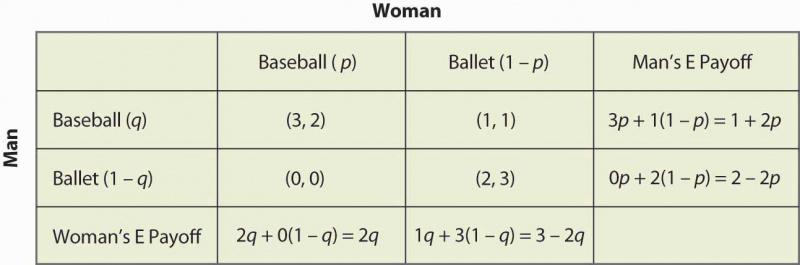
The following video provides a clear, step-by-step walkthrough of this calculation.
GTO-2-03: Computing Mixed-Strategy Nash Equilibria
This video from 'Game Theory Online' demonstrates exactly how to apply the indifference principle to compute the mixed-strategy Nash Equilibrium for the Battle of the Sexes game.
Please watch from 1:43 to 7:49. The video breaks down the process into two parts: (1:43 - 5:19) Finding Player 2's mixed strategy: It sets Player 1's expected payoffs equal to each other and solves for Player 2's probability, p. (5:19 - 6:55) Finding Player 1's mixed strategy: It does the reverse, setting Player 2's expected payoffs equal and solving for Player 1's probability, q. Notice how each player's probabilities are chosen to make the other player indifferent.
The General Method for 2x2 Games
Let's generalize this. For any 2x2 game with the payoff matrix:
| Player 2: C | Player 2: D | |
|---|---|---|
| Player 1: A | ||
| Player 1: B |
Let's denote the payoffs simply as:
| C | D | |
|---|---|---|
| A | a, e | b, f |
| B | c, g | d, h |
Assume Player 1 plays A with probability and B with . Player 2 plays C with probability and D with .
-
Find : Set Player 1's expected utility from A equal to their expected utility from B.
Solving this equation for gives the probability Player 2 must use to make Player 1 indifferent. -
Find : Set Player 2's expected utility from C equal to their expected utility from D.
Solving this equation for gives the probability Player 1 must use to make Player 2 indifferent.
The pair of mixed strategies is the mixed-strategy Nash Equilibrium, provided that a pure-strategy NE does not exist and the resulting and are valid probabilities (i.e., between 0 and 1).
The following resource derives these general formulas and provides a worked example.
This document from Carnegie Mellon University provides a direct method for solving any 2x2 matrix game, including the derivation of the formulas we just discussed. This is a very efficient way to approach these problems.
Please read Section 2.2, "Solution of All 2 by 2 Matrix Games" (pages II-8 and II-9). Focus on how equations (1) and (2) are derived by setting the expected payoffs equal. This formalizes the procedure we've been discussing.
4. Practice: Solving Matching Pennies
Let's apply this method to solve the classic Matching Pennies game, which we know has no pure-strategy NE.
The payoff matrix is:
| Heads (q) | Tails (1-q) | |
|---|---|---|
| Heads (p) | 1, -1 | -1, 1 |
| Tails (1-p) | -1, 1 | 1, -1 |
Your task:
- Set Player 1's expected payoff from playing Heads equal to their expected payoff from playing Tails, assuming Player 2 plays Heads with probability . Solve for .
- Set Player 2's expected payoff from playing Heads equal to their expected payoff from playing Tails, assuming Player 1 plays Heads with probability . Solve for .
- State the mixed-strategy Nash Equilibrium.
You can verify your solution against the example in the resource by Vincent Knight (LINK), under the "Example" heading after the proof of the theorem.
Conclusion
In this lesson, we have extended the concept of Nash Equilibrium to games that lack stable outcomes in pure strategies. By allowing players to randomize, we can find new points of equilibrium.
Key Takeaways:
- A mixed strategy involves choosing randomly among several pure strategies.
- The Indifference Principle (or Equality of Payoffs Theorem) is the key to finding mixed-strategy equilibria. It states that in a Nash Equilibrium, a player must get the same expected payoff from every pure strategy within the support of their mixed strategy.
- This principle allows us to set up a system of linear equations to solve for the equilibrium probabilities in 2x2 games. Each player's probability mix is chosen to make the other player indifferent.
This concludes our first module on the fundamentals of game theory and Nash Equilibrium. You are now equipped to define games, analyze strategies, and find both pure and mixed-strategy equilibria.
Preview of the next lesson:
We will begin the next module by focusing on a special but very important class of games: two-player zero-sum games. We will define the unique properties of these games and introduce the concepts of maximin and minimax values, which will lead us directly to von Neumann's famous Minimax Theorem.