Introduction
Welcome to a new chapter in your AI journey! In the previous module, you mastered supervised learning, where you trained models using data that already had known labels—like predicting whether a patient has diabetes based on labeled medical records. You learned to build and compare powerful classification models.
This lesson marks our entry into a different and equally fascinating paradigm: unsupervised learning. Here, we work with data that has no labels. The challenge is not to predict a known outcome, but to discover the hidden structure and patterns within the data itself.
Your learning outcome for today is to explain the goal of clustering and identify use cases for it. We will explore how we can ask an algorithm to find natural groupings in data, a fundamental technique for exploratory data analysis and a key component in many advanced AI systems. This is the first step toward building systems that can make sense of complex, unlabeled information, a critical skill for your polymath ambitions.
From Labeled to Unlabeled Data: A New Challenge
In supervised learning, the goal is clear: learn a mapping from features to a label . The labels provide the "supervision." But what if you don't have labels? Imagine having a vast collection of customer data without any categories, or thousands of news articles without topics. How do you begin to make sense of it? This is where unsupervised learning shines.
To start, let's get a clear definition of clustering and how it differs from the supervised methods you've already learned.
Exploring Clustering in Machine Learning: A Practical Guide
The article 'Exploring Clustering in Machine Learning' offers a concise and clear introduction to the concept. It perfectly contrasts unsupervised with supervised learning.
Read the 'Introduction' section. Focus on the core idea: clustering operates on unlabeled data to find natural groupings where items in the same group are more similar to each other than to those in other groups.
The Goal of Clustering: Uncovering Hidden Structure
The primary goal of clustering is to partition a dataset into groups, or clusters. The ideal outcome is to have clusters where the data points within a single cluster are very similar to one another, while data points in different clusters are very dissimilar.
Think of it as automatically sorting a mixed bag of fruits. Even without knowing the names "apple," "banana," or "orange," you could group them based on properties like color, shape, and size. Clustering algorithms do this computationally.

To formalize this a bit, let's hear how it's described in a university lecture setting. This will also reinforce the distinction between supervised and unsupervised learning.
This clip from an MIT OpenCourseWare lecture on AI provides a more formal definition of clustering and its place within machine learning.
Watch the segment from 00:56 to 02:16. Professor Guttag defines clustering in the context of the machine learning paradigm you've been studying and contrasts it with supervised learning.
As Professor Guttag mentions, clustering can be framed as an optimization problem. While we won't dive into the deep mathematics just yet, the core idea aligns with your preference for theory. The algorithm's objective is to find the grouping that best minimizes "dissimilarity" within each cluster. In simpler terms, it's trying to find the tightest, most coherent groups possible.
Real-World Use Cases: Where is Clustering Applied?
Understanding the "what" and "why" of clustering is best achieved by exploring its "where." The applications are vast and cut across nearly every industry, making it a versatile tool for finding insights in data.
An Everyday Example: Customer Grouping
Let's begin with a simple, intuitive example of how a business might use clustering.
Unsupervised Machine Learning: Crash Course Statistics #37
The Crash Course series excels at making complex topics accessible. This short segment explains clustering using a very clear example of a pizza restaurant segmenting its customers.
Watch from the beginning (00:03) to 01:43. Notice how the restaurant owner uses clustering to create customer groups based on their ordering habits, allowing for targeted marketing.
This idea of grouping customers is a classic and powerful use case known as customer segmentation. But the applications go far beyond marketing. Let's explore a broader range of examples.
Exploring Clustering in Machine Learning: A Practical Guide
The same article we started with, 'Exploring Clustering in Machine Learning,' also provides an excellent summary of common use cases. This will give you a structured overview of where clustering adds value.
Read the section 'Use Cases of Clustering'. Pay attention to the four main examples provided: Customer Segmentation, Image and Document Clustering, Anomaly Detection, and Biomedical Data Clustering. Think about how finding 'groups' is the central task in each one.
The image below provides a great visual for two of the most common applications you just read about: market segmentation and anomaly (fraud) detection.
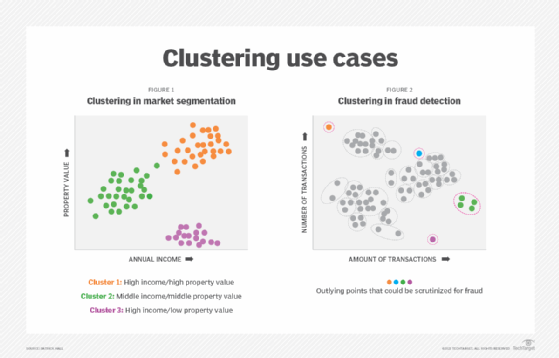
In fraud detection, the "clusters" represent normal behavior. Any data point that doesn't fit into a cluster is an anomaly, a potential problem worth investigating.
Scientific and Research Applications
Clustering is not just for commercial applications; it is a fundamental tool in scientific discovery. By grouping complex data, researchers can uncover patterns that lead to new hypotheses and insights.
32 Unsupervised Learning: Clustering
This text from a data science textbook provides two compelling examples from research and technology: grouping movies by rating patterns and grouping tissues by gene expression.
Read the subsections '32 Unsupervised Learning: Clustering' and '32.1 Examples'. Focus on how clustering can find structure in movie ratings (powering recommender systems) and in biological data (helping to understand tissue function).
The gene expression example is particularly powerful. Biologists can use clustering to identify which genes are active in certain types of cancer cells, helping them discover subgroups of a disease that might respond differently to treatment. This connects directly to your goal of using AI for high-impact applications.
To see how this plays out in a realistic, complex scenario, let's briefly look at the medical example from the MIT lecture.
Let's return to the MIT lecture to see a detailed walkthrough of a medical use case. This demonstrates how clustering is applied to real patient data to find high-risk groups.
Watch the segment from 28:49 to 34:00. You don't need to follow the code in detail. Instead, focus on understanding the problem: the researchers are trying to cluster patients based on four medical features to see if the resulting clusters correspond to different risks of a heart attack. This is a real-world example of using clustering for discovery.
This example shows that clustering isn't always a simple, clean process. It often involves experimentation (like trying different numbers of clusters) to uncover the most meaningful patterns—a process that requires both technical skill and domain knowledge.
Conclusion
In this lesson, you've taken your first step into the world of unsupervised learning. You've moved beyond predicting pre-defined labels and into the more ambiguous but powerful domain of discovering hidden structures in data.
Key Takeaways:
- Clustering is an unsupervised learning technique used to find natural groupings in unlabeled data.
- The primary goal is to partition data such that points within a cluster are highly similar, and points in different clusters are dissimilar.
- This ability to find structure is critical for exploratory data analysis and has a vast range of applications.
- Key use cases include:
- Marketing: Customer segmentation for targeted campaigns.
- Security: Anomaly and fraud detection by identifying outliers.
- Biology: Grouping genes or cells to understand diseases.
- Information Retrieval: Organizing documents or images by topic.
- Recommender Systems: Grouping users or items with similar tastes.
Preview of the Next Lesson:
Now that you understand what clustering is and why it's so useful, the next logical question is how do you actually do it? In our next lesson, we will dive into the mechanics of one of the most fundamental and widely used clustering algorithms: k-means. You will learn its step-by-step logic and prepare to implement it yourself.