Introduction
In our last two lessons, you learned how to construct truth tables for logical statements and how to translate arguments from natural language into symbolic logic. These are the foundational components of computational thinking. Now, we will combine these skills to achieve a significant goal: determining whether an argument is logically sound.
Your ambition to develop a "superpower brain" capable of handling extreme pressure and complex decision-making hinges on the ability to distinguish solid reasoning from flawed logic. In fields like AI, an algorithm built on an invalid argument can lead to catastrophic failures. This lesson provides you with a formal, mechanical method to test the structural integrity of an argument.
Today's learning outcome is to evaluate the validity of logical arguments using truth tables. You will learn the precise definition of a valid argument and a step-by-step process to use truth tables to verify whether a conclusion logically follows from its premises.
1. What is a Valid Argument?
Before we can test an argument, we need a precise definition of what we are testing for. An argument consists of a set of statements called premises that are intended to support another statement, the conclusion.
The concept of validity in logic is very specific: it's not about whether the premises are actually true in the real world. Instead, it's about the argument's structure.
A logical argument is valid if and only if it is impossible for all of its premises to be true while its conclusion is simultaneously false.
In a valid argument, the truth of the premises guarantees the truth of the conclusion. If you accept the premises, you are logically compelled to accept the conclusion.
To deepen this concept, let's turn to a short video and a reading.
Logical Arguments - Modus Ponens & Modus Tollens
Dr. Trefor Bazett gives an excellent and concise definition of what makes a logical argument valid. Pay close attention to the idea that validity is about the structure of the argument, not the content of the premises.
Watch the segment from 00:20 to 01:30. The key takeaway is that in a valid argument, the conclusion logically follows from the premises, assuming they are true.
This text from Mathematics LibreTexts reinforces the definition of validity and introduces the core idea of how we will use truth tables to test for it.
Read the subsections titled 'Argument types' and 'Evaluating deductive arguments'. Focus on the definition provided for a valid deductive argument: 'when the premises are all true, the conclusion must be true.'
2. The Truth Table Test for Validity
Now that we have a clear definition of validity, we can establish a mechanical procedure to test for it using a truth table. The process translates the definition of validity into a concrete search.
The Method:
- Translate the Argument: Convert the premises and the conclusion from natural language into symbolic logic, as you learned in the previous lesson.
- Construct a Truth Table: Create a truth table that includes a column for each premise and a column for the conclusion.
- Analyze the Table: Systematically examine each row of the truth table. Look for a critical row—a row where every premise is true (
T), but the conclusion is false (F). - Determine Validity:
- If you find one or more critical rows, the argument is INVALID. The existence of such a row demonstrates that it is possible for the premises to be true and the conclusion false.
- If you find no critical rows in the entire table, the argument is VALID. This demonstrates that it's impossible for the premises to be true while the conclusion is false.
This image perfectly illustrates the concept.
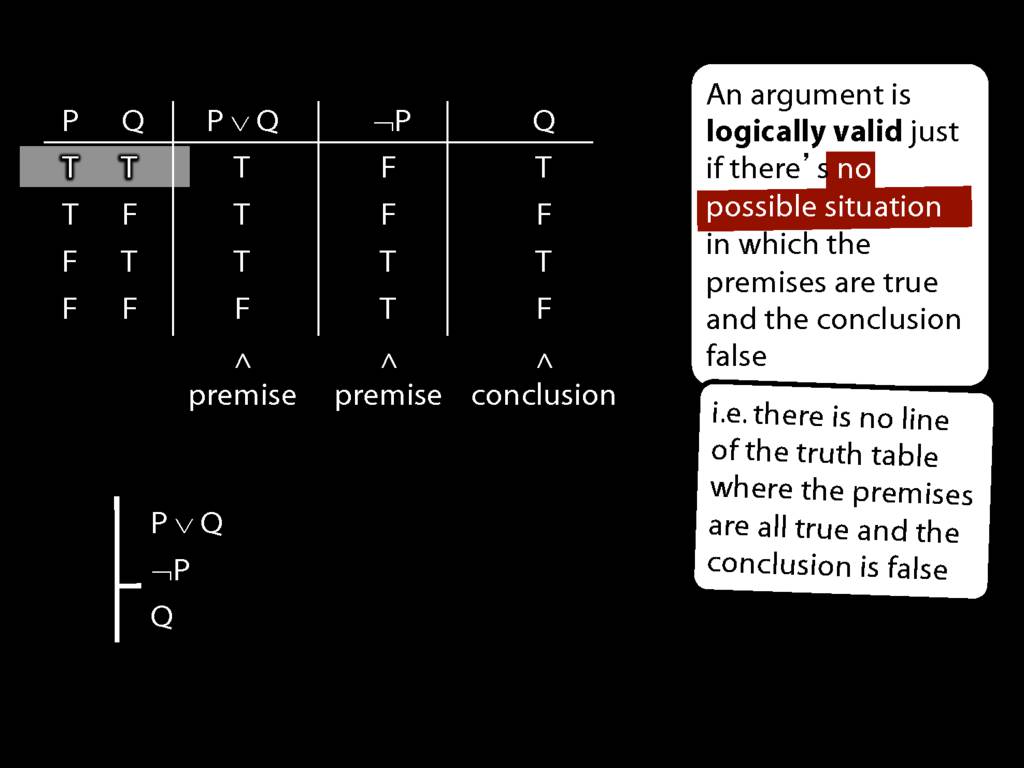
The following reading provides a detailed explanation of this process.
Truth Tables – Introduction to Logic
This chapter from the College of DuPage's Introduction to Logic textbook provides a clear, step-by-step guide on how to set up a truth table to test for validity.
Read the subsection titled 'Formal Validity and Invalidity'. Focus on the definition of validity and the example table provided. Notice how they identify the argument as invalid by finding a specific case (row #5) where all premises are true and the conclusion is false.
3. Worked Examples
Let's apply this method to a couple of classic argument forms. This aligns with your preference for seeing the theory in action before trying it yourself.
Example 1: A Valid Argument (Modus Ponens)
Let's analyze this common argument:
- Premise 1: If it is raining, then the ground is wet.
- Premise 2: It is raining.
- Conclusion: Therefore, the ground is wet.
Step 1: Translate
- Let : "It is raining."
- Let : "The ground is wet."
- Premise 1:
- Premise 2:
- Conclusion:
Step 2 & 3: Construct and Analyze the Truth Table
Let's watch a video that demonstrates this exact process.
Logical Arguments - Modus Ponens & Modus Tollens
Dr. Trefor Bazett will now walk through the process of using a truth table to formally prove that the argument structure we just translated (known as Modus Ponens) is valid.
Watch from 03:24 to 06:31. Observe how he sets up the table with columns for the premises and the conclusion, and then identifies the single row where both premises are true.
As the video showed, the truth table looks like this:
| Premise 1: | Premise 2: | Conclusion: | ||
|---|---|---|---|---|
| T | T | T | T | T |
| T | F | F | T | F |
| F | T | T | F | T |
| F | F | T | F | F |
The only row where both premises are true is row 1. In this row, the conclusion is also true. Since there is no row with all true premises and a false conclusion, the argument is VALID.
Example 2: An Invalid Argument (The Fallacy of Affirming the Consequent)
Now consider this slightly different, but flawed, argument:
- Premise 1: If it is raining, then the ground is wet.
- Premise 2: The ground is wet.
- Conclusion: Therefore, it is raining.
Step 1: Translate
- Premise 1:
- Premise 2:
- Conclusion:
Step 2 & 3: Construct and Analyze the Truth Table
| Premise 1: | Premise 2: | Conclusion: | ||
|---|---|---|---|---|
| T | T | T | T | T |
| T | F | F | F | T |
| F | T | T | T | F |
| F | F | T | F | F |
Step 4: Determine Validity
Look at the table carefully.
- In row 1, both premises are true, and the conclusion is true. This is fine.
- In row 3, both premises are true, but the conclusion is false. This is a critical row.
Because we found a critical row, the argument is INVALID. This row represents a possible scenario where the logic breaks down (e.g., the ground is wet because a sprinkler is on, not because it's raining).
This image shows another example of an invalid argument, known as Denying the Antecedent.

4. Practice Exercises
Now it's your turn to be the logician. For each argument below:
a) Identify the atomic propositions and translate the argument into symbolic logic.
b) Construct a full truth table.
c) State whether the argument is valid or invalid and provide your justification by referencing the rows in your truth table.
Argument 1:
If the server is down, then users cannot log in. Users cannot log in. Therefore, the server is down.
Argument 2:
I will study logic or I will study programming. I will not study programming. Therefore, I will study logic.
Click to see the solutions
Argument 1 Solution:
a) Translation:
- Let : "The server is down."
- Let : "Users cannot log in."
- Premise 1:
- Premise 2:
- Conclusion:
b) Truth Table:
| Premise 1: | Premise 2: | Conclusion: | ||
|---|---|---|---|---|
| T | T | T | T | T |
| T | F | F | F | T |
| F | T | T | T | F |
| F | F | T | F | F |
c) Verdict: The argument is INVALID. Row 3 is a critical row: the premises and are both true, but the conclusion is false. (This is the same logical fallacy as our "wet ground" example).
Argument 2 Solution:
a) Translation:
- Let : "I will study logic."
- Let : "I will study programming."
- Premise 1:
- Premise 2:
- Conclusion:
b) Truth Table:
| Premise 1: | Premise 2: | Conclusion: | |||
|---|---|---|---|---|---|
| T | T | T | F | F | T |
| T | F | T | T | T | T |
| F | T | T | F | F | F |
| F | F | F | T | T | F |
c) Verdict: The argument is VALID. The only row where both premises are true is Row 2. In that row, the conclusion is also true. There are no critical rows where the premises are true and the conclusion is false. (This valid argument form is called a disjunctive syllogism).
Conclusion
Today you've acquired a powerful, algorithmic tool for analyzing reasoning. By using truth tables, you can move beyond intuition and mechanically verify whether a conclusion is a necessary consequence of its premises. This skill is not just an academic exercise; it's a core component of computational thinking that allows for the design of reliable, predictable systems.
Key Takeaways:
- An argument is valid if it's impossible for its premises to be true while its conclusion is false.
- Validity is about the logical structure, not the real-world truth of the statements.
- The truth table test provides a definitive way to check for validity by searching for a critical row (all premises True, conclusion False).
- If even one critical row exists, the argument is invalid. If none exist, it is valid.
Preview of the Next Lesson:
The method you learned today is a cornerstone of deductive reasoning, where conclusions are guaranteed by the premises. However, not all useful reasoning works this way. In the next lesson, we will distinguish between deductive and inductive reasoning, exploring arguments that provide strong evidence for a conclusion without offering an absolute guarantee.