Introduction
Hello! In our last lesson, we took a deep dive into logical fallacies, learning to spot the structural and content-based errors that make an argument weak or invalid. Recognizing these flaws is a vital defensive skill for clear thinking.
Today, we shift our focus from identifying invalid arguments to constructing valid ones. The learning outcome for this lesson is to apply rules ofinference like modus ponens and modus tollens.
These rules are the fundamental building blocks of deductive reasoning. Think of them as the basic, unassailable logical steps that allow you to move from a set of true statements (premises) to a conclusion that is guaranteed to be true. For your goal of developing a "superpower brain," mastering these rules is like learning the CPU's instruction set for logical thought. It's the mechanism that underpins everything from mathematical proofs to the core logic of early AI systems.
1. From Truth Tables to Rules of Inference
In a previous lesson, you learned to verify an argument's validity by constructing a truth table. While this method is exhaustive and correct, it becomes incredibly cumbersome as the number of propositions increases. An argument with just 10 variables would require a truth table with rows!
Rules of inference provide a more elegant and scalable solution. They are simple, pre-validated argument forms that we can use as building blocks to construct complex, valid arguments step by step, without ever drawing a truth table.
Let's begin with a video that formally defines what a rule of inference is and sets the stage for how we'll use them.
Discrete Math - 1.6.1 Rules of Inference for Propositional Logic
This video from Kimberly Brehm's Discrete Math series provides a concise introduction to the purpose of inference rules and how they are used to build valid arguments from premises to a conclusion.
Watch the first 3 minutes and 10 seconds of the video (00:00 - 03:10). Focus on understanding: The definition of an argument: a sequence of premises that imply a conclusion. The concept of a valid argument: one where the truth of the premises guarantees the truth of the conclusion. How argument forms are written, with premises listed first and the conclusion following the 'therefore' (∴) symbol.
The key idea is that a rule of inference is a template for a valid argument. If your argument's structure matches the rule's template, and your premises are true, your conclusion is logically certain.
2. Modus Ponens: The Law of Affirmation
The most fundamental rule of inference is modus ponens, Latin for "the mode that affirms." It is an intuitive rule that we use constantly in our daily reasoning.
Let's watch a clear explanation of this rule.
Logical Arguments - Modus Ponens & Modus Tollens
Dr. Trefor Bazett provides a very clear introduction to Modus Ponens, using a simple, relatable example and then showing how its validity can be proven with a truth table.
Watch the segment from 01:17 to 03:50. Pay attention to: How a natural language argument is translated into its logical form: If P then Q. P. Therefore, Q. The brief look at the truth table. Notice that the only row where both premises (P → Q and P) are true is the row where the conclusion (Q) is also true. This is the definition of a valid argument.
The structure of Modus Ponens is simple and powerful.
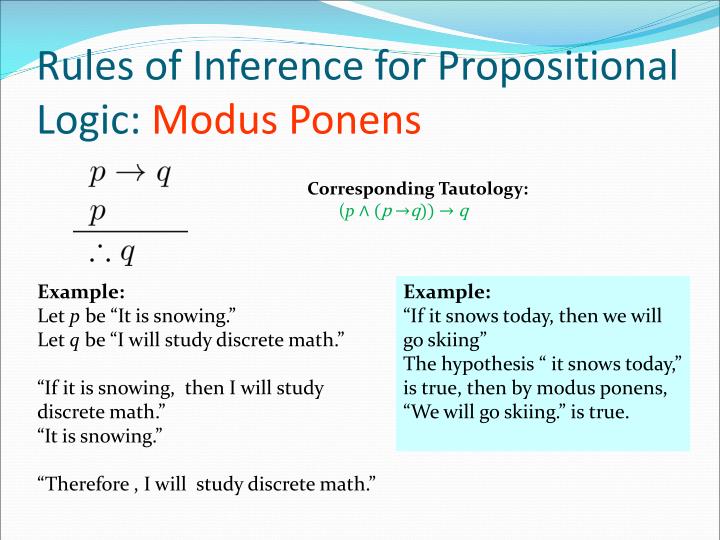
The rule is formally stated as:
| Premise 1 | Premise 2 | Conclusion |
|---|---|---|
In words: If you have a conditional statement, and you also have the antecedent (the 'if' part) as true, you can validly conclude the consequent (the 'then' part).
3. Modus Tollens: The Law of Denial
The second essential rule is modus tollens, Latin for "the mode that denies." This rule works by denying the consequent of a conditional statement.
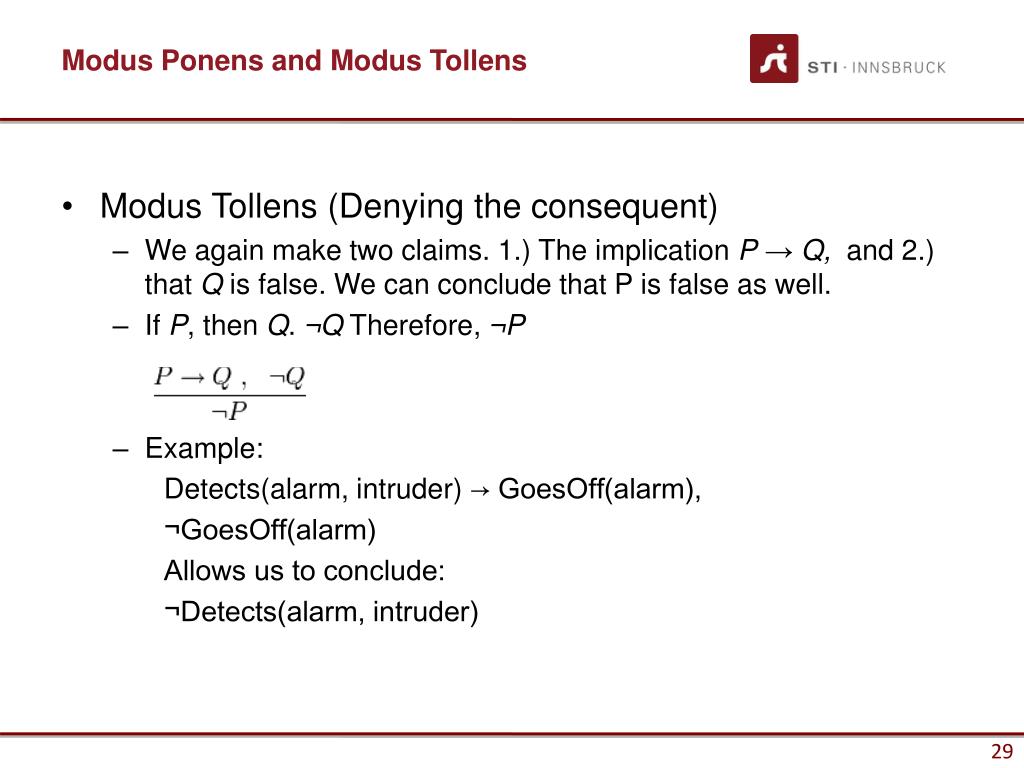
The formal structure for Modus Tollens is:
| Premise 1 | Premise 2 | Conclusion |
|---|---|---|
In words: If you have a conditional statement, and you know the consequent (the 'then' part) is false, you can validly conclude that the antecedent (the 'if' part) must also be false.
A powerful insight is that Modus Tollens is directly related to Modus Ponens through the contrapositive. Remember that the statement is logically equivalent to . If we apply Modus Ponens to the contrapositive form, we get:
- (Premise, as it's equivalent to )
- (Premise)
- (Conclusion by Modus Ponens)
This is exactly the structure of Modus Tollens. It shows how these rules are deeply interconnected.
4. Application: Building Arguments Step-by-Step
Now for the "apply" part of our learning outcome. We will use these rules to build a deductive proof, chaining together small logical steps to reach a conclusion from a set of premises. This process is often shown in a two-column format, with each logical statement on the left and its justification (either as a premise or by citing a rule of inference) on the right.
This next video demonstrates exactly how to do this.
Discrete Math - 1.6.1 Rules of Inference for Propositional Logic
We'll return to Kimberly Brehm's video, which provides excellent, clear examples of building a step-by-step argument.
Watch the segment from 12:01 to 21:51. This is the most critical part of the lesson. First, observe the simple two-column proof (from 12:01 to 16:36). Note how each step is justified. Next, watch the more complex example (from 16:36 to 21:51) where she translates natural language statements into propositions and then constructs a proof using Modus Ponens multiple times.
Let's walk through one more example together, this time from a textbook. This example uses both Modus Tollens and Modus Ponens.
Goal: Show that the following premises lead to the conclusion "We will be home by sunset."
Premises:
- "It is not sunny this afternoon and it is colder than yesterday."
- "We will go swimming only if it is sunny."
- "If we do not go swimming, then we will take a canoe trip."
- "If we take a canoe trip, then we will be home by sunset."
Step 1: Translate to Propositional Logic
Let's define our propositions:
- : "It is sunny this afternoon"
- : "It is colder than yesterday"
- : "We will go swimming"
- : "We will take a canoe trip"
- : "We will be home by sunset"
Our premises become:
- (Remember, "A only if B" translates to )
Our desired conclusion is:
Step 2: Construct the Proof
| Step | Statement | Reason |
|---|---|---|
| 1. | Premise | |
| 2. | Simplification on (1) | |
| 3. | Premise | |
| 4. | Modus Tollens using (2) and (3) | |
| 5. | Premise | |
| 6. | Modus Ponens using (4) and (5) | |
| 7. | Premise | |
| 8. | Modus Ponens using (6) and (7) |
We successfully derived the conclusion from the premises using our rules of inference. This is the core of logical deduction.
5. Practice Exercise
Now it's your turn. Use the same method to derive a conclusion from the following scenario.
Scenario: You are debugging an AI system. You know the following statements to be true.
Premises:
- If the model's accuracy is low, the training data is biased.
- If the training data is biased, the data preprocessing script must be run.
- The data preprocessing script was not run.
Task:
- Translate these premises into propositional logic. Let = "The model's accuracy is low," = "The training data is biased," and = "The data preprocessing script must be run."
- Use rules of inference to derive a conclusion about the model's accuracy. Write out your steps just like in the example above. What can you conclude?
Click for the solution
1. Translation:
- Premise 1:
- Premise 2:
- Premise 3:
2. Proof:
| Step | Statement | Reason |
|---|---|---|
| 1. | Premise | |
| 2. | Premise | |
| 3. | Modus Tollens using (1) and (2) | |
| 4. | Premise | |
| 5. | Modus Tollens using (3) and (4) |
Conclusion: . In natural language, "The model's accuracy is not low."
Conclusion
You have now learned how to apply two of the most important rules of inference, Modus Ponens and Modus Tollens, to construct valid deductive arguments. This moves you beyond simply testing arguments and into the realm of actively building them.
Key Takeaways:
- Rules of inference are valid argument forms used as building blocks for proofs.
- Modus Ponens (If P then Q, P, Q) allows you to affirm the consequent.
- Modus Tollens (If P then Q, Q, P) allows you to deny the antecedent.
- You can chain these rules together to derive conclusions from a set of premises in a step-by-step proof.
This method of systematic, rule-based deduction is precisely how a computer "thinks" when executing logic programming or performing formal verification. It's a structured and powerful way to guarantee true conclusions from true premises.
Preview of the Next Lesson:
In this lesson, we focused on the "how" of applying logical rules. In the next lesson, we will zoom out to discuss the "why." The learning outcome will be to explain the role of formal logic in algorithm design and AI. We will see how the principles you've learned are not just abstract exercises but are directly applied in creating intelligent and reliable systems.