Welcome to your fourth lesson. In our last session, we delved into the axiomatic heart of vector spaces, proving from first principles how properties like the uniqueness of the zero vector and the relationship between scalar multiplication and additive inverses emerge directly from the eight vector space axioms. This rigorous, axiom-based approach is fundamental to the deep understanding of linear algebra we are aiming to build.
Today, we will explore one of the most important concepts in the theory of vector spaces: the idea of a subspace. Many of the vector spaces you encounter in physics—such as the set of solutions to a homogeneous linear differential equation or the states of a quantum system with a specific energy—are naturally viewed as vector spaces existing inside larger ones. This lesson will formalize this notion. Our main goal is to define what a subspace is and, most importantly, to prove the subspace criterion, a powerful and efficient test that allows us to verify if a subset is a subspace without needing to check all ten vector space axioms every time.
1. The Definition of a Subspace
Let's begin with the formal definition.
Definition: Let be a vector space over a field . A subset is called a subspace of if is itself a vector space over with respect to the same operations of vector addition and scalar multiplication defined on .
This definition immediately raises a practical question: to verify that a subset is a subspace, must we painstakingly check all ten vector space axioms for ? The answer, fortunately, is no. Many of the axioms are inherited automatically from the "ambient" space . For instance, since vector addition in is commutative, it will certainly be commutative for the elements within the subset . The same holds for associativity and the distributive properties.
The crucial properties that are not automatically inherited are the closure axioms and the existence axioms for identities and inverses.
- Closure: Are we guaranteed that adding two vectors from results in a vector that is still in ? Similarly, does scaling a vector from produce a vector that remains in ?
- Identity: Does the zero vector of the larger space belong to ?
- Inverses: For every vector , is its additive inverse also in ?
Visually, in , subspaces correspond to the origin itself, lines passing through the origin, and planes passing through the origin.

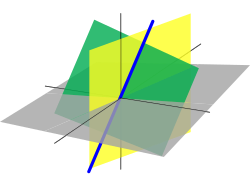
Any subset that does not contain the origin, like a plane shifted away from it, cannot be a subspace.
2. Deriving the Subspace Criterion
Our task is to condense the necessary checks into a minimal, sufficient set of conditions. The following video provides an excellent and rigorous derivation of this simplified criterion. The lecturer carefully distinguishes which axioms are inherited and which must be explicitly verified.
Advanced Linear Algebra 1: Vector Spaces & Subspaces
This video discusses how to determine if a subset of a vector space is itself a vector space, leading to the subspace criterion.
First, watch the segment from the initial analysis, where the lecturer identifies the four properties that seem to require checking: closure under addition, closure under scaling, containment of the zero vector, and containment of additive inverses.
The key insight is that two of these four conditions are actually consequences of another. Specifically, if a non-empty subset is closed under scalar multiplication, it must also contain the zero vector and all its elements' additive inverses. This is a direct consequence of the properties we proved in the last lesson.
- If is non-empty, it contains some vector . If is closed under scalar multiplication, then it must also contain . As we proved, , so .
- If and is closed under scalar multiplication, then it must also contain . We proved that , so .
The lecturer formally proves these prerequisite facts. Since we covered this ground in the previous lesson, you can watch this next part as a confirmation of our prior work.
Advanced Linear Algebra 1: Vector Spaces & Subspaces
The video provides formal proofs that multiplying a vector by the scalar 0 yields the zero vector, and multiplying by -1 yields the additive inverse.
Watch this segment from the formal proofs. Notice how the arguments rely purely on the vector space axioms, just as ours did.
This logical reduction leaves us with just three conditions to check.
3. The Subspace Criterion: Formal Statement and Proof
We can now state the criterion formally. This is one of the most frequently used tools in linear algebra.
Theorem (The Subspace Criterion): Let be a vector space over a field , and let be a non-empty subset of . Then is a subspace of if and only if the following two conditions hold:
- Closure under Addition: For all , their sum is also in .
- Closure under Scalar Multiplication: For all and all scalars , the product is also in .
Often, the non-empty condition is replaced by directly checking if the zero vector is in the subset, which, as we've seen, is a necessary consequence of closure under scalar multiplication. This gives the most common formulation of the criterion:
A subset is a subspace of if and only if:
- .
- is closed under addition.
- is closed under scalar multiplication.
Let's now turn to a formal proof of this theorem.
[PDF] Lecture Notes for MATH 2406 (Abstract Vector Spaces)
These lecture notes by Christopher Heil provide a clear statement and proof of the subspace criterion. The author's detailed explanation of which axioms are inherited versus which need proving aligns perfectly with our discussion.
Please read the section "Subspaces," starting from Definition 3.13. Pay close attention to the statement and proof of Theorem 3.14. The proof is structured as an "if and only if" argument, so there are two directions to consider. The (\Rightarrow) direction is straightforward: if S is a subspace, it must satisfy all vector space axioms, including the two closure axioms. The (\Leftarrow) direction is the more substantial part. It shows why satisfying the closure axioms (on a non-empty set) is sufficient to guarantee that all other axioms hold.
The logic of the proof you just read confirms our derivation: the "for all" axioms (commutativity, associativity, etc.) are inherited from , while the existence of the zero vector and additive inverses within are guaranteed by closure under scalar multiplication.
4. Examples and Applications
With the criterion firmly established, let's see it in action. Applying these three checks is the standard procedure for proving a subset is a subspace.
Example 1: Trivial Subspaces
For any vector space , the set containing only the zero vector, , is a subspace. It contains , , and for any scalar . Also, is trivially a subspace of itself.
Example 2: A Subspace of
Let's consider a concrete example from , which is the subject of the next video. The presenter provides a clear, methodical proof for a given subset by verifying each of the three conditions.
Let's do a Subspace Proof (From Linear Algebra Done Right)
In this video, the presenter from The Math Sorcerer channel gives a textbook demonstration of a subspace proof.
Watch the segment from the proof. Observe the structure: Check for Zero Vector: He plugs (0,0,0) into the defining equation to show it holds. Check for Closure under Addition: He takes two arbitrary vectors from the set, writes down the condition that each one satisfies, and then shows that their sum also satisfies the condition. Check for Closure under Scalar Multiplication: He takes an arbitrary vector and an arbitrary scalar and shows their product satisfies the defining condition.
This step-by-step process is the template for virtually all subspace proofs you will write.
Example 3: Subspaces of Function Spaces
Your background in physics makes you very familiar with function spaces. Let's consider , the vector space of all functions from to . Is the subset of all continuous functions a subspace?
- Zero Vector: The zero vector in is the function for all . This function is continuous, so .
- Closure under Addition: From analysis, you know that the sum of two continuous functions is continuous. So if , then .
- Closure under Scalar Multiplication: You also know that a constant multiple of a continuous function is continuous. So if and , then .
Since all three conditions hold, is a subspace of .
Example 4: A Counterexample
Consider the subset . Is this a subspace of ?
This subset represents a plane in . Let's check the conditions.
- Zero Vector: Does satisfy the condition? . No.
The test fails at the first step. is not a subspace because it does not contain the origin.
Conclusion
In this lesson, we have formally defined the concept of a vector subspace and established the fundamental tool for identifying one.
The key takeaways are:
- A subspace is a subset of a vector space that is itself a vector space under the inherited operations.
- To verify if a subset is a subspace, we don't need to check all ten vector space axioms. It is sufficient to use the subspace criterion:
- The zero vector of the parent space is in ().
- is closed under vector addition ().
- is closed under scalar multiplication ().
- We proved why this criterion is sufficient: the remaining axioms are either inherited from the parent space or are logical consequences of these three conditions.
Having established how to identify these fundamental building blocks, our next lesson will investigate how subspaces interact. We will prove a crucial property: that the intersection of any collection of subspaces is, itself, a subspace. This result forms the basis for defining the "smallest" subspace containing a given set of vectors, a concept known as the span.