In our previous lesson, we established the axiomatic foundation for scalars by defining a field. We saw that familiar number systems like , , and , as well as less familiar finite structures like , all share a common algebraic structure that allows for consistent arithmetic. This concept of a field is the bedrock upon which we will now build the central object of linear algebra: the vector space.
This lesson introduces the formal definition of a vector space over an arbitrary field . You are likely familiar with vectors as arrows in Euclidean space or as column vectors in matrix algebra. Our goal is to abstract the essential properties from these examples—namely, the ability to add vectors and scale them—into a set of axioms. By the end of this lesson, you will be able to state the vector space axioms and use them to rigorously verify whether a given mathematical structure, from simple tuples to more abstract function spaces, qualifies as a vector space.
1. The Axioms of a Vector Space
A vector space is a structure built from two sets: a set of "vectors" and a field of "scalars" . It is equipped with two operations: vector addition and scalar multiplication. The power of this definition lies in its generality; by focusing only on these operations and their properties, the results we derive will apply to an astonishingly wide range of mathematical and physical systems.
The following reading provides the formal definition.
This document by Evan Dummit provides a clear and standard axiomatic definition of a vector space. It lists the eight fundamental properties that vector addition and scalar multiplication must satisfy.
Please read the first page, focusing on the section "1.1 The Formal Definition of a Vector Space". Pay close attention to the eight axioms, labeled [V1] through [V8]. Note how they are organized: four for addition, two for scalar multiplication, and two that connect the operations (distributivity).
To summarize and slightly re-organize, a set is a vector space over a field if it possesses an addition operation and a scalar multiplication operation satisfying:
A. Addition forms a commutative group:
- Commutativity: for all .
- Associativity: for all .
- Additive Identity: There exists a zero vector such that for all .
- Additive Inverse: For every , there exists an inverse vector such that .
B. Scalar multiplication is compatible:
5. Multiplicative Identity: for all , where is the multiplicative identity in .
6. Compatibility: for all and .
C. Operations are distributive:
7. Distributivity over vector addition: .
8. Distributivity over scalar addition: .
For a physicist's perspective on these axioms and their importance, the following lecture segment is excellent.
5. Linear Algebra: Vector Spaces and Operators
In this MIT OpenCourseWare lecture, Professor Peter Shor explains the motivation for defining vector spaces, especially complex vector spaces in the context of quantum mechanics.
Watch from this point where he introduces the two essential components: vectors and numbers (the field). Then continue through the formal definition, where he lists the axioms. Note his emphasis that vectors are just abstract elements; their nature (real, complex) is not specified, only the field of scalars is.
The crucial insight here is that the word "vector" is simply a name for an element of a vector space. It is not required to be a list of numbers. As we'll see, functions, matrices, and polynomials can all be vectors.
2. Canonical Examples
Let's examine how these axioms apply to some familiar structures.
-
The space : This is the quintessential example. It consists of all n-tuples where each . Addition and scalar multiplication are defined component-wise. For instance, in , and . The zero vector is , and the additive inverse of is . All axioms follow directly from the field axioms holding in each component.
-
The space of matrices : The set of all matrices with entries from a field forms a vector space. Addition is standard matrix addition, and scalar multiplication involves multiplying every entry by the scalar. The "zero vector" is the zero matrix. Again, the axioms are satisfied because they hold for each entry individually.
-
Function Spaces: This is perhaps the most important generalization. Let be any non-empty set and be a field. The set of all functions , denoted , forms a vector space. The operations are defined "pointwise":
- Addition: for all .
- Scalar Multiplication: for all .
The "zero vector" is the zero function, which maps every element of to . The additive inverse of is , defined by .
The principle of superposition in physics is a direct manifestation of vector addition in a function space. For instance, two waves can be added together to produce a new, valid wave.
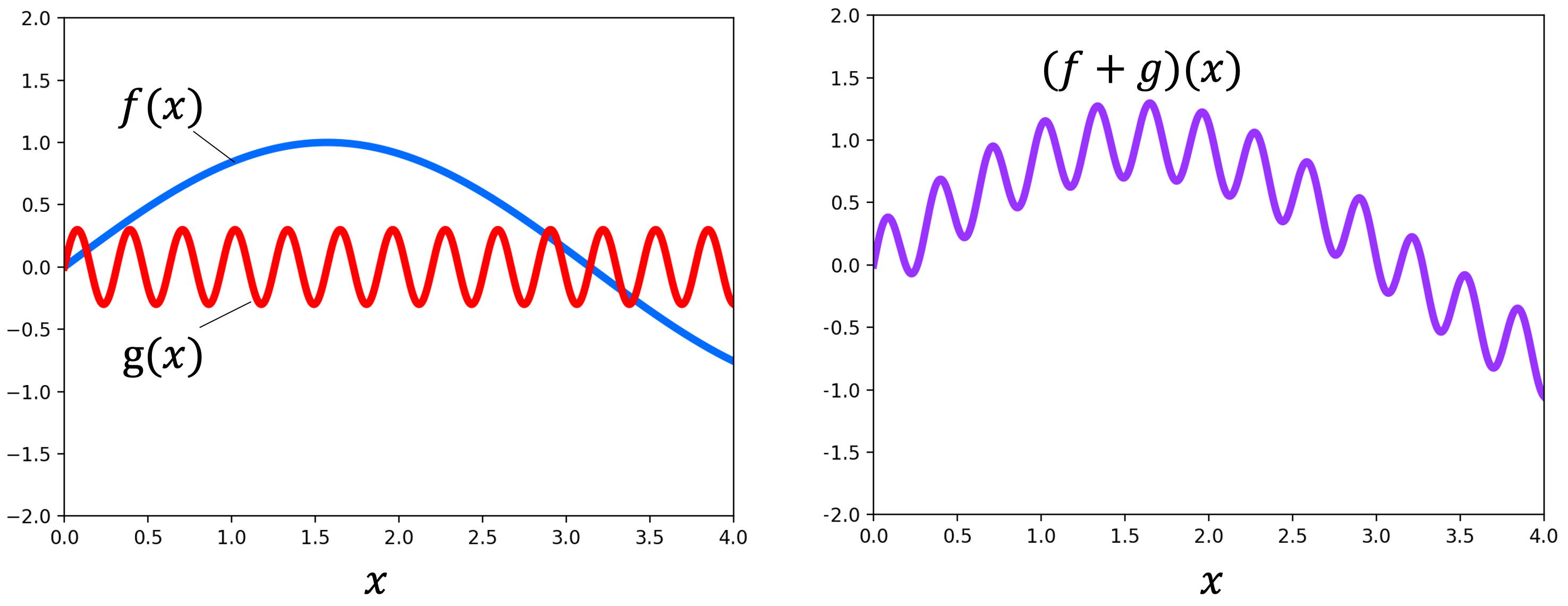
Your extensive work in quantum mechanics relies on this. A wavefunction is a vector in the space of complex-valued functions, and the superposition is a linear combination in this vector space. Spaces of polynomials, sequences, and continuous or differentiable functions are all specific, important examples of function spaces.
3. A Physicist's View: Abstract Vectors in Practice
The abstract nature of vector spaces is not just a mathematical curiosity; it has profound physical implications. Consider the space of 2x2 Hermitian matrices, which you have encountered in the context of spin-1/2 systems and Pauli matrices.
Is this a real or a complex vector space?
Let be a 2x2 Hermitian matrix. If we multiply it by a real scalar , the resulting matrix is also Hermitian, since . The space is closed under real scalar multiplication.
However, if we multiply by a non-real complex scalar, say , the resulting matrix is generally not Hermitian: .
Since closure under scalar multiplication must hold for all scalars in the field, the set of 2x2 Hermitian matrices forms a real vector space, but not a complex one. This is a subtle but critical point that the professor in the MIT video highlights.
5. Linear Algebra: Vector Spaces and Operators
Professor Shor provides several illuminating examples. This particular one connects directly to your background in quantum mechanics.
Watch the segment from this example concerning the space of 2x2 Hermitian matrices. His explanation vividly demonstrates why it's a real vector space despite containing complex numbers.
4. Verification in Practice: Exotic and Failed Vector Spaces
To truly master the axioms, it's essential to test them against unusual structures and identify exactly why a given structure might fail. The following document provides a superb collection of such examples.
[PDF] Examples of ings at Are, and Are Not, Ve or Spaces
This handout by Richard Chapling is an excellent resource for developing intuition. It moves beyond standard examples to more creative ones, and also provides a catalogue of non-examples, pinpointing which axioms fail.
First, read the "Weird examples" section, particularly the first one: Let V = {x ∈R : x > 0}. We will verify this is a vector space over \mathbb{R}. Then, read the section "3 Examples that are not vector spaces". Focus on understanding one example for each type of failure: Not closed under addition No identity Not closed under scalar multiplication Not distributive
Let's walk through the "weird example" from the reading. Let (the set of positive real numbers). Let the field be . Define "vector addition" as standard multiplication, and "scalar multiplication" as exponentiation.
Is this a vector space? Let's check a few axioms:
- Closure: If , then their product is also in . If and , is also in . Closure holds.
- Additive Identity: We need a "zero vector" such that for any . In our notation, this is . Clearly, the identity element for multiplication, , serves this role. So, . This is a perfect illustration that the zero vector doesn't have to be the number 0.
- Additive Inverse: For each , we need an inverse such that . This means . The inverse is , which is in since is.
- Distributivity: Let's check .
- LHS:
- RHS:
- Since , this axiom holds.
You can (and should) verify the remaining axioms on your own. This exercise demonstrates that as long as the axiomatic structure is satisfied, the underlying operations can be quite different from our usual intuition.
Conclusion
In this lesson, we have moved from the concrete picture of vectors as arrows to the abstract and powerful definition of a vector space. This abstraction is what gives linear algebra its wide-ranging applicability across mathematics, physics, and engineering.
The key takeaways are:
- A vector space is a set over a field , equipped with vector addition and scalar multiplication operations that satisfy eight fundamental axioms.
- The elements of a vector space, called vectors, are abstract entities. They can be n-tuples, matrices, polynomials, or functions. What matters is not what they are, but how they behave under addition and scalar multiplication.
- Many important structures in physics, such as the set of states in quantum mechanics (wavefunctions) or the set of Hermitian operators, are vector spaces. The principle of superposition is a direct consequence of the vector space structure.
- To verify if a structure is a vector space, one must systematically check all the axioms. A failure in even one axiom means the structure is not a vector space.
In our next lesson, we will begin to explore the consequences of these axioms by proving some elementary properties that hold true in any vector space, such as the uniqueness of the zero vector and additive inverses. This will be our first step in building the rich theory of linear algebra from this axiomatic foundation.