Hello! In our last lesson, we explored how to calculate fundamental properties of a binary tree like its size, height, and diameter. We saw how recursive traversals, particularly post-order, are incredibly powerful for solving these problems, and you learned a key optimization technique for the diameter problem to reduce its complexity from O(N²) to O(N).
Today, we will continue applying and adapting our traversal knowledge to solve a common category of interview problems: "view" problems. Specifically, this lesson focuses on finding the left and right views of a binary tree. You'll learn to identify the nodes visible from the tree's sides, a task that requires a clever combination of traversal and level-tracking.
By the end of this 60-minute lesson, you will be able to implement efficient solutions to find the left and right views of any given binary tree.
1. What are Left and Right Views?
Imagine you are standing to the far left or far right of a binary tree. The "view" is the set of nodes you can see from that perspective, from top to bottom. Nodes at a lower level might be hidden behind nodes at an upper level.
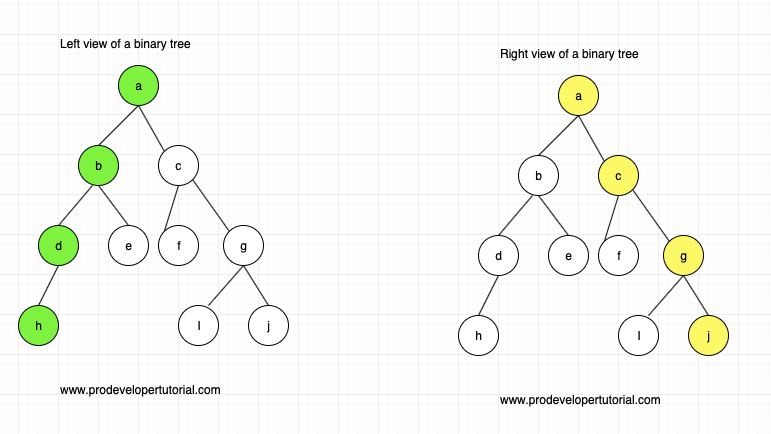
Our goal is to write a function that returns a list of these nodes' values.
2. The Core Idea: First Node at Each Level
If you think about the problem, the nodes that form the left or right view share a common property:
- Left View: Consists of the first node at every level.
- Right View: Consists of the last node at every level.
This observation gives us two potential paths forward:
- Level-Order Traversal (BFS): We can traverse the tree level by level using a queue. For each level, we can simply pick the first node for the left view or the last node for the right view. This is a perfectly valid and intuitive approach.
- Depth-First Traversal (DFS): We can use a recursive approach. This is often more elegant and space-efficient (using the call stack, which is O(Height) vs. O(Width) for the BFS queue). But how do we know which node is "first" or "last" at a level during a recursive traversal? This requires a clever trick.
Given your goal of interview preparation, mastering the efficient recursive (DFS) solution is crucial, as it showcases a deeper understanding of traversal patterns. We will focus on this approach.
3. Finding the Right View: A "Reverse" Pre-order Traversal
To get the right view, we want to encounter the rightmost node at each level first. A standard pre-order traversal goes Root -> Left -> Right. This prioritizes the left side. What if we reverse the order of the recursive calls?
Let's use a Root -> Right -> Left traversal.
With this traversal order, the very first time we visit any level, we are guaranteed to be at its rightmost node. We just need a way to keep track of the levels we've already added to our result.
The following video from "take U forward" explains this elegant solution perfectly. It uses a simple but powerful trick to track visited levels without any extra data structures.
L24. Right/Left View of Binary Tree | C++ | Java
This video details the optimal recursive approach for finding the right view of a binary tree. Pay close attention to the traversal order and the condition used to add a node to the view.
Watch from 01:00 to 11:35. The key parts are: the initial concept (01:00), the choice of 'reverse pre-order' traversal (05:28), the core logic of using the result list's size to track levels (06:28), and the detailed dry run (08:13).
Dissecting the Recursive Logic
Let's break down the core components of the algorithm you just saw.
- Helper Function: We use a recursive function, say
rightViewRec(TreeNode node, int level, List<Integer> result). - Base Case: If
node == null, we simplyreturn. - The "First Visit" Trick: This is the most important part. Before making recursive calls, we check:
if (result.size() == level).levelstarts at 0 for the root.result.size()tells us how many levels for which we have already stored a node.- If
result.size()equalslevel, it means we are visiting this level for the very first time. Since our traversal order isRoot -> Right -> Left, this first-encountered node must be the rightmost one. So, we add it to ourresultlist.
- Recursive Calls: We make the calls in a specific order to prioritize the right side:
- First,
rightViewRec(node.right, level + 1, result). - Then,
rightViewRec(node.left, level + 1, result).
- First,
Java Implementation for Right View
Here is the clean Java code that implements this logic. You will find this is a very common pattern in top-tier interviews.
import java.util.ArrayList;
import java.util.List;

class TreeNode {
    int val;
    TreeNode left;
    TreeNode right;
    TreeNode(int val) { this.val = val; }
}

public class Solution {

    public List<Integer> rightSideView(TreeNode root) {
        List<Integer> result = new ArrayList<>();
        rightViewRec(root, 0, result);
        return result;
    }

    private void rightViewRec(TreeNode node, int level, List<Integer> result) {
        // Base case: we've gone past a leaf node
        if (node == null) {
            return;
        }

        // If this is the first node we've seen at this level
        if (level == result.size()) {
            result.add(node.val);
        }

        // Recurse for the right subtree first
        rightViewRec(node.right, level + 1, result);

        // Then recurse for the left subtree
        rightViewRec(node.left, level + 1, result);
    }
}
- Time Complexity: O(N), as we visit every node exactly once.
- Space Complexity: O(H), where H is the height of the tree. This space is used by the recursion call stack. In the worst case of a skewed tree, this is O(N), but for a balanced tree, it's O(log N).
4. Finding the Left View: A Simple Adaptation
Now for the left view. Based on the logic we just established, how would you adapt the algorithm?
Think about it!
The core logic of if (level == result.size()) remains the same, as it's a generic way to detect the first visit to any level. The only thing that needs to change is the traversal order. To see the leftmost node first, we should visit the left subtree before the right one.
Exactly! We simply change the traversal order to the standard pre-order: Root -> Left -> Right.
Java Implementation for Left View
The code is nearly identical. Only the order of the two recursive calls is swapped.
public class Solution {

    public List<Integer> leftSideView(TreeNode root) {
        List<Integer> result = new ArrayList<>();
        leftViewRec(root, 0, result);
        return result;
    }

    private void leftViewRec(TreeNode node, int level, List<Integer> result) {
        if (node == null) {
            return;
        }

        if (level == result.size()) {
            result.add(node.val);
        }

        // Recurse for the left subtree first
        leftViewRec(node.left, level + 1, result);

        // Then recurse for the right subtree
        leftViewRec(node.right, level + 1, result);
    }
}
This elegant symmetry between the left and right view solutions is what makes the recursive approach so powerful.
5. Alternative: The Iterative Level-Order Approach
While the recursive DFS is often preferred for its conciseness, it's essential to also know the iterative BFS approach, as interviewers might specifically ask for it or for non-recursive solutions.
The idea is to perform a standard level-order traversal. In each level, we identify and add only the first node to our list for the left view.
The article 'Left View of Binary Tree' from EnjoyAlgorithms provides a well-explained iterative solution using level-order traversal. Understanding this complements the recursive approach.
Read the section 'Iterative approach using level order traversal'. Notice how it uses the queue size to process one level at a time and a simple check (if (i == 1)) to grab the first node of that level.
To adapt the iterative approach for the right view, you would simply add the node to the result when i == currLevelNodeCount (i.e., the last node in the level's for-loop).
Test your understanding!
Consider the following binary tree:
      1
     / \
    2   3
     \   \
      5   4
Trace the recursive right view algorithm (Root -> Right -> Left) step by step. What will the final result list be?
Show answer
rightViewRec(node=1, level=0, result=[]):level == result.size()(0==0) is true.resultbecomes[1].- Call
rightViewRec(node=3, level=1, result=[1]):level == result.size()(1==1) is true.resultbecomes[1, 3]. - Call
rightViewRec(node=4, level=2, result=[1, 3]):level == result.size()(2==2) is true.resultbecomes[1, 3, 4]. - Recursive calls on
node=4's children return. - Back at
node=3, callrightViewRec(node=null, level=2, result=[1, 3, 4]). It returns. - Back at
node=1, callrightViewRec(node=2, level=1, result=[1, 3, 4]):level == result.size()(1==3) is false. - Call
rightViewRec(node=5, level=2, result=[1, 3, 4]):level == result.size()(2==3) is false. - Recursive calls on
node=5's children return. - Back at
node=2, callrightViewRec(node=null, level=2, result=[1, 3, 4]). It returns.
The final result is [1, 3, 4].
Conclusion
In this lesson, we tackled the left and right view problems, adding two important patterns to your tree algorithm toolkit.
Key Takeaways:
- The left/right view of a binary tree consists of the first/last node at each level.
- The most elegant solution is a recursive DFS that combines a specific traversal order with level tracking.
- Right View: Use a
Root -> Right -> Lefttraversal. - Left View: Use a
Root -> Left -> Right(standard pre-order) traversal.
- Right View: Use a
- The condition
if (result.size() == level)is a space-efficient trick to identify the first time you visit a new level during the traversal. - An iterative level-order (BFS) approach is a valid and important alternative to know.
Preview of the Next Lesson:
We will continue with "view" problems and move on to the top and bottom views of a binary tree. These problems introduce a new dimension: horizontal distance from the root. You'll see how we can augment our traversal state to track both vertical level and horizontal distance to solve these more complex challenges.