Hello! Welcome back to our series on Dynamic Programming.
In our last lesson, we introduced Dynamic Programming and learned our first technique: memoization. We saw how this top-down, recursive approach could dramatically optimize the Fibonacci problem by storing the results of subproblems, reducing the time complexity from exponential to linear.
Today, we'll explore the second major DP technique: tabulation. Your learning outcome is to convert a memoized solution to a tabulated one (bottom-up DP), demonstrated on the Fibonacci problem. This method is iterative, avoids recursion entirely, and is a cornerstone of solving DP problems in both technical interviews and competitive programming.
1. Recap: Memoization (Top-Down)
Let's quickly recall our memoized solution for the N-th Fibonacci number.
// Helper function with memoization
private int fib(int n, int[] memo) {
    // Base cases
    if (n <= 1) {
        return n;
    }
    // 1. Check if the result is already computed
    if (memo[n] != -1) {
        return memo[n];
    }
    // 2. Compute and store the result before returning
    memo[n] = fib(n - 1, memo) + fib(n - 2, memo);
    return memo[n];
}

// Main function to initiate the process
public int fibonacci(int n) {
    // 3. Create and initialize the storage
    int[] memo = new int[n + 1];
    Arrays.fill(memo, -1);
    return fib(n, memo);
}
This approach starts from the top (n) and breaks the problem down, solving subproblems as needed. It's intuitive because it closely follows the mathematical recurrence. However, the reliance on recursion can lead to StackOverflowError for very large n and carries some function call overhead.
2. Tabulation: The Bottom-Up Approach
Tabulation takes the opposite approach. Instead of starting from n and going down, it starts from the smallest subproblems and builds its way up to the final solution.
- Top-Down (Memoization): Starts at
fib(n)and recursively callsfib(n-1),fib(n-2), etc., until it hits base cases. - Bottom-Up (Tabulation): Starts by solving
fib(0)andfib(1), then uses those results to solvefib(2), then uses that to solvefib(3), and so on, until it reachesfib(n).
This iterative method "fills a table" of results from the bottom up, hence the name "tabulation."
The article 'Memoization vs. tabulation in dynamic programming' on Educative.io provides a concise definition of this technique. Please read this short section to formalize your understanding.
Read the section titled 'Tabulation technique'. Focus on the keywords: 'bottom-up method', 'iteration', and 'building a table'.
3. Converting Fibonacci from Memoization to Tabulation
The conversion process is systematic and follows a clear logic. We'll use the same recurrence relation, F(n) = F(n-1) + F(n-2), but apply it iteratively.
DP 1. Introduction to Dynamic Programming | Memoization | Tabulation | Space Optimization Techniques
The video 'DP 1. Introduction to Dynamic Programming' from the 'take U forward' channel has an excellent segment demonstrating this conversion. It clearly shows how to translate the logic from the recursive solution to an iterative one.
Watch the video from 23:27 to 26:36. Pay close attention to how the base cases from the recursion become the initial values in the DP array, and how the recursive relation is transformed into a loop.
Let's break this down into a step-by-step process for implementation in Java.
Step 1: Create the DP Table
Create an array, let's call it dp, of size n + 1 to store the Fibonacci numbers up to n.int[] dp = new int[n + 1];
Step 2: Initialize the Base Cases
This is the "bottom-up" part. We start by filling in the answers we already know. For Fibonacci, the base cases are F(0) = 0 and F(1) = 1.dp[0] = 0;dp[1] = 1;
Step 3: Iterate and Fill the Table
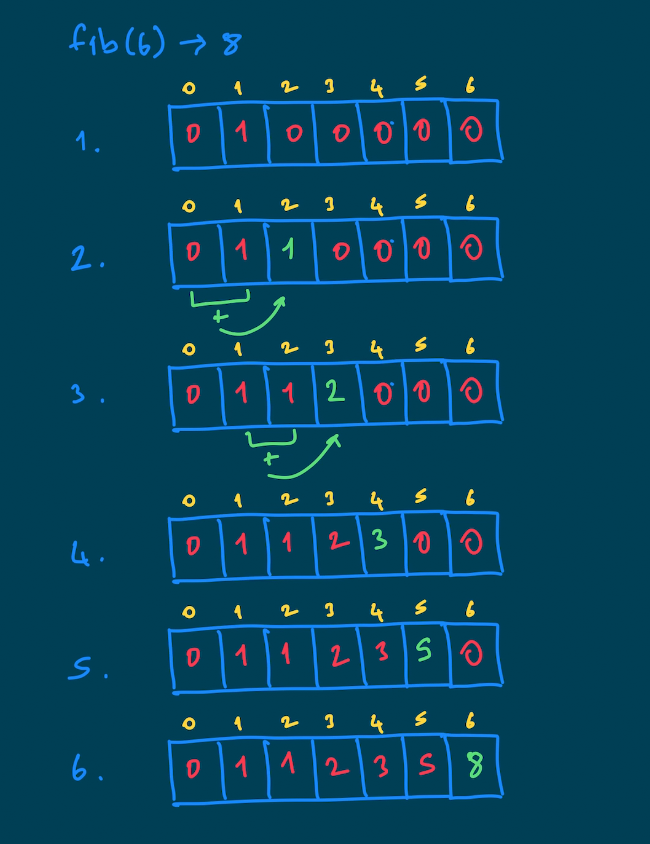
Write a loop that iterates from i = 2 up to n. In each step, calculate dp[i] using the results of the previous subproblems, which are already stored in the table.for (int i = 2; i <= n; i++) { dp[i] = dp[i-1] + dp[i-2]; }
Step 4: Return the Final Answer
The answer to our original problem, fib(n), is now stored at the last computed index of our table.return dp[n];
Here is a visual representation of the table being filled for n=6:
Here is the complete Java code for the tabulated solution.
Dynamic Programming (DP) Introduction
This GeeksForGeeks article provides a clean and direct Java implementation of the tabulation approach we just discussed. Review the code to solidify the steps.
In the article, find the section titled 'Using Tabulation Approach - O(n) Time and O(n) Space'. Study the provided Java code. Notice how it directly implements the four steps we just outlined.
4. Memoization vs. Tabulation
You now know both major DP techniques. Let's summarize their key differences. This is a very common discussion point in interviews.
| Feature | Memoization (Top-Down) | Tabulation (Bottom-Up) |
|---|---|---|
| Approach | Recursive | Iterative |
| Execution | Starts from the main problem and breaks it down | Starts from the base cases and builds up |
| Subproblem Solving | Solves only the subproblems that are actually needed | Solves all subproblems from 0 up to n |
| Overhead | Can have recursion overhead; risk of stack overflow | No recursion overhead; generally faster |
| Code Structure | Often closer to the pure mathematical recurrence | Requires thinking about the order of iteration |
| State Space | If some subproblems are irrelevant, they are not computed | All states in the DP table are computed |
Memoization vs. Tabulation Comparison Table
The Educative.io article provides a nice comparison table. Please review it to get a comprehensive overview of the trade-offs.
Scroll to the 'Memoization vs. Tabulation' section and study the comparison table. It's a great summary for quick revision.
5. Space Optimization: A Common Follow-up
For the Fibonacci problem, if you look at the tabulated recurrence dp[i] = dp[i-1] + dp[i-2], you'll notice that to compute the current value dp[i], we only need the two previous values. We don't actually need the entire dp array of size n+1.
This observation allows for a significant optimization, which is a frequent follow-up question in interviews. We can reduce the space complexity from O(n) to O(1).
Instead of an array, we can use just two variables to keep track of the previous two Fibonacci numbers.
DP 1. Introduction to Dynamic Programming | Memoization | Tabulation | Space Optimization Techniques
Let's return to the 'take U forward' video, which provides a fantastic explanation of this space optimization technique.
Watch from 27:02 to 31:46. The video explains how to use previous and previous2 variables to get rid of the DP array, reducing the space complexity to O(1) while keeping the time complexity at O(n).
Here's the space-optimized Java code:
public int fibonacci(int n) {
    if (n <= 1) {
        return n;
    }

    int prev2 = 0; // Represents fib(i-2)
    int prev1 = 1; // Represents fib(i-1)

    for (int i = 2; i <= n; i++) {
        int current = prev1 + prev2;
        prev2 = prev1;
        prev1 = current;
    }

    return prev1; // prev1 holds the final fib(n)
}
This is the most efficient way to solve the Fibonacci problem, with O(n) time complexity and O(1) space complexity.
Test your understanding!
You are asked to solve a DP problem with the recurrence relation dp[i] = 2 * dp[i-1] + dp[i-3]. You have already implemented a tabulation solution using an O(n) space array.
How could you optimize the space complexity? What is the minimum number of variables you would need to keep track of previous states to solve for dp[i]?
Show answer
To calculate dp[i], you need the values of dp[i-1] and dp[i-3]. This means you need to know the state of the last three subproblems (i-1, i-2, and i-3) to be able to calculate the next one. Therefore, you would need to keep track of at least 3 previous values.
For example, you could use variables like prev3, prev2, and prev1. The space complexity would be O(1).
Conclusion
Excellent work! You've now mastered the two fundamental approaches to dynamic programming: top-down with memoization and bottom-up with tabulation. Understanding when and how to apply each is crucial for tackling a wide range of algorithmic problems.
Key Takeaways:
- Tabulation is a bottom-up, iterative approach to DP that builds solutions from base cases.
- It avoids recursion, which can prevent stack overflow errors and reduce overhead.
- The conversion process involves: creating a DP table, initializing base cases, and iterating to fill the table using the recurrence relation.
- For some problems like Fibonacci, the tabulated solution can be space-optimized if the current state only depends on a fixed number of previous states.
Preview of the Next Lesson:
We've used the Fibonacci sequence as a learning tool because its state is defined by a single variable (n), leading to a 1D DP array. In our next lesson, we'll level up by tackling the classic 0/1 Knapsack problem. This will require us to manage a state defined by two variables, introducing us to the world of 2D dynamic programming.