Hello! Let's dive into our next lesson.
In our previous session, you mastered how to adapt binary search for rotated sorted arrays. This was a great exercise in understanding an algorithm's core assumptions and modifying it when those assumptions are broken. You learned to solve a classic interview problem in O(log n) time by always identifying the sorted half of the array.
Today, we're shifting our focus from searching to a powerful array preprocessing technique: prefix and suffix sums. Imagine you need to answer many queries about the sum of elements within various subarrays. Calculating each sum from scratch would be inefficient. Prefix sums provide a way to answer any such "range query" in constant time after a single pass through the array. This is a fundamental pattern in competitive programming and technical interviews.
1. The Core Idea: Prefix Sums for Range Queries
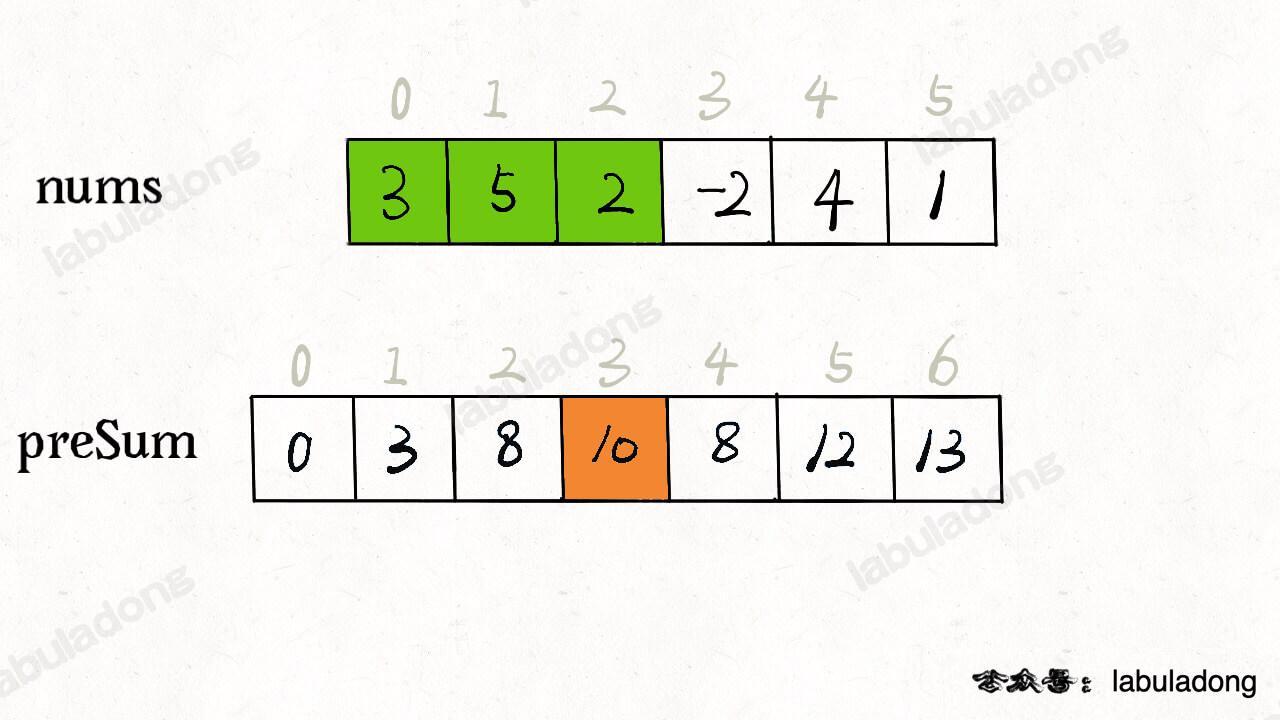
The basic idea of a prefix sum is simple: for an array arr, we create a new array, let's call it prefix, where prefix[i] stores the cumulative sum of all elements from arr[0] up to arr[i].
Building the Prefix Sum Array
You can build this array in a single linear pass, O(n) time. The formula is straightforward:prefix[0] = arr[0]prefix[i] = prefix[i-1] + arr[i] for i > 0
Here is a simple Java implementation:
public int[] computePrefixSum(int[] arr) {
    if (arr == null || arr.length == 0) {
        return new int[0];
    }
    int[] prefix = new int[arr.length];
    prefix[0] = arr[0];
    for (int i = 1; i < arr.length; i++) {
        prefix[i] = prefix[i - 1] + arr[i];
    }
    return prefix;
}
Answering Range Queries in O(1)
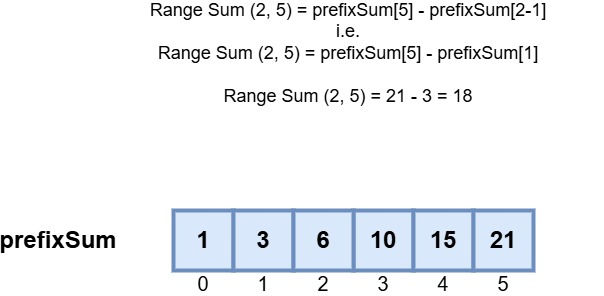
Once you have the prefix array, how do you find the sum of elements in a range [l, r] (inclusive)?
- The sum from index
0toris simplyprefix[r]. - The sum from index
0tol-1isprefix[l-1].
If you subtract the second from the first, you are left with the sum of elements from l to r.
So, the magic formula is:sum(l, r) = prefix[r] - prefix[l-1]
You need to handle the edge case where l = 0. In that situation, the sum is just prefix[r].
To see this concept explained with a walkthrough, the following video is an excellent starting point.
Coding Interview Patterns - Prefix Sum | 10 different problems in a single video
This video by Nikhil Lohia introduces the prefix sum concept and immediately demonstrates its power in solving range sum queries efficiently.
Watch from 00:40 to 05:29. Focus on how the prefix sum array is constructed and how the simple subtraction prefix[end] - prefix[start-1] yields the range sum in constant time.
2. The Suffix Sum and a Classic Problem: Equilibrium Index
Just as prefix sums accumulate from the start, suffix sums accumulate from the end. A suffix array would store at suffix[i] the sum of all elements from arr[i] to arr[n-1].
- Formula:
suffix[n-1] = arr[n-1], andsuffix[i] = suffix[i+1] + arr[i]fori < n-1.
This concept is useful in problems where you need information about the part of the array to the right of an element. A great example is the Equilibrium Index problem.
Problem: Find an index i in an array such that the sum of elements at lower indices is equal to the sum of elements at higher indices.
For an index i, we need to check if sum(0, i-1) == sum(i+1, n-1).
A naive solution would be to iterate through each index i and, for each one, calculate the left and right sums in two separate loops. This would be O(n^2). We can do much better!
An O(n) Solution:
The key is to avoid recalculating the sums. We can do this in one pass.
- First, calculate the
totalSumof the entire array. - Initialize a
leftSumvariable to 0. - Iterate through the array from
i = 0ton-1:
a. Calculate therightSumfor the current indexi. This is simplytotalSum - leftSum - arr[i].
b. Check ifleftSum == rightSum. If they are equal, you've found an equilibrium index.
c. UpdateleftSumby adding the current element:leftSum += arr[i].
Notice how leftSum is effectively a running prefix sum as we iterate. This clever trick avoids pre-calculating two separate prefix and suffix arrays.
Mastering Prefix & Suffix Problems in DSA
The following article gives a concise Java implementation for the Equilibrium Index problem, demonstrating this efficient one-pass approach.
Read section '🔹 4. Equilibrium Index (Prefix & Suffix Sum Trick)'. Analyze the code to see how it uses a running leftSum and the pre-calculated total sum to find the rightSum in O(1) at each step.
3. Advanced Application: Subarray Sum Equals K
This is a very common interview question (LeetCode 560) that beautifully demonstrates the power of combining prefix sums with a HashMap.
Problem: Given an array of integers nums and an integer k, return the total number of continuous subarrays whose sum equals k.
The brute-force O(n^2) approach involves checking every possible subarray. The O(n) solution is much more elegant.
We know sum(i, j) = prefix[j] - prefix[i-1]. We are looking for cases where this equals k.prefix[j] - prefix[i-1] = k
Rearranging this equation gives:prefix[i-1] = prefix[j] - k
This is the crucial insight. As we iterate through the array and calculate the prefix sum up to the current index j (let's call it currentSum), we can ask: "How many times have we previously seen a prefix sum that equals currentSum - k?" Each time we have, it corresponds to a new subarray ending at j with a sum of k.
We can use a HashMap to store the frequencies of the prefix sums we've encountered so far.
The Algorithm:
- Initialize
count = 0,currentSum = 0. - Initialize a
HashMap<Integer, Integer>calledprefixSumFrequencies. - Put
(0, 1)into the map. This is a crucial starting point to handle subarrays that start from index 0. A prefix sum of 0 has occurred once (the "empty" prefix before the array starts). - Iterate through the array
nums:
a. Add the current number tocurrentSum.
b. Check ifprefixSumFrequenciescontains the keycurrentSum - k. If it does, add its value (the frequency) tocount.
c. Update the frequency ofcurrentSumin the map.map.put(currentSum, map.getOrDefault(currentSum, 0) + 1). - Return
count.
The following video provides a fantastic walkthrough of this exact logic.
Coding Interview Patterns - Prefix Sum | 10 different problems in a single video
Let's return to Nikhil Lohia's video, where he explains the 'Subarray Sum Equals K' problem. His explanation of the formula and the role of the HashMap is very clear.
Watch from 13:49 to 23:08. Pay close attention to why the map is initialized with (0, 1) and how the formula prefix[j] - k = prefix[i-1] is used at each step to find valid subarrays.
Test your understanding!
Given nums = [1, 2, 3] and k = 3. Let's trace the algorithm.
map = {0: 1},currentSum = 0,count = 0.
num = 1:currentSumbecomes 1.- Does
mapcontain1 - 3 = -2? No. - Update map:
map = {0: 1, 1: 1}.
num = 2:currentSumbecomes 3.- Does
mapcontain3 - 3 = 0? Yes, its value is 1. So,countbecomes 1. (This found the subarray[1, 2]). - Update map:
map = {0: 1, 1: 1, 3: 1}.
num = 3:currentSumbecomes 6.- Does
mapcontain6 - 3 = 3? Yes, its value is 1. What subarray does this correspond to?
Show answer
When currentSum is 6, we found a previous prefix sum of 3. The subarray between the point where the prefix sum was 3 (after [1,2]) and the current point (after [1,2,3]) is just [3]. So this discovery corresponds to the subarray [3], which sums to k. The count would become 2.
4. A Glimpse into 2D Prefix Sums
The prefix sum concept can be extended to 2D matrices. A 2D prefix sum matrix, prefix[i][j], stores the sum of all elements in the rectangle from (0, 0) to (i, j). This allows you to find the sum of any submatrix in O(1) time after an O(m*n) preprocessing step. This is a very common technique in competitive programming involving grid problems.
For further study, I recommend reviewing the section on 2D prefix sums in the video (LINK, from 05:29 to 13:09) and the corresponding Java code in the article "Mastering Prefix Sum in Java" (LINK, section 3).
Conclusion
You've now learned a versatile and powerful technique for solving a wide range of array problems. By investing a linear amount of time upfront to preprocess the array, you can answer subsequent queries in constant time.
Key Takeaways:
- Prefix Sum: A technique to pre-calculate cumulative sums, allowing
O(1)time for range sum queries after anO(n)setup. - Core Formula: The sum of a range
[l, r]isprefix[r] - prefix[l-1]. - HashMap Synergy: Combining prefix sums with a
HashMapis a powerful pattern for solving subarray problems like "Subarray Sum Equals K" inO(n)time. - Versatility: The core idea can be adapted to suffix sums, products, and even 2D matrices.
Preview of the next lesson:
While prefix sums can help find the sum of any subarray, what if you only want to find the subarray with the maximum possible sum? A prefix sum approach to this would still be O(n^2). In our next lesson, we will explore Kadane's Algorithm, a brilliant and elegant dynamic programming approach that solves the "Maximum Subarray Sum" problem in just O(n) time.