Hello! Welcome to your next lesson on linked lists.
In our last session, we explored Floyd's Tortoise and Hare algorithm to detect cycles. You saw how using two pointers moving at different speeds can solve a seemingly complex problem with elegant, constant-space code. Today, we will reinforce that concept by applying the very same technique to a different, but equally common, interview problem.
Your learning outcome for this lesson is to find the middle element of a linked list using the slow and fast pointer technique. This is a fundamental problem that further demonstrates the versatility of the two-pointer pattern.
1. Understanding the "Middle"
First, let's clearly define the problem. Finding the middle of a list with an odd number of nodes is straightforward. For a list like 1 -> 2 -> 3 -> 4 -> 5, the middle node is 3.
But what about a list with an even number of nodes, like 1 -> 2 -> 3 -> 4 -> 5 -> 6? There are two "middle" nodes, 3 and 4. In such cases, the standard convention for this problem (as seen on platforms like LeetCode) is to return the second middle node. So, for the even-length list, the answer would be 4.
The following video from the 'take U forward' channel provides a quick, clear explanation of this problem definition.
L13. Find the middle element of the LinkedList | Multiple Approaches
This short clip introduces the problem and clarifies the rule for handling lists with an even number of nodes.
Watch from the beginning (00:03) to 01:26. Focus on understanding the expected output for both odd and even length lists.
2. The Naive Approach: A Two-Pass Solution
Before jumping to the optimal solution, let's consider the most intuitive way to solve this. If you knew the total number of nodes in the list, you could easily find the middle.
This leads to a simple two-pass algorithm:
- First Pass: Traverse the entire linked list from
headtonulljust to count the total number of nodes, let's call itN. - Second Pass: Calculate the index of the middle node. Based on the problem's rule, this would be the
(N/2) + 1-th node. Reset a pointer to theheadand traverse(N/2)times to reach this middle node.
This approach works correctly.
- Time Complexity: You traverse the list once fully and then about half-way again, giving a complexity of
O(N + N/2), which simplifies toO(N). - Space Complexity: You only use a few variables for counting and traversal, so the space is
O(1).
While the complexity is linear, a common follow-up question in an interview is, "Can you do this in a single pass?" Let's see how.
3. The Optimal Solution: The Slow and Fast Pointer Technique
This is where the technique from our previous lesson shines. The intuition is beautifully simple:
If you have two pointers, one moving twice as fast as the other, by the time the fast pointer reaches the end of the list, the slow pointer will have traveled exactly half the distance. This means the slow pointer will be positioned at the middle element.
Let's apply this:
- Initialize two pointers,
slowandfast, both pointing to thehead. - In each step of a loop, move
slowone node forward (slow = slow.next) andfasttwo nodes forward (fast = fast.next.next). - The loop continues as long as
fastand its next node are notnull.
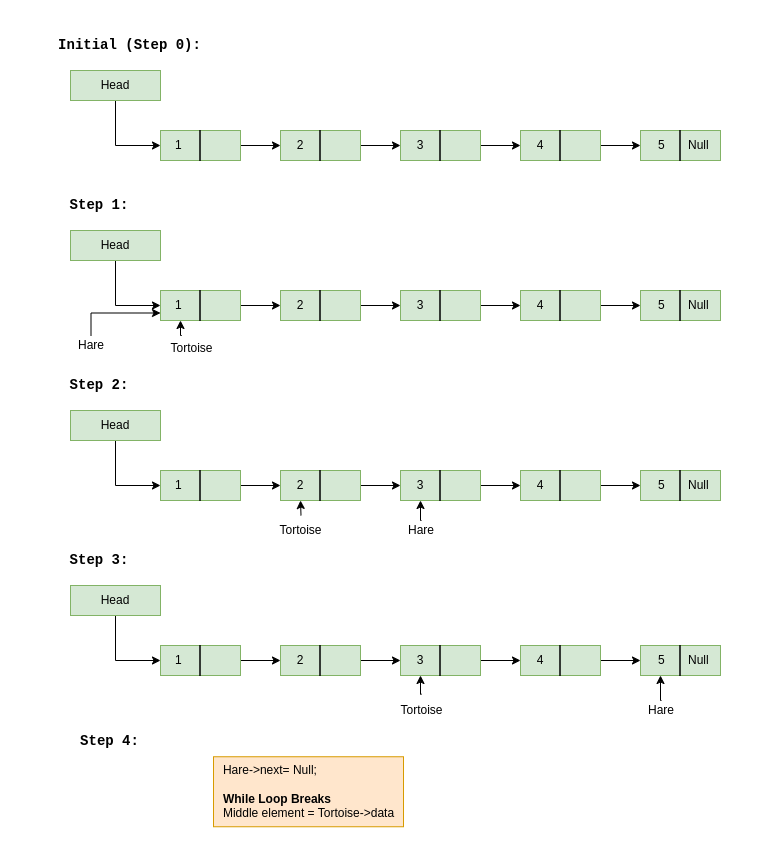
Let's trace this with the image below.
Let's see how this handles our two cases:
- Odd Length List (e.g., 5 nodes): The
fastpointer will land on the last node. It cannot move further becausefast.nextisnull. At this exact moment, theslowpointer will be at the middle node. - Even Length List (e.g., 6 nodes): The
fastpointer will completely traverse the list and becomenull. The loop terminates, and theslowpointer will be at the second of the two middle nodes, which is exactly what the problem requires.
This video provides a detailed walkthrough of this algorithm, showing how the pointers move for both odd and even length lists.
L13. Find the middle element of the LinkedList | Multiple Approaches
The 'take U forward' video now explains the optimal 'Tortoise and Hare' algorithm, providing a great visual and intuitive understanding of why it works.
Watch from 07:14 to 11:23. Pay close attention to where the fast pointer stops in both the odd and even length examples, and the corresponding position of the slow pointer.
4. Java Implementation
The implementation in Java is concise and directly follows the logic we've discussed. The most important part is the while loop's condition, which elegantly handles both odd and even length lists.
Find Middle of the Linked List
The article 'Find Middle of the Linked List' from enjoyalgorithms.com provides a clean implementation of this technique. It's a good reference to see the algorithm translated into code.
Read the sections 'Efficient solution using slow and fast pointers' and the corresponding 'Implementation code Java'. This will solidify your understanding of the code structure.
Here is the core Java code for the algorithm:
// Assuming a ListNode class is defined:
// class ListNode {
//     int val;
//     ListNode next;
//     ListNode(int x) { val = x; }
// }

public class Solution {
    public ListNode findMiddle(ListNode head) {
        // If list is empty or has only one node, head is the middle
        if (head == null || head.next == null) {
            return head;
        }

        ListNode slow = head;
        ListNode fast = head;

        // The loop condition is crucial
        // 1. fast != null: Handles even-length lists.
        // 2. fast.next != null: Handles odd-length lists.
        while (fast != null && fast.next != null) {
            slow = slow.next;
            fast = fast.next.next;
        }

        // When the loop ends, slow is at the middle
        return slow;
    }
}
Complexity Analysis
- Time Complexity:
O(N). Thefastpointer traverses the list once, so the loop runs for approximatelyN/2iterations. This gives us linear time complexity. Crucially, it's done in a single pass. - Space Complexity:
O(1). We only use two node pointers,slowandfast, providing a constant space solution.
Test your understanding!
The standard algorithm we discussed returns the second middle node for an even-length list (e.g., node 4 in 1->2->3->4->5->6).
How would you modify the algorithm to return the first middle node (e.g., node 3 in the same list)?
Show answer
There are a couple of ways, but one simple modification is to change the initial position of the fast pointer.
If you initialize fast = head.next.next instead of fast = head, the slow pointer will end up one position earlier in even-length lists.
Let's trace 1->2->3->4->5->6:
- Initial:
slowat1,fastat3. - Iteration 1:
slowmoves to2,fastmoves to5. - Iteration 2:
slowmoves to3,fastmoves tonull(5.next.next). - The loop
while (fast != null && fast.next != null)terminates. - The function returns
slow, which is pointing to node3.
This works for odd lists as well. This kind of modification is a great way to test your deep understanding of how the pointers' relative speeds and starting positions affect the outcome.
Conclusion
Great job! You've successfully adapted the slow and fast pointer technique to a new problem, reinforcing this powerful pattern. This approach is highly valued in interviews because it's efficient, elegant, and demonstrates a solid grasp of pointer manipulation.
Key Takeaways:
- Reusability: The slow/fast pointer technique is not just for cycle detection; it's a versatile pattern for linked list problems.
- The Core Logic: The fundamental idea is that the slow pointer covers half the distance of the fast pointer. By the time the fast pointer finishes its traversal, the slow pointer is naturally at the halfway point.
- Efficiency: This single-pass,
O(1)space algorithm is the optimal solution for finding the middle element.
Preview of the next lesson:
We will continue exploring clever pointer manipulations. In the next lesson, you will learn how to find the intersection point of two linked lists. This problem introduces another non-obvious but highly efficient pointer-based solution that will further expand your problem-solving toolkit.