Welcome to the final lesson of our "Math Foundations" module. In the last few lessons, we've built a powerful quaternion class, culminating in the ability to update an object's orientation based on its angular velocity. We now have a complete, self-contained mathematical toolkit for representing and manipulating 3D rotations.
Before we move on to building the physics simulation itself, it's crucial to solidify why we've invested so much effort in quaternions when more intuitive methods, like Euler angles, exist. This lesson directly addresses that question. We will dissect a critical flaw in Euler angles known as gimbal lock and demonstrate why quaternions are the professional standard for robust 3D applications, including the physics engine you're building.
By the end of this lesson, you will be able to explain the gimbal lock problem both intuitively and mathematically, and articulate the specific advantages that make quaternions the superior choice for representing orientation in your physics engine.
The "Intuitive" Choice and Its Pitfalls
On the surface, representing a 3D rotation with three angles seems straightforward. You rotate by a certain amount around the X-axis, then the Y-axis, then the Z-axis. This is the Euler angle representation, and it's popular in user interfaces because it's easy for humans to conceptualize. However, this apparent simplicity hides significant problems for computation.
The blog post "G-Engine #9: Quaternions" provides a good overview of different rotation representations and their trade-offs. Let's start by reading its assessment of Euler angles.
G-Engine #9: Quaternions - Clark Kromenaker
This article section summarizes the pros and cons of using Euler angles for rotation, introducing the concept of gimbal lock as a major drawback.
Please read the section titled Euler Angle Representation. Pay attention to the list of downsides it mentions; we will be exploring these in detail.
As the article notes, the most significant of these downsides is a phenomenon called gimbal lock.
What is Gimbal Lock?
The term "gimbal lock" comes from a physical analogy. A gimbal is a mechanical device with nested rings, designed to keep an object (like a compass or gyroscope) stable regardless of the motion of its support.

Imagine a system with three gimbals for rotation around the X, Y, and Z axes.
- The outer ring controls yaw (rotation around the Z-axis).
- The middle ring controls pitch (rotation around the Y-axis).
- The inner ring controls roll (rotation around the X-axis).
This system can orient an object in any direction. However, a problem arises when you pitch the middle ring by exactly 90 degrees. At this point, the axis of the inner ring (roll) aligns perfectly with the axis of the outer ring (yaw).
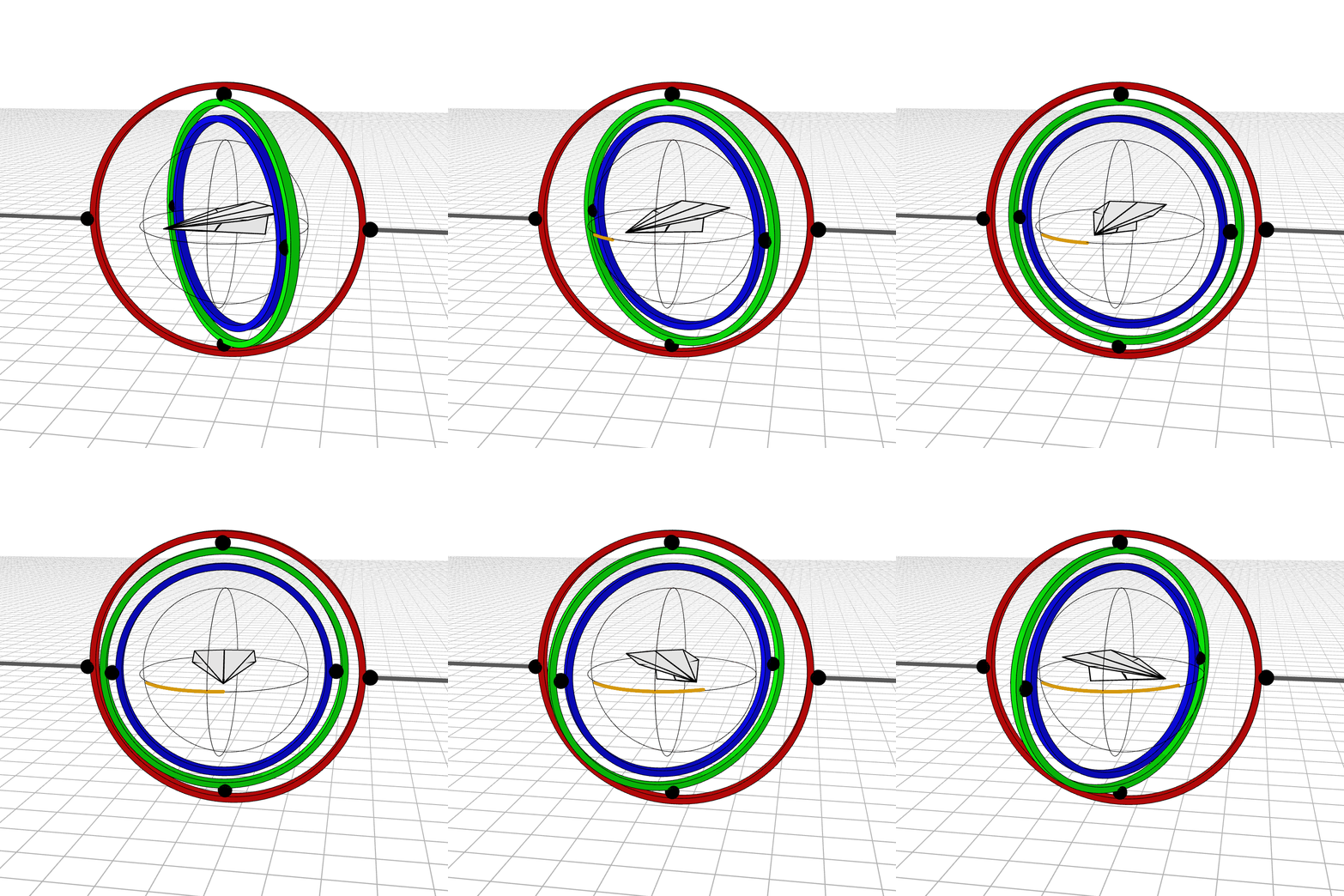
When this alignment occurs, you've effectively lost a degree of freedom. Trying to yaw the object is now the same as trying to roll it. You can no longer rotate the object around its local vertical axis independently. This loss of an independent axis of rotation is gimbal lock.
The following video provides a clear, narrated visualization of this process.
Euler vs Quaternion - What's the difference?
This video provides an excellent visual explanation of the gimbal mechanism and how the alignment of axes leads to gimbal lock.
Watch the segment from where it introduces the gimbal structure and explains the phenomenon. The key takeaway is that gimbal lock is a mathematical artifact of the Euler angle representation, not a limitation of real-world physics.
The Mathematical Inevitability of Gimbal Lock
Gimbal lock is not just a quirk of a mechanical device; it is a fundamental mathematical singularity inherent in using three parameters to describe 3D rotations (the rotation group SO(3)). An excellent article from CompuTools blog provides a deep, yet accessible, dive into the mathematics.
This article gives a fantastic explanation of gimbal lock, from physical intuition to the underlying mathematical reasons involving topology and Jacobian matrices.
First, read the introduction and the section What Is Gimbal Lock to solidify the physical analogy. Next, read Why Euler Angles Have Singularities. This section introduces the topological reason for the problem, which is that you cannot map the surface of a sphere to a flat plane without singularities (like the poles on a map). The same principle applies to mapping the 3D rotation space SO(3) onto three numbers. Finally, read the core mathematical explanation in Mathematical Cause. You don't need to re-derive the Jacobian matrix yourself, but understand its role: it relates changes in Euler angles to angular velocities. The crucial insight is that its determinant becomes zero at the gimbal lock configuration (pitch = ±90°). A singular matrix is not invertible, which mathematically signifies the loss of a degree of freedom.
As the article explains, when the Jacobian determinant is zero, a change in yaw and a change in roll produce the same change in orientation. The system becomes degenerate. This is not a bug you can fix; it's a mathematical fact about Euler angles. Any animation or physics simulation relying on them is vulnerable to sudden, unpredictable spinning when it approaches these configurations.
Quaternions: The Singularity-Free Solution
This is where quaternions prove their worth. They provide a representation of 3D rotation that is free from gimbal lock.
Let's explore the specific reasons why quaternions are the preferred choice for your physics engine.
1. No Gimbal Lock
Quaternions represent rotations in a 4-dimensional space. Specifically, a unit quaternion corresponds to a point on the surface of a 4D hypersphere (S³). This space is smooth and continuous everywhere, with no singularities. Mathematically, it forms a "double cover" of the rotation group SO(3), meaning every rotation is represented by two quaternions ( and ), but this redundancy is harmless and allows the representation to be globally well-behaved.
This section of the CompuTools article explains why quaternions are immune to gimbal lock.
Please read the section Switching to Quaternions. The key concept is that quaternions are defined on a space (SU(2)) that is a smooth manifold with no singularities.
2. Smooth and Unambiguous Interpolation
A major application of rotations is smoothly interpolating an object's orientation between a starting and ending pose. For quaternions, this is done using Spherical Linear Interpolation (SLERP), which you've already encountered. SLERP always finds the shortest, most direct rotational path on the 4D hypersphere, resulting in a smooth and natural-looking animation.
Euler angles, on the other hand, interpolate each of the three angles independently. This can lead to bizarre, non-intuitive paths and is highly susceptible to gimbal lock, where the object might suddenly spin wildly to get from one orientation to another. The video from Class Outside that we watched earlier has an excellent demonstration of this.
Euler vs Quaternion - What's the difference?
This segment visually contrasts the interpolation behavior of Euler angles and quaternions.
Watch the section on interpolation, from the start of the animation comparison. Notice how the quaternion interpolation is smooth and direct, while the Euler interpolation produces a strange, looping path for the same rotation.
3. Computational Efficiency and Numerical Stability
As we've seen in previous lessons, composing rotations with quaternions is a single multiplication. Rotating a vector is a simple "sandwich" product. These operations are efficient.
Rotation matrices also avoid gimbal lock, but they have their own issues. A 3x3 matrix requires 9 floats, compared to a quaternion's 4 floats. More importantly, due to floating-point inaccuracies, a series of matrix multiplications can cause the matrix to "drift" and no longer be purely orthogonal. This introduces scaling and shearing artifacts. Correcting this drift requires a computationally expensive process like Gram-Schmidt orthonormalization.
In contrast, correcting drift in a quaternion is as simple as re-normalizing it to unit length, which is a fast operation we've already implemented. This makes quaternions far more robust and stable for a long-running physics simulation.
This final reading compares the practical trade-offs between quaternions and rotation matrices.
Read the section Hybrid Use with Rotation Matrices. This reinforces the point about the ease and efficiency of normalizing a quaternion versus a matrix.
Conclusion
You have now seen a definitive answer to why we use quaternions. While Euler angles are an intuitive way for humans to specify an orientation, they are a computational minefield due to the mathematical certainty of gimbal lock. They are ill-suited for the core of a physics or graphics engine.
Key Takeaways:
- Gimbal Lock is a singularity in the Euler angle representation where a degree of rotational freedom is lost. It occurs when two of the three rotation axes align.
- This problem is not an implementation bug but a fundamental mathematical limitation of trying to describe 3D rotations with only three numbers.
- Quaternions solve this problem by representing rotations in a higher-dimensional, singularity-free space.
- Beyond avoiding gimbal lock, quaternions are preferred in physics engines for their compactness (4 floats), computational efficiency, numerical stability (easy to normalize), and ability to produce smooth, unambiguous interpolation (SLERP).
You have now completed the mathematical foundations of our physics engine. Every piece is in place: a simulation loop, a way to visualize data, and a robust system for representing and manipulating 3D orientation.
In the next module, we will finally begin simulating physics. We will take the quaternion integration formula from our last lesson and apply it, first to simple particles, and then to full rigid bodies. Our first topic will be implementing the workhorse of simple physics simulation: Semi-implicit Euler integration.